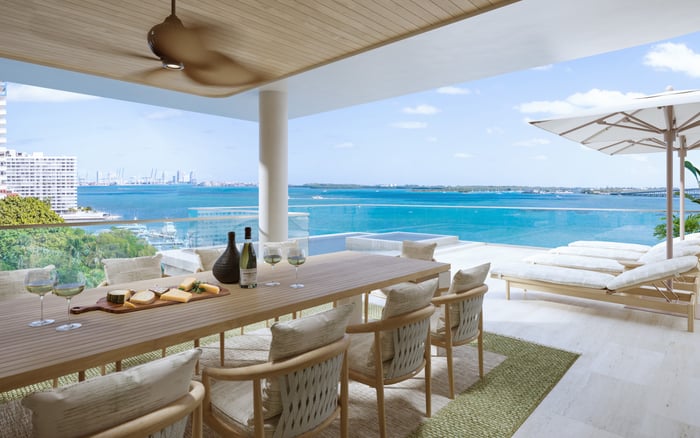
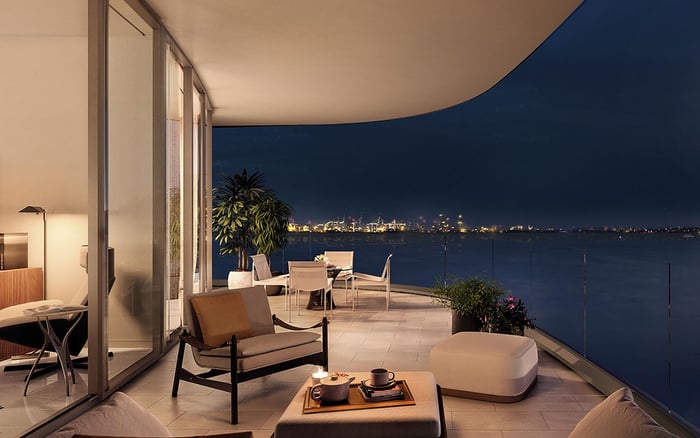
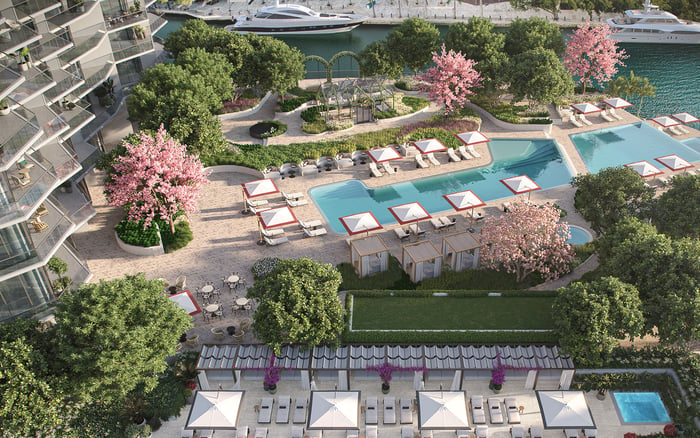
A buyer-oriented comparison of St. Regis® Residences Brickell and Continuum on South Beach, focused on club access, private amenities, and the lived rhythm of Brickell versus South Beach.
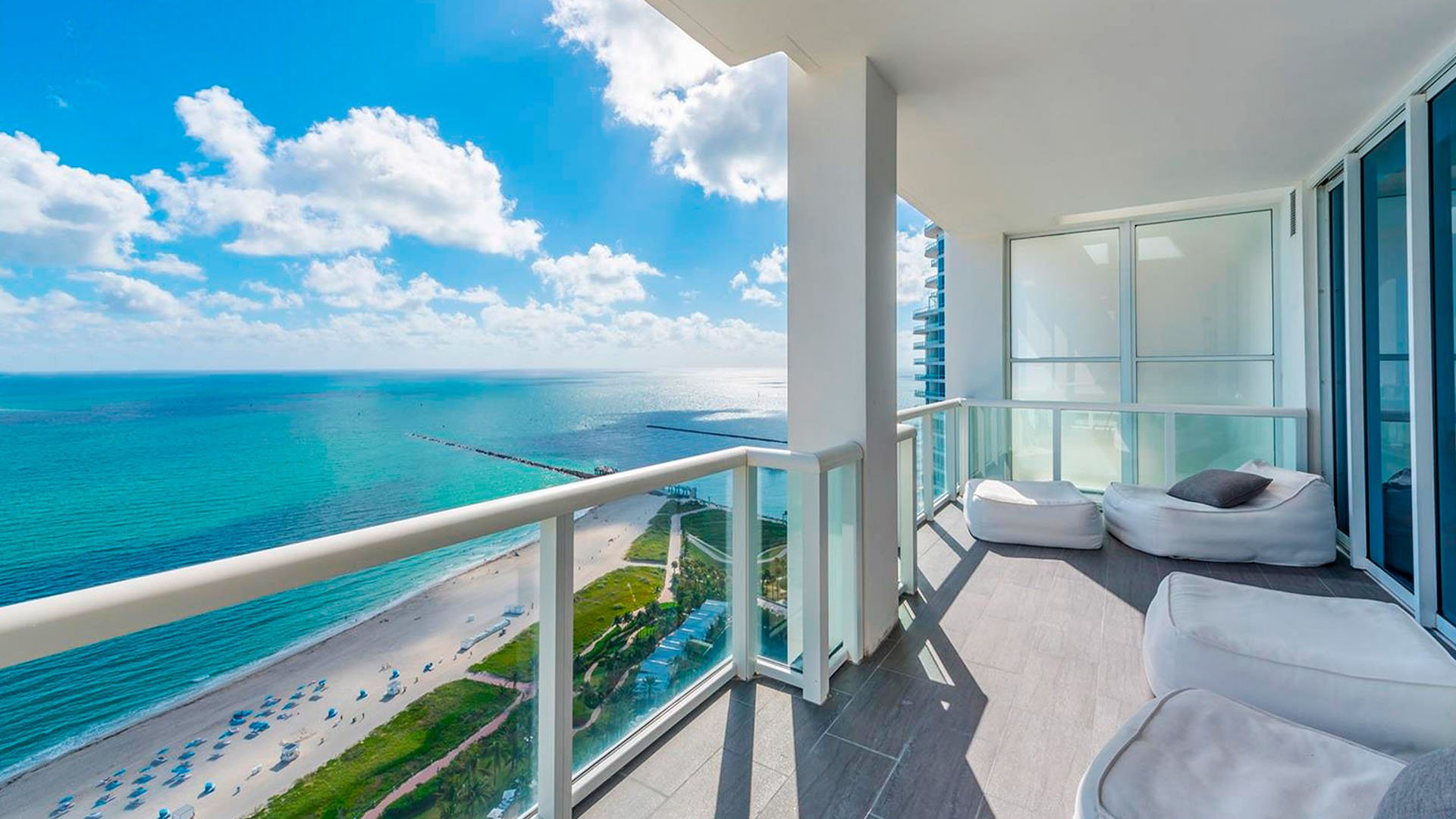
St. Regis® Residences Brickell and Continuum on South Beach belong in the same conversation because both speak to buyers who expect privacy, service, design discipline, and a polished residential experience. Yet the stronger comparison is not a contest of name recognition. It is a study in how two luxury addresses can feel entirely different from Monday morning through Sunday evening.
For a South Florida buyer, the distinction begins with rhythm. Brickell is vertical, connected, and mainland-oriented. It suits owners who want proximity to dining, offices, cultural venues, waterfront promenades, and the practical energy of Miami’s business core. South Beach is more resort-like in tempo, with daily life shaped by sand, water, walking routes, restaurants, and a sense of arrival that feels separate from the mainland. Continuum on South Beach belongs to that coastal vocabulary, while St. Regis® Residences Brickell is naturally understood through the lens of an urban waterfront lifestyle.
Both can be prestigious. They simply answer different questions.
Club access is one of the most important phrases in branded and high-service condominium shopping, but it is also one of the easiest to misunderstand. The word “club” may refer to private resident spaces, optional memberships, hospitality privileges, food and beverage environments, wellness programming, guest policies, or some combination of those experiences. Buyers should not assume that prestige alone creates identical access rights.
The right question is not, “Does it have a club?” The sharper question is, “What exactly is included for this residence, who controls it, how can guests use it, and can the rules change?” That distinction is especially relevant when comparing a new branded residential environment with an established coastal address. One may emphasize curated private resident amenities. The other may lean into a long-standing South Beach lifestyle with its own social patterns and building culture.
Documents matter. So do house rules, membership language, owner privileges, rental restrictions, guest registration policies, and the way amenity spaces are actually used during peak periods. A buyer focused on effortless entertaining should study whether access feels generous or carefully controlled. A buyer focused on privacy may prefer the opposite.
Private amenities are often marketed as a collection of beautiful nouns: spa, gym, lounge, pool, dining room, screening room, wellness suite, arrival court. At the ultra-premium level, however, the checklist is less useful than the choreography. The question is how the building moves people from home to amenity to car to neighborhood without friction.
In Brickell, private amenities can serve as a counterweight to the city. They create calm above or beside an active district. For an owner who works, hosts, travels frequently, or wants an elegant base in Miami, the strongest amenity package is one that compresses the day. Fitness, meeting space, service, valet, package handling, and discreet social rooms can matter more than spectacle.
In South Beach, private amenities may be judged differently. The exterior environment already supplies a powerful leisure setting, so the building’s private spaces must either elevate that lifestyle or protect the owner from its busier edges. Beach access, if relevant to a buyer’s daily routine, should be evaluated not as a slogan but as a lived sequence: leaving the residence, moving through common areas, reaching the sand, returning with privacy, and hosting guests without turning the building into a public corridor.
Balcony orientation, service flow, elevator experience, pool culture, and the separation of residents from visitors can be more consequential than the number of amenity rooms.
Brickell appeals to buyers who want Miami without giving up momentum. It is a district where weekday life can feel efficient, social, and compact. Dining, professional meetings, workouts, errands, and waterfront walks can be arranged within a tight urban radius. For many owners, that is the luxury: less planning, less driving, and more useful time.
The Brickell buyer often values immediacy. A residence here can function as a primary home, a city pied-à-terre, or a base for international travel and business. The neighborhood’s verticality also shapes expectations. Views, arrival sequence, privacy from surrounding towers, elevator performance, valet rhythm, and acoustic comfort become central to the buying decision.
For St. Regis® Residences Brickell, the brand conversation adds another layer. Buyers will naturally examine how the service promise translates into daily condominium life. The most discerning will look past the name and into operating details: staffing, owner services, reservation systems, guest management, and the degree to which the experience feels residential rather than hotel-like.
South Beach is less about compression and more about atmosphere. The daily rhythm is shaped by light, water, walking, dining, and the emotional release of being near the ocean. Continuum on South Beach speaks to buyers who want their home environment to feel like a coastal compound rather than a city perch.
That does not make the lifestyle casual in the ordinary sense. At the highest end, South Beach luxury depends on control. Privacy, access, security, parking, guest movement, and amenity density all become critical because the surrounding neighborhood is desirable to residents and visitors alike. The best ownership experience lets the owner enjoy the energy without surrendering to it.
A South Beach buyer should spend time in the neighborhood at different hours. Morning walks, late dinners, weekend arrivals, holiday periods, and high-season traffic all reveal different truths. The right address can make the area feel graceful and effortless. The wrong fit can make even a beautiful residence feel too exposed.
The most useful comparison begins with a personal calendar. If most days begin with meetings, school routes, mainland appointments, and evening dining in the urban core, Brickell may support the rhythm more naturally. If the highest value is waking into a beach-oriented lifestyle with resort-like transitions, South Beach may feel more aligned.
Then evaluate amenity control. Are the spaces primarily for residents? Are certain privileges conditional? How are guests handled? What is the relationship between private amenities and any broader hospitality or club component? What happens in peak season? A prestigious building can still disappoint if the rules do not match how an owner actually lives.
Finally, consider resale psychology. Buyers tend to remember clarity. A residence that knows what it is, whether urban branded sanctuary or established coastal retreat, is easier to understand and easier to defend. The best acquisition is not simply the one with the most impressive brochure. It is the one whose private systems, neighborhood rhythm, and access model reinforce one another.
For ultra-premium buyers, St. Regis® Residences Brickell and Continuum on South Beach should not be reduced to a mainland-versus-beach cliché. They represent two valid interpretations of South Florida prestige. One leans toward the controlled pace of a sophisticated urban address. The other leans toward the sensory value of coastal living, with South Beach as the daily backdrop.
The decisive issue is fit. Club access should be read carefully. Private amenities should be tested against real routines. Neighborhood rhythm should be felt, not imagined. When those three elements align, the residence becomes more than a luxury purchase. It becomes a setting that supports the owner’s life with quiet precision.
Are St. Regis® Residences Brickell and Continuum on South Beach direct substitutes? Not exactly. They may appeal to a similar prestige buyer, but their neighborhood rhythm and daily use case are meaningfully different.
Which is better for an urban lifestyle? Brickell is generally the more natural fit for buyers who want a mainland, city-centered routine with dining, business, and mobility close by.
Which is better for a coastal lifestyle? South Beach is generally better suited to buyers who prioritize a beach-oriented setting and a more resort-like daily cadence.
Why is club access so important in this comparison? Club access can shape privacy, guest use, social life, and owner privileges, so the exact rules should be reviewed before purchase.
Should buyers rely on brand prestige alone? No. Brand prestige matters, but operating rules, service execution, and amenity access determine the lived experience.
What private amenity details deserve the most attention? Buyers should study resident-only access, guest policies, service flow, pool use, wellness spaces, parking, and elevator experience.
Is Brickell better for frequent travelers? It can be, especially for owners who want an efficient urban base, but the best choice depends on the buyer’s actual travel and daily patterns.
Is South Beach too active for a privacy-focused buyer? Not necessarily. The key is whether the building’s access, security, and resident circulation create enough separation from neighborhood energy.
How should a buyer compare neighborhood rhythm? Visit at different times, including mornings, evenings, weekends, and high-season periods, then judge how the area feels in real use.
What is the simplest way to decide between the two? Choose the address whose access rules, amenity culture, and daily surroundings best match the life you intend to live.
For a discreet conversation and a curated building-by-building shortlist, connect with MILLION.
If branded residences are on your mind — as a home or as an allocation — we would be glad to share what we are seeing, privately.
Begin a quiet conversation