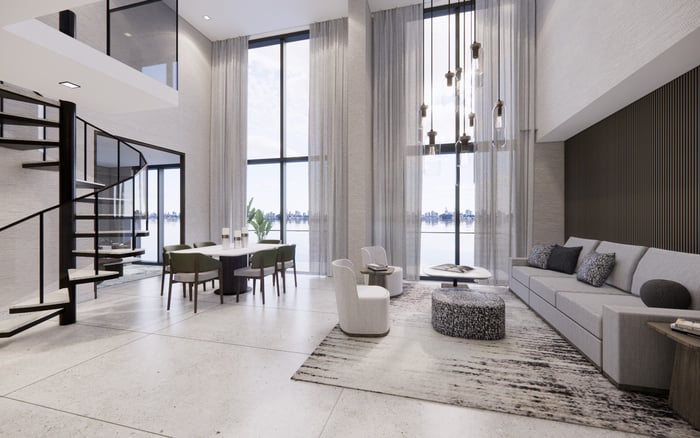
A buyer-focused look at how North Bay Village and Edgewater differ for flexible floor plans, secondary-bedroom strategy, and staff-room usefulness in Miami luxury residences.

In South Florida’s upper-tier condominium market, floor-plan flexibility has become a quiet marker of luxury. The question is no longer simply how many bedrooms a residence offers, but how well those rooms can evolve as family, guests, work, wellness, and household support needs change over time. For buyers comparing North Bay Village and Edgewater, the distinction is not merely geographic. It is a difference in residential tempo.
North Bay Village tends to appeal to buyers who want a softer waterfront setting, with a sense of separation from the urban core while remaining connected to Miami Beach and the mainland. Edgewater, by contrast, is more vertical, more urban, and more closely tied to the energy of central Miami. Both can serve sophisticated buyers, but the stronger choice depends on how a residence will live from Monday morning through a long holiday weekend.
In search shorthand, North Bay Village often signals a bay-centered residential mindset, while Edgewater suggests skyline proximity and a stronger daily connection to arts, dining, and downtown routines. The floor plan should be evaluated through that lens before finishes, views, or amenity decks dominate the conversation.
North Bay Village is especially compelling for buyers who want flexibility without the sensation of a dense urban corridor. Here, a secondary bedroom can become a guest room, office, nursery, study, or wellness room without feeling like a compromise. The most valuable layouts give each secondary room a clear purpose while preserving privacy for the primary suite.
For families, the appeal is practical. A child’s room should not depend on future reconfiguration to feel livable. A guest room should allow visitors to stay comfortably without interrupting the household’s main routine. A staff room, if present, should sit close enough to service areas to be useful, but not so centrally that it erodes the privacy of the home.
Names such as Continuum Club & Residences North Bay Village and Pagani North Bay Village have helped place the area in the conversation for buyers who want waterfront living with a more composed residential cadence. The important point is not the brand alone, but how a North Bay Village plan can support everyday ease: arrivals, storage, household help, children’s schedules, and guests who may stay longer than a weekend.
Waterview considerations are also more nuanced here than simple exposure. A beautiful view matters, but the room behind the view matters more. A secondary bedroom with good light, sensible proportions, and enough wall space for furniture will usually age better than a room that relies on scenery alone.
Edgewater attracts a different buyer psychology. It suits those who want the water, the skyline, and a closer relationship with Miami’s central neighborhoods. The setting can feel more immediate and connected, which raises the stakes for floor-plan efficiency. In a more urban residence, every room must justify its place.
This is where adaptable secondary bedrooms become especially important. A room may need to function as a guest suite in season, a private office during the week, and a media room in the evening. The best plans make those transitions feel intentional rather than improvised. Door placement, closet depth, acoustic separation, and access to a bath all shape whether a room feels genuinely flexible.
EDITION Edgewater belongs to the broader conversation about how the neighborhood is evolving for luxury buyers who value design, services, and centrality. Still, buyers should look beyond the headline and study whether the plan supports their personal household pattern. A striking living room is persuasive at first viewing; a well-placed secondary room is often what makes the residence endure.
Edgewater can be particularly attractive for buyers who entertain frequently or move between work, cultural events, and waterfront leisure. In that case, the staff-room question becomes more operational. Where do deliveries go? How does housekeeping move through the residence? Can overnight help stay without making the home feel crowded? These answers are embedded in the plan.
A secondary bedroom should be judged with the same seriousness as the primary suite, even if it will not be used every day. In luxury real estate, a poorly conceived secondary room can weaken a residence’s long-term appeal, especially for buyers who host family, maintain a hybrid work routine, or expect future resale to another sophisticated household.
Start with shape. A rectangular room with usable walls usually outperforms a more dramatic space that cannot hold a bed, desk, dresser, or seating without awkward compromises. Then study privacy. A bedroom opening directly into the main entertaining area may work as a den, but it may not serve relatives or long-stay guests well.
Natural light is another decisive factor. A flexible room that feels pleasant during the day is more likely to be used in multiple ways. A dark room may be labeled as a bedroom, but in practice it often becomes storage. Buyers should also consider bathroom access. A secondary bedroom with direct or semi-private bath access has a wider range of uses than one that depends on a powder room or a shared corridor.
For buyers comparing North Bay Village and Edgewater, the question becomes lifestyle-specific. North Bay Village may allow a more relaxed distribution of rooms, especially for those who prioritize quiet and household separation. Edgewater may reward a more efficient, convertible approach, where one room carries several roles across the week.
The staff room is one of the most misunderstood spaces in luxury condominiums. Some buyers see it as essential; others see it as square footage that could be better absorbed into storage, laundry, or a larger secondary suite. The right answer depends on how the residence will be serviced.
A useful staff room is not defined only by size. Its value comes from placement. It should relate logically to the kitchen, laundry, service entry, or back-of-house circulation if those elements exist in the plan. If it is isolated in an awkward corner, it may be less useful than a larger laundry room with excellent storage.
For households with regular help, overnight care, or visiting support during season, the staff room can be a meaningful advantage. For second-home buyers who arrive for shorter stays, usefulness may depend on whether the space can double as a flex room, small office, luggage room, or household command center. New-construction buyers should ask this question early, because a floor plan that seems generous on paper may not offer the circulation required for real support.
This is where discretion matters. The best layouts allow service functions to occur without making guests feel aware of them. They create a sense of order. In both neighborhoods, that sense of order is one of the strongest indicators of a well-planned luxury residence.
When comparing North Bay Village and Edgewater, resist the temptation to choose by view alone. Instead, walk through a normal day in the residence. Where does a guest wake up? Where does a child study? Where does luggage go after a long trip? Where can a private call happen while entertaining continues in the living room? Where does household help enter, work, and store supplies?
In North Bay Village, the winning plan may be the one that feels calm, separated, and residential. In Edgewater, the winning plan may be the one that compresses several uses into an elegant urban footprint. Neither is inherently superior. The better buy is the one whose secondary bedrooms and support spaces match the owner’s true rhythm.
For resale-minded buyers, flexibility is also defensive. A residence that can serve a couple, a family, a seasonal owner, or a work-from-home buyer has a broader future audience. That does not mean every room should be generic. It means the plan should offer optionality without sacrificing proportion, privacy, or grace.
Is North Bay Village better than Edgewater for flexible floor plans? It can be, particularly for buyers who value a calmer waterfront setting and more residential separation. The better choice still depends on the individual plan.
Is Edgewater better for buyers who want an urban lifestyle? Yes, Edgewater generally suits buyers who want closer access to central Miami routines, dining, culture, and skyline energy.
What makes a secondary bedroom truly useful? Good proportions, natural light, privacy, closet space, and convenient bath access are the key factors.
Should a staff room count as a full bedroom? Not always. Its value depends on size, placement, privacy, and whether it can serve multiple household functions.
Can a secondary bedroom work as an office? Yes, if it has light, acoustic separation, sensible outlets, and enough wall space for proper furniture.
What should second-home buyers prioritize? They should prioritize storage, guest comfort, lock-and-leave ease, and flexible rooms that can adapt during peak visits.
Does a view compensate for an awkward room? Rarely. A strong view is valuable, but poor proportions or weak privacy can limit daily usefulness.
Are staff rooms more important for larger residences? Usually, because larger homes often involve more frequent servicing, guests, and household management.
How should families compare these two neighborhoods? Families should focus on bedroom separation, study space, storage, and how daily routines move through the residence.
What is the safest long-term floor-plan strategy? Choose a plan with adaptable rooms, clear circulation, and support spaces that can serve more than one future buyer profile.
When you're ready to tour or underwrite the options, connect with MILLION.
If branded residences are on your mind — as a home or as an allocation — we would be glad to share what we are seeing, privately.
Begin a quiet conversation