A buyer-focused look at how families should evaluate Shore Club Private Collections Miami Beach for weekday school-morning departures, from internal circulation to causeway dependency.

For buyers considering Shore Club Private Collections Miami Beach, the conversation often begins with architecture, oceanfront presence, interiors, amenities, and the emotional pull of a legacy Miami Beach address. For families with school-age children, however, the more consequential question may be quieter and more practical: how does the building release vehicles into the street network on a weekday morning?
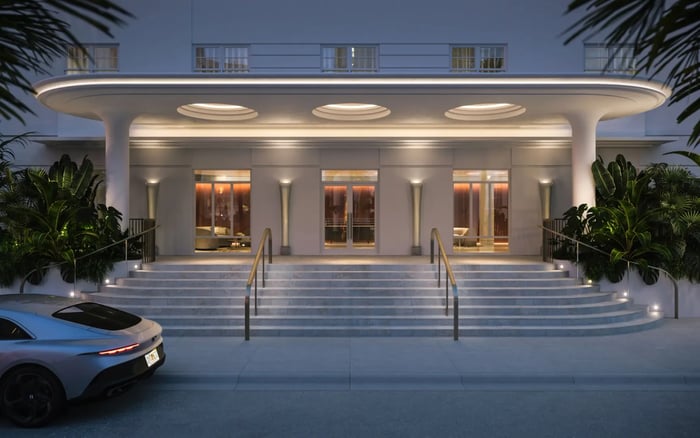
A rendering can communicate elegance at arrival. It cannot prove how a household will experience the 7:15 to 8:15 a.m. school window, when residents are leaving for classrooms, drivers are making first-turn decisions, and the Miami Beach grid is already absorbing local and cross-island demand. The question is not whether the project looks refined. The question is whether the departure sequence remains composed when time is not flexible.
In practical terms, the diligence is distinctly Miami Beach-specific: Oceanfront, beach-access, new-construction, private-school, and the operating realities of Shore Club Private Collections Miami Beach all meet at the curb. That is why a family buyer should evaluate the school-morning exit as a separate livability asset, not as a minor operational footnote.
The morning exit should be studied in four distinct layers. The first is internal circulation: the path from residence to vehicle, through valet or self-park systems where applicable, and toward the point of release. A beautiful porte cochère can still underperform if departing cars encounter a bottleneck at the final exit.
The second layer is the immediate Collins Avenue and cross-street interface. This is where the property’s private experience meets the public street grid. The relevant question is not simply whether the arrival court feels elegant, but how efficiently vehicles can enter traffic, make the necessary turn, and avoid being held by short queues or blocked movements.
The third layer is bridge and causeway dependency. A family attending a Miami Beach school is dealing primarily with local circulation. A family driving to a mainland school must add another layer of risk, because the commute depends not only on Collins Avenue and nearby cross streets, but also on the performance of the chosen bridge or causeway during the morning peak.
The fourth layer is the school itself. Location, drop-off pattern, and bell schedule can materially change the lived experience. The same residence may be highly convenient for one household and operationally demanding for another, depending on whether the destination is nearby on the beach or across the water.
Sales imagery is designed to communicate atmosphere. It can show proportion, materiality, landscaping, arrival choreography, and the aspirational rhythm of a completed address. It should not be treated as evidence that vehicles will move smoothly during the tightest school-morning window.
A family should ask what happens when multiple residents leave within the same 20 minutes. Will vehicles stack internally, at the exit, or on the street? Is the first required turn easy to complete in morning conditions? Does the driver need to cross active traffic quickly, or can the route begin with a lower-friction movement? These questions are operational, and operational questions should be tested in real time.
The most important distinction is between internal grace and external performance. A property can feel calm within its own boundary and still lose time at the public interface. Conversely, a simple exit can perform well if it releases vehicles cleanly in the direction families actually need to travel.
The proper test is not an off-peak tour or a late-morning drive. It is a school-day departure that mirrors the household’s real routine. A buyer should visit during the intended departure window, ideally more than once, and observe the sequence from vehicle readiness to the first meaningful movement onto the street grid.
The test should begin before the car reaches Collins Avenue. Time the elevator-to-vehicle experience if that will be part of the daily rhythm. Observe whether staff movements, resident departures, delivery activity, and guest vehicles share the same zones. Then focus on the release point. Count how many signal cycles, gaps, or turns are required before the vehicle is truly on its way.
Families should also map at least two route profiles. One should assume a beach-area school, where the emphasis is local north-south movement and cross-street access. The other should assume a mainland destination, where the commute must be evaluated through a bridge or causeway lens. Even if a household currently favors one school, future flexibility matters for resale and long-term family planning.
Collins Avenue matters because it is the transition between private luxury and the public reality of Miami Beach movement. For a school-morning buyer, the building’s interface with Collins and its nearby cross streets can be as important as finishes, views, or amenity programming.
The first turns after leaving the property set the tone for the trip. If the destination is north or south on the beach, the driver’s ability to merge and choose direction matters. If the destination is across the water, the route must position the vehicle toward the appropriate causeway without unnecessary loops or avoidable conflict points.
This is where a buyer should resist general commute estimates. A five-minute difference in release time can compound if it places the vehicle into a less favorable traffic wave. The relevant question is not the average drive in ideal conditions. It is whether the first mile behaves predictably when the household leaves at the same time every school day.
The same residence can carry different school-morning value for two families. A household using a Miami Beach school may prioritize clean local access, manageable turns, and proximity to the selected campus. A household crossing to the mainland must analyze local release plus bridge or causeway behavior, adding another variable to the routine.
This is not a reason to discount the address. It is a reason to price convenience intelligently. In the ultra-premium segment, buyers often evaluate view corridors, ceiling heights, privacy, and service ratios with precision. Family mobility deserves the same rigor.
The best question is simple: for our actual school, our actual bell time, and our actual departure habits, does this residence support the morning we want? If the answer is yes after repeated school-day testing, the property’s livability case becomes stronger. If the answer is uncertain, the buyer should keep investigating before allowing the rendering to carry more weight than the routine.
Before committing, a family should ask how vehicles are expected to circulate internally during peak morning periods, how resident departures are separated from service functions where relevant, and what happens when several households request vehicles or depart at similar times.
They should also ask their own representatives to model the route to each serious school option, not just the current favorite. A move into a luxury residence is often a multi-year decision. School choices can change with age, admissions, curriculum, or family preference. The residence should be evaluated for that possible range, not only for today’s plan.
Finally, buyers should rely on lived observation. Stand at the interface. Watch the traffic. Drive the route. Repeat it on school days. The morning exit is not a design promise. It is a performance condition.
Why is school-morning exit important at Shore Club Private Collections Miami Beach? For families, the weekday departure can define daily livability as much as amenities or views.
Is a rendering enough to judge vehicle flow? No. Renderings can show arrival design, but they do not prove queuing, turns, or street access during the school window.
What time period should buyers test? The key window to observe is roughly 7:15 to 8:15 a.m. on actual school days.
What is the first thing to evaluate inside the property? Study internal circulation, including how vehicles move from resident use areas toward the exit point.
Why does Collins Avenue matter so much? It is the immediate street interface that determines how quickly vehicles enter the Miami Beach grid.
Should mainland school commutes be judged differently? Yes. They depend on local traffic plus bridge or causeway performance, which adds another variable.
Can two families have different experiences in the same building? Yes. The selected school and bell schedule can materially change the morning commute.
Are off-peak drive estimates useful? They can provide context, but they should not replace a real school-day test.
What should buyers ask before contract? Ask how peak departures are managed, where queuing occurs, and how quickly cars can reach the street.
What is the core due-diligence takeaway? Test the exact routine before relying on sales-gallery descriptions or visual impressions.
For a tailored shortlist and next-step guidance, connect with MILLION.
If branded residences are on your mind — as a home or as an allocation — we would be glad to share what we are seeing, privately.
Begin a quiet conversation