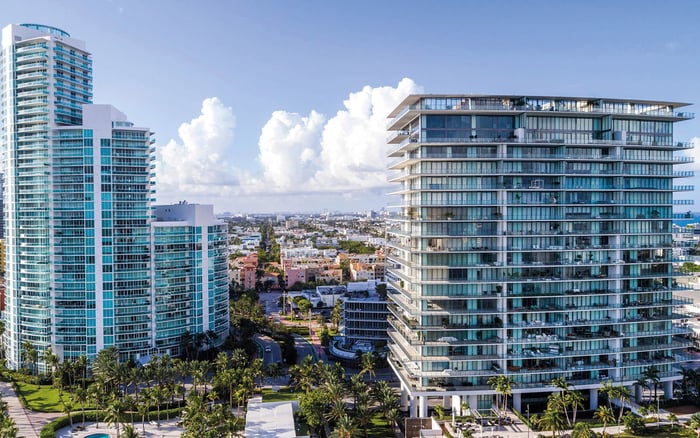
A buyer-focused guide to reading Continuum on South Beach service fees through the lens of daily value, resort-scale amenities, privacy, management, and long-term asset care.

At Continuum on South Beach, the monthly service-fee conversation should begin with a simple shift in perspective: what does the residence deliver every day? In a conventional condominium, a buyer may read the association charge as overhead. At this two-tower oceanfront condominium complex in Miami Beach’s South of Fifth area, the sharper question is how that monthly number supports a compound-like residential environment defined by privacy, access, maintenance, hospitality, and protection of the shared asset.
The distinction matters because Continuum on South Beach is not positioned as a simple vertical building with a lobby, elevator bank, and pool deck. It is a resort-scale residential setting at the southern tip of Miami Beach, where location, land, service, and managed amenities combine into the value proposition. Oceanfront living at this level is not only about the view from the apartment. It is also about the ease with which an owner moves from residence to beach, from pool to spa, and from landscaped grounds to the dining and marina energy of South of Fifth.
That is why buyers should resist comparing service fees solely by monthly total. A residence in a lean amenity building and a residence in a large oceanfront compound may both be condominiums, but they are not selling the same daily experience.
The cleanest exercise is to divide the monthly service fee by roughly 30 days, then ask what that daily figure buys in practical terms. The answer is not one amenity. It is the orchestration of many elements: staffing, insurance, maintenance, beach services, security, landscaping, pool operations, spa facilities, tennis courts, restaurant access, and ongoing attention to the shared residential infrastructure.
Exact service-fee amounts vary by residence size, tower, line, and ownership details, so a universal number is not useful without current unit-level documents. Still, the daily-value exercise is powerful. It reframes a monthly charge from a static bill into a recurring investment in convenience, responsiveness, privacy, and building quality.
For a primary resident, daily value may mean secure arrival, a maintained pool environment, and immediate access to the beach without arranging logistics. For a seasonal owner, it may mean returning to a professionally managed property where shared spaces have been maintained in their absence. For a long-term holder, investment discipline includes evaluating whether the service model supports the property’s competitive position over time.
A sophisticated buyer should read the service fee as a funding mechanism for the ecosystem. At Continuum, that ecosystem includes pools, gardens, beach services, tennis courts, spa facilities, and restaurant access, all within a highly coveted South of Fifth setting. Those features require personnel, maintenance, planning, insurance, and ongoing upgrades. The broader the amenity platform, the more important it becomes to judge cost against the depth of services being maintained.
Waterfront value in Miami Beach is often measured by scarcity, but lived value is measured by execution. A wide amenity program loses meaning if it is not consistently kept, staffed, and managed. Conversely, a higher monthly obligation can be rational when it supports a level of daily reliability that a luxury buyer might otherwise seek through private staff, a club membership, a hotel suite, or a yacht-marina service standard.
That is the context in which Continuum on South Beach should be understood. Its large land footprint and compound-like setting are differentiators, and those differentiators have operational implications.
South of Fifth is one of Miami Beach’s most closely watched luxury residential pockets because it combines oceanfront access, dining, marina proximity, and a concentration of high-end buildings. The neighborhood gives owners the feeling of being at the edge of the city while remaining close to the cultural and culinary rhythm that defines South Beach.
In that setting, service fees are tied to more than building operations. They are part of the total cost of owning within a rare residential geography. The southern tip of Miami Beach gives Continuum much of its status, while the monthly fee helps preserve the day-to-day experience that makes the address function as more than a pin on the map.
Buyers comparing the South Beach service model may also study Apogee South Beach or Setai Residences Miami Beach to understand how ultra-luxury expectations differ from building to building. The point is not that one fee is automatically better than another. The point is that the fee must be judged against the particular promise of the property.
A common mistake is to compare Continuum’s service structure with buildings that have fewer shared spaces and a narrower operating mandate. That can make one monthly figure look expensive without explaining what is being supported.
A more appropriate comparison set includes luxury hotels, branded residences, private clubs, and other ultra-premium waterfront properties. Buyers in this tier often expect a building to reduce friction. They want privacy without isolation, amenities without daily coordination, and beachfront access without sacrificing residential discretion.
That is why service-fee value should be translated into lived benefits. Does the building make daily life easier? Does it protect the owner’s time? Does it maintain shared spaces at a level that matches the residence price point? Does the property management model support confidence when the owner is away? These questions are more revealing than asking whether the fee is high in isolation.
For buyers who want a Miami Beach lens beyond South of Fifth, 57 Ocean Miami Beach and The Ritz-Carlton Residences® Miami Beach can provide useful context around how beachfront and service-oriented residential living is presented in different parts of the market.
Before treating any fee as acceptable, a buyer should review current unit-level details. Service fees can vary by tower, residence size, line, and other ownership considerations. The relevant number is the number attached to the specific residence under consideration, not a building-wide assumption.
The next step is to connect that number to the association’s operating responsibilities. Staffing, insurance, maintenance, reserves, capital planning, and shared-space upgrades all affect the ownership experience. A polished buyer does not merely ask, “What are the dues?” The better question is, “What daily residential standard do these dues help sustain?”
Lifestyle value is especially important for owners who split time among homes. If the residence is not occupied year-round, professional management, security, maintenance, and reliable amenity operations may carry even greater weight. The monthly fee becomes part of the cost of confidence.
Continuum on South Beach should be evaluated through the lens of use, not just cost. Its service fees support a resort-scale residential environment in one of Miami Beach’s defining luxury enclaves. The practical exercise is to translate the monthly fee into a daily figure, then test that number against what the owner receives: privacy, beach access, pools, gardens, wellness, tennis, hospitality-style convenience, management, and the preservation of a blue-chip address.
A lower monthly fee is not automatically a better value. A higher monthly fee is not automatically justified. The correct reading is more nuanced: does the fee structure sustain the daily standard that drew the buyer to Continuum in the first place?
Are service fees at Continuum on South Beach the same for every residence? No. Fees can vary by residence size, tower, line, and ownership details, so buyers should review current unit-specific information.
Why can fees be higher in a resort-scale condominium? A broader amenity and service platform requires staffing, maintenance, insurance, and ongoing attention to shared infrastructure.
What amenities help explain the service-fee structure? The amenity ecosystem includes pools, gardens, restaurant access, spa facilities, tennis courts, and beach services.
How should a buyer evaluate monthly fees? Divide the monthly amount into a daily figure, then connect that number to convenience, privacy, service, access, and upkeep.
Is Continuum on South Beach considered oceanfront? Yes. It is described as an oceanfront condominium complex in Miami Beach’s South of Fifth area.
Does the South of Fifth location affect value? Yes. South of Fifth’s dining, marina access, waterfront setting, and luxury concentration strengthen the lifestyle proposition.
Are service fees only an operating expense? Not necessarily. They can also be viewed as support for quality of life and asset protection.
Should buyers compare Continuum with simpler condominiums? Only with caution. A building with fewer amenities may not be a fair comparison for a resort-scale residential environment.
What should seasonal owners focus on? Seasonal owners should pay close attention to security, maintenance, professional management, and the condition of shared spaces.
What is the most important service-fee question? Ask whether the monthly cost supports the daily standard of living, privacy, and access that justify the purchase.
To compare the best-fit options with clarity, connect with MILLION.
If branded residences are on your mind — as a home or as an allocation — we would be glad to share what we are seeing, privately.
Begin a quiet conversation