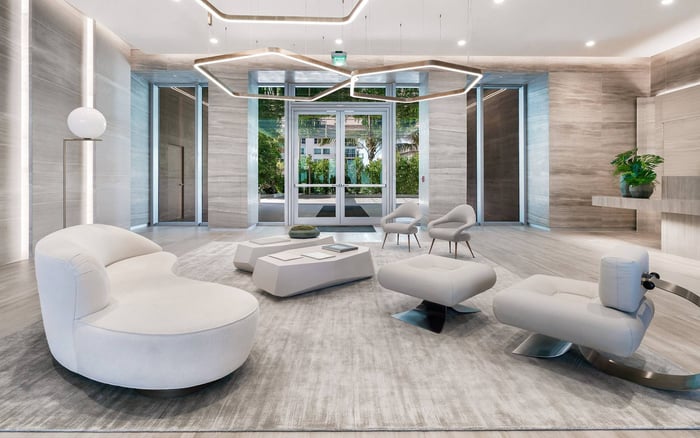
A buyer-focused comparison of Apogee South Beach and Faena House Miami Beach, distinguishing documented arrival and elevator features from guest-separation policies that require association confirmation.
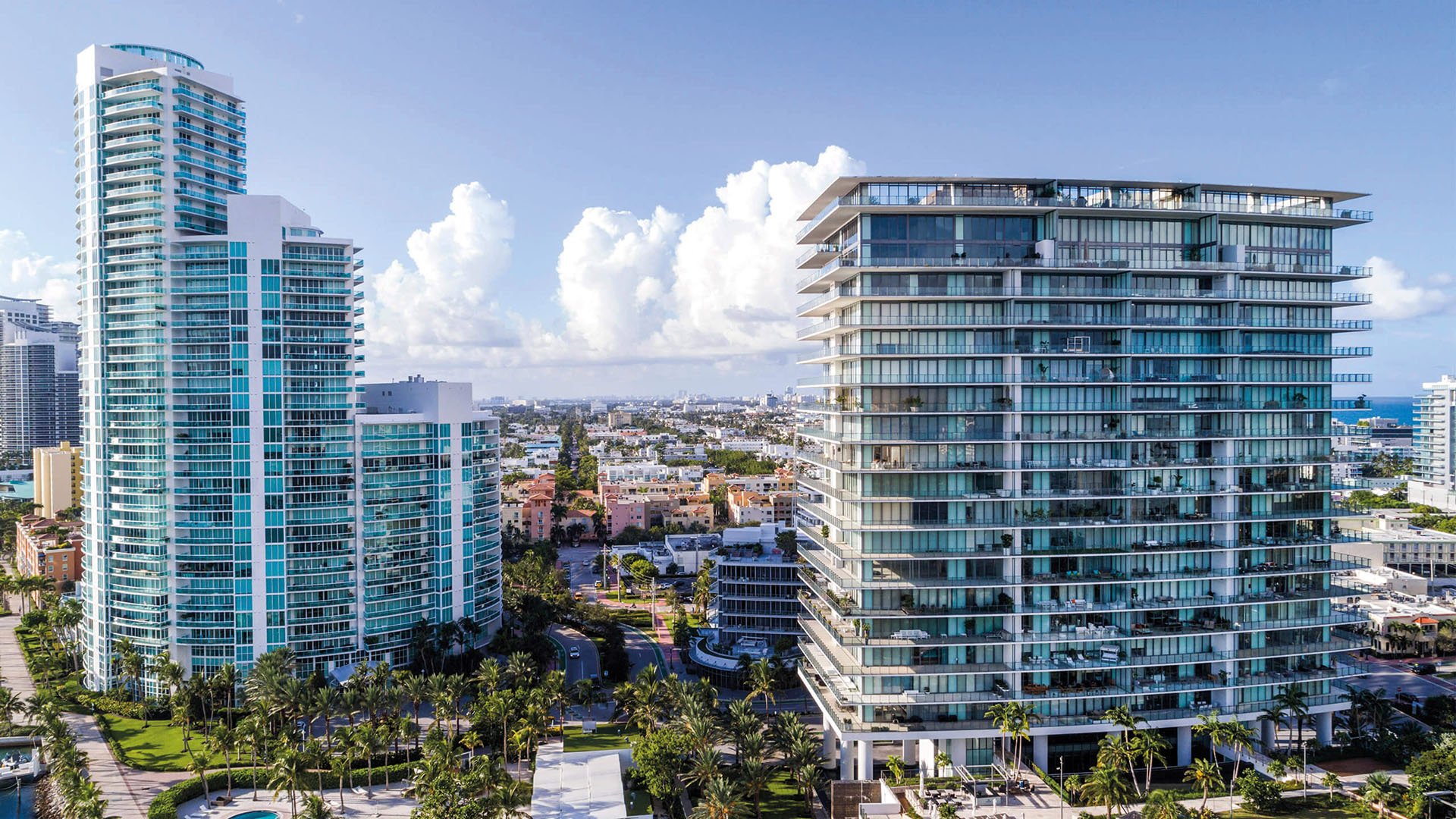
For a buyer who values discretion, the journey from car to residence deserves the same scrutiny as the floor plan. A covered arrival, an attentive doorman and a private elevator entrance each serve a different purpose. None, on its own, establishes that residents, visitors and service personnel remain separated throughout the building.
At Apogee South Beach and Faena House Miami Beach, the documented features allow a meaningful comparison of arrival architecture and access infrastructure-not a categorical privacy ranking. The distinction is between what each building physically provides and what its current operating rules permit.
Private entry is a feature; resident-only circulation is an operating condition. A buyer should establish both before deciding whether either property meets a household's privacy expectations.
At 800 South Pointe Drive in South of Fifth, Apogee South Beach contains 67 residences. Its advertised configuration is approximately four residences per floor, not one household per floor. Private elevator access should therefore not be read as exclusive occupation of an entire level.
The arrival features include a secured entrance, 24-hour security, concierge service and 24-hour valet parking. Together, they establish a staffed, managed arrival process. They do not establish the precise authorization sequence for a visitor entering the building or reaching a residence.
Within the home, advertised technology includes keyless fingerprint door entry and an AMX interactive smart panel connecting residents with security, valet, spa and other building services. Fingerprint door entry controls access to the residence; it is not evidence of biometric elevator authorization. Nor does the service panel establish how guest access is approved.
The advertised features for individual residences add detail, but have limits. For Unit 903, they include a secured lobby, secured elevators, a doorman, an on-site guard and secured garage or parking. For Unit 1501, they include a doorman, secured garage or parking and an on-site guard. These details reinforce the security picture without establishing building-wide elevator permissions or visitor restrictions.
For a prospective owner, the next step is to confirm how these features operate for the residence under consideration. The advertised terminology is useful; the association's current rules determine what it means in practice.
At 3315 Collins Avenue in Miami Beach's Mid-Beach/Millionaire's Row area, Faena House Miami Beach comprises 47 oceanfront condominium residences. It is not an 18-residence building, nor does it universally offer one residence per floor. Private elevator entry is advertised, but does not establish full-floor occupancy.
The vehicle arrival has a distinct architectural setting: a porte-cochère with a travertine-paved drive. Advertised amenities include a 24-hour doorman, valet service and five-star concierge service, along with secure private underground parking. These elements describe the arrival setting and vehicle handling, not the full access-control process.
The documented elevator configuration includes three passenger elevators and a dedicated service elevator. This establishes separate service infrastructure. Without current operating rules, however, it does not establish that the service elevator is staff-only or that guests are excluded from particular routes.
Likewise, advertised 24-hour security surveillance is distinct from visitor screening. Surveillance does not explain whether a guest needs advance authorization, where approval occurs or which elevator destinations become available afterward. Those questions require management confirmation, not architectural inference.
A disciplined comparison separates three layers. The first is the residence threshold: how an owner reaches and enters the home. Both properties advertise private elevator access or entry. Apogee also advertises fingerprint door entry, which warrants a separate line item in the buyer's assessment.
The second layer is shared circulation: passenger elevators, service elevators, lobbies and parking connections. Faena House's dedicated service elevator establishes an additional route for service circulation. Apogee's advertised unit-level features include secured elevators. Neither establishes the full permissions governing those systems.
The third layer is operational separation: who may use each route, under whose authorization and at what times. The documented details stop short of proving comprehensive resident-only circulation. A private landing, a secured elevator and a dedicated service elevator answer different questions. Treating them as interchangeable risks assuming protections that have not been established.
The available details do not establish visitor preregistration, guest-only routes, visitor badges, escorted access or precise elevator credentialing rules at either property. That does not mean these practices are absent. It means they should not be treated as confirmed features of the purchase.
Buyers should request current association rules and ask management to explain a typical guest arrival from curb to residence. The explanation should identify who authorizes access, whether authorization is destination-specific and how it expires. Ask separately about deliveries, household employees, contractors and overnight visitors; do not assume one procedure covers every category.
The same discipline applies when expanding a Miami Beach search to The Perigon Miami Beach. Evaluate its current arrangements independently. Familiar amenity language is no substitute for property-specific confirmation.
Base the access review on current written permissions, supported by a management-led walkthrough where available. For Apogee, distinguish the residence door's fingerprint function from the elevator's authorization system. For Faena House, establish how passenger and service elevators are allocated in practice.
Request guest and delivery procedures, service-elevator restrictions, valet protocols and security staffing details. Ask how a vehicle handoff connects with pedestrian entry, and whether parking access and residence access require separate permissions. These are diligence questions, not assumptions about either building.
Finally, compare the written answers with the route to the actual residence. The decision should turn on the household's requirements and the building's confirmed practices, not a broader promise of privacy. Apogee and Faena House each offer documented elements of a discreet arrival; the strongest buyer file connects those elements to current, clearly understood rules.
For a tailored Miami Beach residence search grounded in your arrival and privacy priorities, connect with MILLION.
If branded residences are on your mind — as a home or as an allocation — we would be glad to share what we are seeing, privately.
Begin a quiet conversationNo. Private elevator entry describes access to the home, while resident-only circulation depends on elevator permissions and current building operating rules.
Apogee contains 67 residences at 800 South Pointe Drive in Miami Beach's South of Fifth neighborhood.
Its advertised configuration is approximately four residences per floor. Private elevator access should not be interpreted as full-floor occupancy.
Advertised features include a secured entrance, 24-hour security, concierge service and 24-hour valet parking.
The advertised fingerprint technology concerns door entry. It does not establish biometric elevator credentialing.
Faena House comprises 47 oceanfront condominium residences. Private elevator entry does not establish that every residence occupies an entire floor.
Faena House has a porte-cochère with a travertine-paved drive and secure private underground parking with valet service.
Its specifications identify three passenger elevators and a dedicated service elevator. The service elevator does not by itself prove an enforced staff-only or guest-exclusion policy.
The available details do not establish guest-only routes, visitor preregistration, badges or escorted-access requirements. Buyers should obtain current procedures from management.
Request current association rules, elevator-access permissions, guest and delivery procedures, service-elevator restrictions, valet protocols and security staffing details.