For many private families, a Florida move does not begin with office leases or corporate filings. It begins with a home. In South Florida, the residence often becomes the anchor for domicile, staffing, school selection, advisor relationships, and eventually a formal family office footprint.

For a family office considering Florida, the most visible decision is rarely the first office lease. It is often the residential acquisition that sets the move in motion. Once a principal purchases or leases a primary home, the logic of domicile sharpens, staffing needs become more immediate, and the surrounding support structure begins to take shape.
That pattern is especially pronounced in South Florida, where tax posture, lifestyle quality, global connectivity, and deep luxury inventory converge in a single market. The Florida Constitution limits state taxation of the income of natural persons, and the Florida Department of Revenue confirms that Florida’s estate tax was eliminated for decedents dying after December 31, 2004. Those features can be significant, but they do not replace careful domicile planning.
Tax efficiency alone does not explain why real estate leads the move. A family office is not simply relocating balance sheets. It is relocating decision-making, family routines, security protocols, philanthropic activity, staffing, and often school selection. The residence becomes the place where those priorities converge.
A principal can evaluate advisors remotely, visit offices periodically, and test a market for months. Buying a home is different. It is a durable commitment, and that is precisely why it so often precedes the broader office architecture.
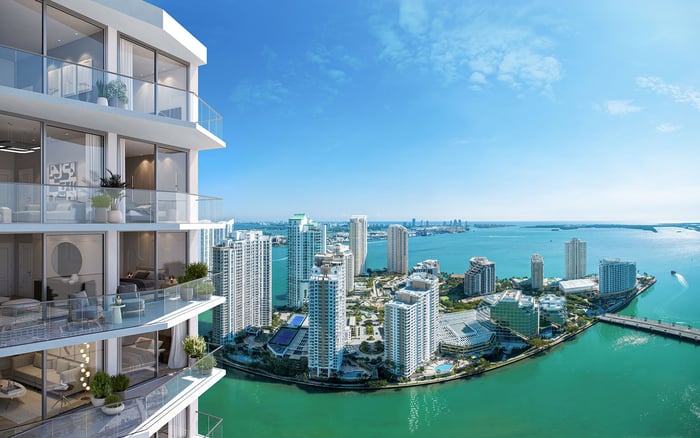
In South Florida, that sequence is intuitive. The region offers immediate access to premier housing, from waterfront towers and serviced residences to estate-style neighborhoods with privacy and proximity to professional services. In Brickell and downtown Miami, buyers seeking a home near a growing business core may gravitate toward projects such as The Residences at 1428 Brickell or St. Regis® Residences Brickell, where the residential decision can align with a more formal regional presence.
That is the practical appeal of a Florida move. The house or condominium is not separate from the office strategy. It often defines it.
South Florida offers more than a simple low-tax narrative. It provides a mature ecosystem that can absorb complex family needs quickly. Attorneys, accountants, trustees, wealth planners, security consultants, aviation resources, household staffing networks, and other specialists are sufficiently concentrated to help operationalize a move once a residence is secured. For a family office, that density matters.
Geography matters just as much. Miami International Airport reported 55.3 million passengers in 2025, including 24.8 million international passengers, and lists nonstop service to 190 destinations through 57 passenger carriers. That scale makes Miami a practical base for families with business, philanthropic, or personal commitments across multiple countries.
The local property market is another differentiator. Families can source a primary residence, a seasonal foothold, office space, and even income-producing assets within the same metropolitan ecosystem. According to MIAMI Realtors, foreign buyers purchased $4.4 billion of South Florida residential property in 2025, and global buyers accounted for 52% of new South Florida construction, pre-construction, and condo-conversion sales over a recent 22-month period. That depth supports liquidity and product variety, although each acquisition still needs property-level underwriting.
Palm Beach remains one of the state’s most established enclaves for private households seeking discretion, clubs, philanthropy, and social continuity. West Palm Beach, meanwhile, continues to broaden the choice set for buyers who want waterfront living with easier access to a growing business environment. In that context, Alba West Palm Beach fits naturally into the conversation around newer inventory in West Palm Beach.
Miami presents a different proposition. The city combines deep luxury supply with a maturing commercial core, making it attractive for families seeking a visible foothold and a functional headquarters market in one place. Downtown, Brickell, and Edgewater appeal to buyers who prioritize immediacy, service, and connectivity. For those drawn to the urban waterfront, Aston Martin Residences Downtown Miami exemplifies the type of high-design inventory that can anchor a Downtown move.
Miami Beach remains the symbolic choice for buyers seeking a trophy address. Submarkets such as Fisher Island and South of Fifth continue to carry signaling power, not only because of scarcity but because a residential acquisition there often signals a serious Florida commitment. Buyers exploring that side of the market may also look at The Perigon Miami Beach for newer oceanfront positioning.
Coral Gables appeals to a different profile. It suits families seeking estate-style living, a polished civic environment, and proximity to offices and advisors without the velocity of the beachfront market. For that buyer, Ponce Park Coral Gables reflects the neighborhood’s blend of walkability, refinement, and institutional access. Key Biscayne also deserves attention for families prioritizing privacy, school access, and a more contained residential setting near the urban core.
When a Florida move begins with real estate, the search needs to be both strategic and private. MILLION helps principals and advisors evaluate South Florida’s most limited trophy and luxury inventory through a tailored process that can include on-market residences, new-development allocations, and select off-market opportunities where available. The goal is to match the residence with how the household will actually live, staff, travel, entertain, and establish a durable Florida presence.
Sophisticated buyers do not choose a market on tax policy alone. They ask whether the place can support daily life at the level they require.
Private-school access is often one of the strongest neighborhood filters, especially for relocations involving children. That can narrow the search quickly toward established submarkets rather than purely tax-optimized addresses. Security, commute patterns, household staffing, proximity to marinas, private aviation routines, medical access, and club networks may all influence the final choice.
Physical asset quality has also moved higher in the screening process. Florida DBPR confirms milestone-inspection and structural-integrity reserve-study requirements for many condominium and cooperative buildings of three or more habitable stories. For family offices, construction quality, reserve funding, engineering documentation, and insurance coverage are not aesthetic preferences. They are risk-management inputs.
Coastal resilience belongs in the same diligence file. Miami-Dade County’s sea-level-rise materials rely on regional projections showing sea levels expected to be 10 to 17 inches higher by 2040 than 2000 levels. Elevation, flood exposure, storm hardening, and long-term insurability should be reviewed before the residence becomes the anchor of a larger move.
A Florida residence can support a domicile plan, but it does not complete one by itself. Advisors typically look for a coherent pattern: physical presence, Florida driver’s license, voter registration where applicable, primary mailing address, homestead filings if eligible, local doctors, clubs, advisors, bank relationships, vehicle registrations, and a documented reduction of ties to the prior jurisdiction.
This distinction is critical for families leaving states that scrutinize departures closely. A luxury purchase may help demonstrate intent, but the strongest domicile positions are built through actual use and consistent records. Renting first can be prudent for families still testing schools, neighborhoods, and travel patterns. Buying immediately can make sense when the family is ready for permanence and the residence supports daily life from the start.
Once the residence is in place, the rest of the move tends to accelerate. A family office may begin by shifting travel schedules and extending stays. Then it formalizes local advisory relationships, hires or transfers staff, evaluates commercial space, and develops a permanent operating structure.
Miami is particularly well suited to this sequence because its downtown core and adjacent districts now offer a deeper office environment than many legacy observers assume. Families can pair a high-end residence with a credible regional headquarters strategy, then broaden into investment activity ranging from direct real estate to local operating companies.
That layered approach is why the residential transaction matters so much. It is not merely a purchase. It is the cornerstone of domicile, governance, and long-term presence.
Florida continues to attract private capital seeking a market that can support both personal lifestyle and institutional ambition. At the same time, the migration narrative deserves precision. The U.S. Census Bureau reported in January 2026 that Florida’s net domestic migration slowed sharply in 2025 compared with 2022 and 2023. South Florida remains compelling, but the strongest relocation decisions should be based on family fit, infrastructure, advisor depth, and property-level fundamentals rather than broad migration momentum.
The most successful relocations tend to recognize that real estate is not the end of the process. It is the beginning. In South Florida, where housing, connectivity, advisory depth, and prestige intersect, the home often becomes the clearest signal that a family office move is already underway.
This article is general editorial information, not legal, tax, or residency advice. Any domicile or entity move should be coordinated with qualified advisors.
Why does real estate often lead a family office relocation to Florida? A residential purchase or long-term lease usually establishes where the principal will spend time, which then shapes staffing, schooling, advisory relationships, and office planning.
Is tax policy the only reason families move to Florida? No. Taxes matter, but so do connectivity, schools, advisory depth, housing quality, security, healthcare, and the ability to build a full operating presence.
Why is Palm Beach so relevant to family offices? Palm Beach offers an established private-client ecosystem, social continuity, and a proven residential environment for multigenerational households.
What makes Miami attractive for a family office move? Miami combines luxury housing, international access, a growing business core, and strategic relevance for families active across the Americas.
How important are private schools in these decisions? Very important. School access often narrows the neighborhood search and can outweigh purely financial considerations.
Does a family office need office space immediately after buying a home? Not always. Many families begin with the residence, then formalize office requirements after local routines and advisory relationships are established.
Why do newer projects appeal to relocating families? Newer buildings often align with resilience priorities, modern systems, security expectations, and lower-friction ownership.
Can a relocation also support an investment strategy? Yes. Many families use a Florida move to explore additional local real estate holdings alongside the primary residence.
Which South Florida areas are most often considered first? Palm Beach, Miami Beach, Coral Gables, Key Biscayne, Downtown Miami, and Brickell are frequent starting points because each serves a distinct lifestyle and operating profile.
What is the clearest sign a family office move is becoming permanent? The purchase of a primary residence is often a strong signal, but permanence is ultimately shown through consistent use, records, staffing, and advisory infrastructure.
For a discreet residential search that can anchor a Florida move with precision, connect with MILLION for tailored access to South Florida’s scarce trophy and luxury inventory, including select investments.
If branded residences are on your mind — as a home or as an allocation — we would be glad to share what we are seeing, privately.
Begin a quiet conversation