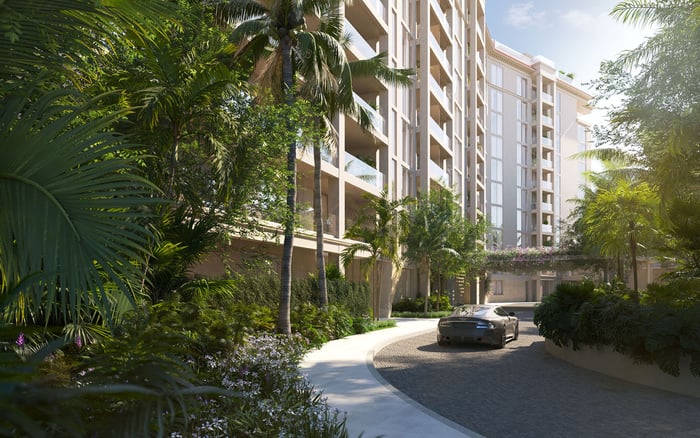
At The Links Estates, acquisition price per square foot captures scale and finish, but not the layered cost of island operations, private services, club access, insurance, or future capital obligations. A disciplined buyer should therefore compare both purchase basis and all-in annual ownership exposure.

At The Links Estates at Fisher Island, cost per square foot provides an immediate shorthand for a rare proposition: a planned enclave of 12 turnkey single-family residences on one of South Florida’s most private islands. Available estates average about 10,000 interior square feet, on lots ranging from roughly 13,000 to 21,000 square feet.
The pricing context is equally rarefied. Initial 2022 figures began around $3,300 per square foot, while starting prices of $36 million equated to an approximate basis of $3,600 per square foot. Individual offerings have since illustrated how widely the metric can move: one estate at 1006 Links Drive showed $3,929 per square foot, while another 10,200-square-foot residence was presented at $3,726 per square foot. Project pricing has ranged from approximately $30 million to $55 million.
Those figures are useful, but they are not interchangeable. Lot selection, specifications, finish packages and the definition of square footage can materially alter the result. Before making comparisons, buyers must confirm whether a quoted area refers to interior, total or gross space.
The decisive figure is not purchase PPSF alone, but the cost of sustaining the entire ownership experience.
These are fully built-out homes rather than unfinished structures. European-designed kitchens, integrated pools and extensive finish programs are integral to the proposition. Architecture is by Portuondo Perotti Architects, with interiors by Florence-based INDELUX. Amenities include rooftop terraces with gyms, spas, lounging areas and covered barbecue spaces, along with zero-edge heated pools.
Accordingly, acquisition PPSF reflects more than walls and land. It also encompasses a substantial degree of design, fit-out and private amenity infrastructure. That distinction matters when comparing The Links Estates at Fisher Island with condominium residences such as The Residences at Six Fisher Island, where shared-building services and common amenities may follow a different operating structure.
For the Estates & Single-Family category, the proper question is not simply whether one home costs more per interior foot than another. It is what has already been delivered within that basis, what remains the owner’s responsibility and which costs will recur after closing.
Fisher Island is a 216-acre private island accessible only by ferry or yacht. That exclusivity depends on transportation, roads, security and shared infrastructure. None of those recurring systems is captured by an estate’s acquisition PPSF.
A buyer should separate at least three potential layers. The first is the island-wide FICA obligation. The second is any estate-specific association charge tied to The Links Estates. The third is the Fisher Island Club relationship, including the initiation, dues, guest, minimum-spend or capital terms applicable to the transaction.
These obligations should not be treated as one bundled lifestyle fee. A complete club-pricing schedule is not publicly available, making current written terms essential. Buyers should also confirm whether membership is mandatory, optional or transferable for the estate under consideration.
The distinction is especially important when comparing the enclave with established Fisher Island choices such as Palazzo del Sol or Palazzo della Luna. The point is not that one structure is inherently preferable. Rather, service delivery, staffing and cost allocation can differ, rendering a simple PPSF comparison incomplete.
The island lifestyle includes beach, dining, wellness, spa and tennis offerings, all of which carry labor and operating costs beyond an estate’s purchase price. The private home adds another layer: landscaping, pool care, security interfaces, mechanical systems, rooftop spaces and routine property management.
A complete operating-cost schedule for The Links Estates is not available. Buyers should therefore request the estate association’s current or proposed budget and a precise description of covered services. The documents should clarify staffing levels, management responsibilities, landscaping standards, pool-maintenance duties and any services billed directly to individual owners.
This is where new-construction diligence becomes more consequential than a polished amenity description. If a service is described as available, the buyer should determine whether it is included, separately charged, usage-based or dependent on club membership. If staff will serve multiple estates, the allocation formula also warrants review.
Within Pricing & Trends analysis, two homes with similar acquisition PPSF can produce markedly different annual carrying profiles once association costs, club charges, insurance and owner-retained staff are considered. A realistic model should account for both predictable annual expenses and a contingency for variable service use.
FICA’s October 2022 reserve study contained an island-wide reserve requirement of approximately $37.4 million. The scale is notable because shared roads, ferry-related assets and other common components will eventually require repair or replacement.
That requirement does not, by itself, establish current reserve health. A reserve requirement, an annual contribution and cash already funded are distinct figures. Buyers should request the latest reserve study, current budget, reserve balances, contribution schedule, capital plan and special-assessment history. They should also examine how costs are allocated among owners and whether material projects have been deferred.
Reserve sufficiency matters because a shortfall can lead to higher regular assessments or special assessments. This exposure belongs in the acquisition analysis, even though it cannot be expressed neatly within today’s purchase PPSF. Legal and financial advisers can test the assumptions against the governing documents and the buyer’s anticipated holding period.
A practical underwriting sheet should place acquisition PPSF alongside annual FICA obligations, estate-level association charges, club costs, insurance, direct staffing and property-care expenses. It should also incorporate potential assessment exposure rather than assume reserves will eliminate future capital calls.
This Fisher Island case belongs naturally in sophisticated Buyer’s Guides because the most visible number is not necessarily the most useful for decision-making. Buyers should model a normal operating year, a higher-service year and a capital-event year. That approach reveals how much of the ownership experience is fixed, discretionary or exposed to community decisions.
Timing also belongs in the contract analysis. Completion dates range from 2025 to 2028, so broker summaries should not supersede the executed agreement. The contract’s construction schedule, extension rights, completion standard, deposit provisions and remedies should govern the buyer’s expectations.
The final comparison is therefore two-dimensional: the price paid for the finished private estate, and the annual plus long-term cost of maintaining access, service and infrastructure at the expected level. PPSF remains useful, but only after its measurement basis has been normalized and its omissions made visible.
For discreet guidance on Fisher Island ownership and South Florida’s ultra-premium market, connect with MILLION.
If branded residences are on your mind — as a home or as an allocation — we would be glad to share what we are seeing, privately.
Begin a quiet conversationThe enclave is planned to include 12 turnkey single-family residences on Fisher Island.
Available estates average about 10,000 interior square feet, with lots ranging from roughly 13,000 to 21,000 square feet.
Published project pricing has ranged from approximately $30 million to $55 million, although individual figures can vary by estate and timing.
Lot selection, specifications, finish packages and the square-footage measurement basis can all affect the calculation.
It does not capture recurring island operations, estate association expenses, club charges, insurance, direct staffing or future assessment exposure.
Buyers should distinguish island-wide FICA obligations, estate-specific association charges and Fisher Island Club costs.
A complete public schedule of initiation fees, dues, guest fees and related charges is not available, so transaction-specific written terms are essential.
They should verify dues, covered staffing, management, landscaping, pool maintenance and any services billed directly to the owner.
It illustrates the scale of island-wide long-term capital needs, but does not by itself establish current reserve sufficiency.
Because public completion references range from 2025 to 2028, buyers should rely on the executed contract’s schedule, rights and remedies.