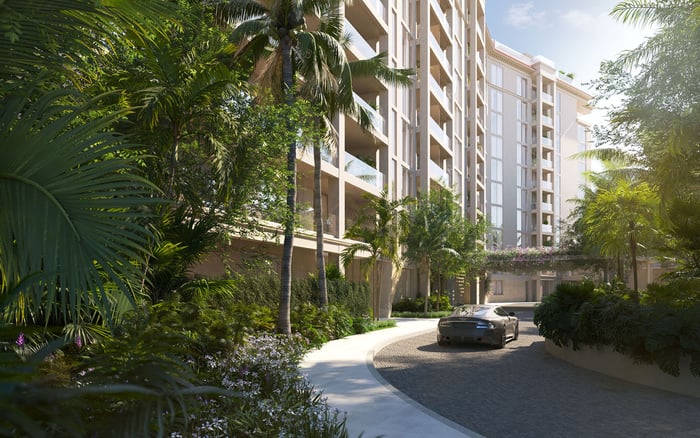
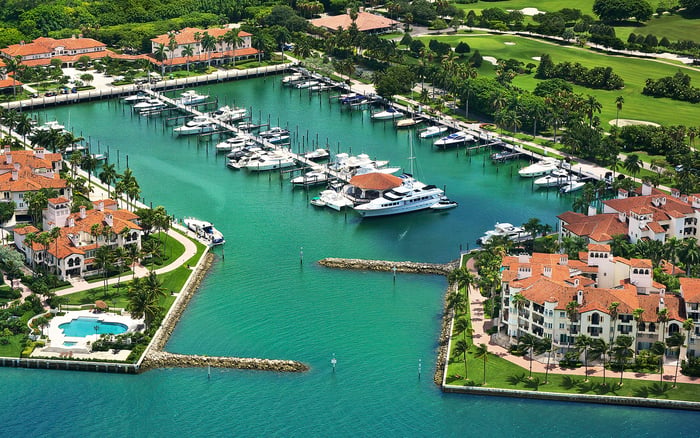
A buyer-focused look at why Palazzo del Sol’s waterfront appeal should be evaluated alongside maritime access, bridge clearance, and infrastructure control.

Palazzo del Sol is firmly established as a Fisher Island address for buyers who expect privacy, water, architecture, and a residential finish aligned with Miami’s most selective waterfront market. Yet the sharper ownership question is not only what sits inside the residence. It is what sits beyond the condominium association’s direct control.
For yacht-oriented owners, the practical value of a waterfront home is inseparable from dependable movement. A residence can offer views, privacy, and resort-style amenities, but large-vessel access depends on a wider system of bridges, channels, maritime routes, and public or quasi-public infrastructure. Those elements can shape the daily usability of an ownership position as meaningfully as a great-room plan or the quality of a terrace.
That distinction is especially important at Palazzo del Sol Fisher Island, where the lifestyle proposition is tied to high-mobility living. Fisher Island’s appeal is not simply residential seclusion. It is the ability to live privately while remaining connected to Miami Beach, the mainland, marinas, air travel, and the marine network that defines elite South Florida ownership.
Bridge clearance is not a decorative concern. It is a physical constraint. For owners whose lives involve larger yachts, tender movements, crew logistics, or frequent marine travel, the height, route, and reliability of access corridors can affect how a property functions over time.
This does not make Palazzo del Sol less luxurious. It makes the buying process more technical. The same buyer who studies elevator privacy, service access, exposure, terrace depth, and parking should also ask how maritime access is governed. Which routes serve the property? What physical limits apply? Who controls or influences those routes? What happens if infrastructure policy, maintenance, or regional planning changes?
The essential point is that condominium ownership and navigation control are separate concepts. Buying into a condominium association may provide rights within the building and its private property framework, but it does not automatically confer authority over bridges, channels, or surrounding maritime infrastructure. For a buyer with a large vessel, that difference can be material.
Fisher Island ownership has always carried an aura of separation. The island’s privacy is central to its appeal, and that privacy can make the experience feel self-contained. Yet waterfront living at this level is never entirely self-contained. It depends on the wider maritime geography of Biscayne Bay, along with the channels and crossings that connect island life to the rest of Miami.
That is why the Fisher Island conversation should include more than views and services. A sophisticated buyer should understand how access works in practice. Categories that often sound like lifestyle labels, including Marina, Boat-slip, Waterview, and Second-home, become due-diligence filters when a residence is evaluated for daily use rather than occasional admiration.
For some buyers, bridge clearance may be irrelevant. For others, it may be decisive. The difference depends on vessel size, route expectations, frequency of use, and tolerance for operational friction. A collector of residences may focus on rarity and privacy. A boating family may focus on timing, route predictability, and whether access conditions align with how they actually live.
Ultra-prime condominiums are often evaluated through amenity value: architecture, service environment, finishes, wellness spaces, privacy controls, and waterfront presentation. Palazzo del Sol fits naturally within that language. But access value is different. It asks whether the location supports the owner’s intended mobility with the same confidence that the building supports residential life.
In South Florida, the most informed buyers increasingly treat access as part of the asset. This is particularly true when a residence is not simply a seasonal retreat, but a base for yachts, business movement, aviation connections, and family logistics. A beautiful waterfront address can still require careful inquiry if the surrounding routes are governed by parties beyond the condominium.
The ownership question, then, is not accusatory. It is prudent. A buyer should not assume that the association can resolve every access issue simply because the building is prestigious. The relevant inquiry is jurisdictional: who owns, manages, maintains, regulates, or can change the infrastructure that affects movement?
The cleanest approach is to evaluate residence ownership, maritime infrastructure, and physical bridge limits together. These should not be separate conversations held after contract. They should be part of the same strategic review that covers legal structure, association documents, waterfront use, insurance, service logistics, and resale positioning.
A buyer’s team should seek clarity on whether the intended vessel profile is compatible with the access routes the owner expects to use. They should understand what is private, what is shared, and what is governed outside the condominium framework. They should also separate present usability from future control. A route that works today may still be subject to maintenance, policy, traffic, or infrastructure decisions over which an individual owner has limited influence.
This matters for resale as well. The future buyer pool for a residence at this level may include principals who evaluate the home through the lens of yacht operations and high-mobility living. If access has been well understood and documented during acquisition, the ownership narrative becomes stronger. If it has been assumed, it can become a negotiation point later.
The right buyer for Palazzo del Sol is not discouraged by complexity. This is the nature of ultra-prime ownership in a coastal city. The best assets often sit within layered systems of private rights, public infrastructure, association governance, environmental conditions, and regional planning.
What separates a sophisticated purchaser from a merely enthusiastic one is the willingness to ask operational questions before falling in love with the view. How will the property be used? How often will maritime access matter? Are vessels central to the lifestyle or incidental to it? Does the owner need certainty, convenience, or simply proximity to the water?
At this level, luxury is the absence of avoidable surprise. Palazzo del Sol’s appeal can be understood more fully when the residence is evaluated not only as a finished interior, but as a position within Fisher Island’s broader access ecosystem. The most confident purchase is the one where privacy, design, and mobility have all been tested with equal discipline.
Why does bridge clearance matter at Palazzo del Sol? Bridge clearance can affect the practicality of movement for larger vessels. It is a physical access issue, not merely a lifestyle preference.
Does owning at Palazzo del Sol mean controlling nearby maritime routes? No. Condominium ownership should be distinguished from control over bridges, channels, and surrounding navigation infrastructure.
Is Palazzo del Sol still considered a luxury waterfront property? Yes. The point is not to question its luxury, but to evaluate whether access conditions align with a buyer’s intended use.
Who should review maritime access before purchase? Buyers should involve legal, marine, and ownership advisors who can examine governance, route practicality, and access assumptions.
Is bridge clearance important for every buyer? Not necessarily. It matters most for owners whose lifestyle depends on larger yachts, frequent marine movement, or precise mobility.
What is the main ownership issue for yacht-focused buyers? The key issue is whether the infrastructure serving their desired routes is controlled by the condominium or by outside parties.
Can a condominium association guarantee maritime access? Buyers should not assume that it can. Association authority may not extend to public or regional navigation infrastructure.
How does this affect long-term value? Reliable access can influence usability and buyer confidence, especially among purchasers who prioritize yachting and mobility.
Should buyers review this before or after selecting a residence? It is best reviewed before purchase, alongside legal documents, association structure, and practical ownership planning.
What is the best way to think about Palazzo del Sol ownership? Think of it as a private residential asset connected to a broader maritime system that deserves careful due diligence.
To compare the best-fit options with clarity, connect with MILLION.
If branded residences are on your mind — as a home or as an allocation — we would be glad to share what we are seeing, privately.
Begin a quiet conversation