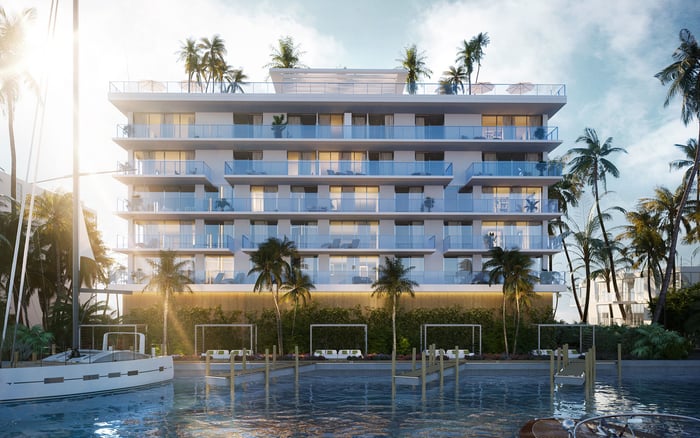
A buyer-focused editorial on the ownership considerations that matter around La Maré Bay Harbor Islands, Origin Bay Harbor Islands, and Vita at Grove Isle, from governance and use rights to carrying costs, resale positioning, and private advisory review.

At the upper end of South Florida real estate, ownership is rarely defined by floor plan alone. The more consequential questions sit around structure: how the association is governed, what rights attach to the residence, how use is regulated, how carrying costs may evolve, and how the building’s private character is protected over time.
That distinction is especially relevant when comparing Bay Harbor Islands and Grove Isle. Each appeals to buyers who value water, privacy, and a quieter rhythm than the most visible resort corridors. Yet the ownership lens is not interchangeable. A residence at La Maré Bay Harbor Islands may raise a different set of questions than Origin Bay Harbor Islands, while Vita at Grove Isle sits within a distinct island context with its own practical considerations.
For sophisticated buyers, the right question is not which project appears most glamorous. It is which ownership framework best matches lifestyle, investment horizon, liquidity needs, privacy expectations, and tolerance for ongoing obligations.
Bay Harbor Islands attracts buyers who often prefer discretion over spectacle. The setting is residential, waterfront-oriented, and proximate to the broader Miami Beach and Bal Harbour ecosystem without feeling absorbed by it. For ownership purposes, the neighborhood’s appeal is tied closely to scarcity of atmosphere: calm streets, water adjacency, and a lower-key expression of luxury.
A Bay Harbor buyer should look closely at how each building protects that atmosphere. Governance documents, use restrictions, guest policies, leasing rules, pet policies, parking provisions, delivery protocols, and amenity operations can shape the lived experience as much as architecture. These are not afterthoughts. They are the operating system of the building.
With boutique or limited-inventory residences, buyers should also understand how association expenses are shared. Smaller ownership communities may feel more private, but each owner may have a proportionally meaningful role in maintaining the building’s standards. That can be attractive for buyers who want influence and intimacy, provided they are comfortable with the financial and governance implications.
When considering La Maré Bay Harbor Islands or Origin Bay Harbor Islands, the strongest ownership comparison begins with fit. A buyer should examine the relationship among residence scale, views, outdoor space, storage, parking, and the way daily arrivals and departures are managed. Even where two properties share a neighborhood, the day-to-day ownership experience can diverge sharply.
Contract review is essential. Deposits, cancellation rights, closing conditions, delivery standards, finish specifications, warranty language, association budgets, and estimated assessments all deserve professional scrutiny. In South Florida’s luxury segment, the most elegant sales presentation can still leave material ownership questions unresolved until the legal documents are read carefully.
Resale positioning is another critical angle. Some buyers prioritize the rarest line, the most private exposure, or the most adaptable plan. Others value predictable monthly carrying costs or a residence that can accommodate seasonal use without operational complexity. In Bay Harbor Islands, where privacy and neighborhood feel are central, the future buyer pool may reward residences that are easy to understand, easy to maintain, and aligned with the area’s restrained luxury identity.
Grove Isle carries a different emotional and practical signature. It is associated with seclusion, water, and a sense of arrival that feels separate from the urban pulse nearby. For buyers evaluating Vita at Grove Isle, the ownership question is not only about the residence itself. It is about how private-island living functions over years of daily use.
Coconut Grove ownership conversations often include access, drive times, service logistics, guest movement, privacy, and proximity to schools, clubs, marinas, parks, and cultural life. A secluded setting can be highly desirable, but it should be tested against actual routines. How often will the residence be used? Who will manage it when the owner is away? How will staff, vendors, guests, and family members move through the property?
Buyers should also consider how the building’s rules support quiet enjoyment. In a private environment, noise policies, construction protocols, amenity reservations, move-in procedures, and short-term guest parameters can be especially important. The more refined the setting, the more governance matters.
Investment in this tier should be defined with precision. Some owners are seeking appreciation, some are seeking capital preservation, some want a seasonal residence that also feels like a long-term family asset, and others are acquiring for lifestyle first with financial discipline in the background. Those are different mandates.
Carrying costs should be modeled conservatively. Association dues, insurance, taxes, reserves, maintenance, staffing, utilities, furnishings, and potential assessments all shape the true cost of ownership. A buyer who can comfortably purchase may still prefer a property with clearer ongoing obligations. Conversely, a buyer with a long horizon may accept higher carrying costs if the residence delivers exceptional privacy, scarcity, and personal utility.
Liquidity also matters. Ultra-luxury resale markets can be selective. The most durable residences tend to have clear strengths: a compelling setting, logical layouts, protected views where applicable, high-quality building management, and a story that remains legible to future buyers. Ownership should be evaluated not only at purchase, but also at the eventual exit.
Before committing, buyers should ask for the documents that define ownership, not only the materials that present the lifestyle. The association budget, declaration, bylaws, rules and regulations, purchase agreement, construction or delivery obligations, reservation terms if applicable, and any disclosures should be reviewed by qualified counsel and financial advisors.
Particular attention should be paid to leasing flexibility. Even owners who do not plan to rent may want to preserve future optionality. Restrictions on lease length, frequency, tenant approval, guest use, and corporate ownership can materially affect value and convenience. The same is true for renovation rights, combining units, transferring parking rights, storage use, and rules around service providers.
The most elegant acquisition is often the one with the fewest surprises. In South Florida, beauty is abundant. Clarity is rarer, and it is what separates a pleasing purchase from a resilient ownership position.
What is the first ownership issue to review in a luxury condo purchase? Start with the governing documents, because they define use rights, restrictions, budgets, and owner obligations.
Are La Maré Bay Harbor Islands and Origin Bay Harbor Islands evaluated the same way? They share a neighborhood context, but each should be reviewed through its own documents, design, budget, and ownership structure.
Why does Bay Harbor Islands appeal to discreet luxury buyers? Its appeal is tied to a quieter residential atmosphere, water adjacency, and proximity to major luxury destinations.
What makes Vita at Grove Isle a different ownership conversation? Grove Isle places greater emphasis on seclusion, access, privacy, and how island living fits daily routines.
Should buyers focus more on amenities or association governance? Amenities matter, but governance determines how the building actually operates and how owners share responsibilities.
How should carrying costs be analyzed? Model association dues, taxes, insurance, reserves, maintenance, utilities, and potential assessments before making a commitment.
Do rental rules matter if the buyer does not plan to lease the residence? Yes, because rental flexibility can affect future optionality, resale appeal, and estate or family planning.
What should seasonal owners prioritize? They should examine management, security, access, service protocols, and how the residence is cared for while vacant.
Is resale value only about location? No, resale also depends on layout, view quality, building condition, rules, carrying costs, and buyer confidence.
What is the best way to shortlist comparable options for touring? Start with location fit, delivery status, and daily lifestyle priorities, then compare stacks and elevations to validate views and privacy.
For a confidential assessment and a building-by-building shortlist, connect with MILLION.
If branded residences are on your mind — as a home or as an allocation — we would be glad to share what we are seeing, privately.
Begin a quiet conversation