A buyer-focused review of planned arrivals at The Residences at 1428 Brickell, distinguishing documented valet and drop-off amenities from driver-waiting, staging, and late-night procedures that require written confirmation.

For an owner who travels with a household driver, an elegant arrival is only the beginning. The more consequential questions are where the vehicle waits, who authorizes its return, and how the passenger reaches it after midnight. At The Residences at 1428 Brickell, the planned arrival amenities provide a considered foundation-not a complete chauffeur-service protocol.
The distinction is straightforward: climate-controlled drop-off space is documented; secure, long-duration driver waiting is not. Buyers should assess the residence against their household's actual movements, from a brief grocery arrival to an evening when a driver remains available for several hours. These are different operating requirements, even when they begin beneath the same porte cochère.
The amenities discussed here are planned services, not a verified operating record. That distinction should guide both expectations and purchase-stage questions.
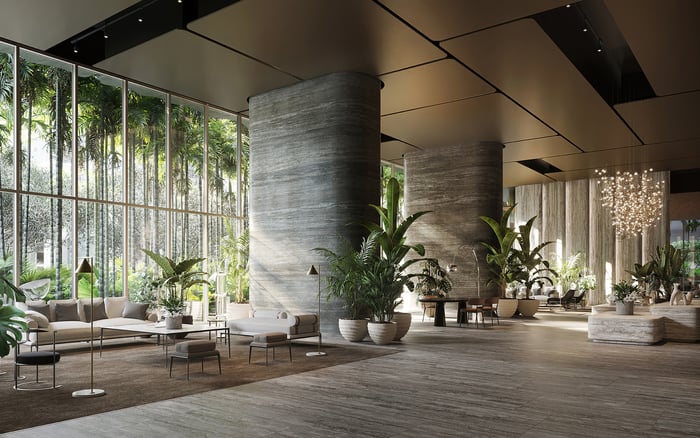
Located at 1428 Brickell Avenue, Miami, the property is planned with a guarded, landscaped porte cochère. The arrival offering includes 24/7 valet attendants and porters, a planned 24/7 staffed guard house, and 24/7 roaming security.
The service roles are distinct: the valet handles the vehicle, while the porter assists with packages. That division matters for a household arriving with luggage or shopping. It defines intended responsibilities without establishing that a porter will escort passengers during every late-night pickup.
Vehicular access is identified from Brickell Avenue and SE 14th Street. Traffic-direction rules and queue capacity, however, are not specified. Two access points should not be read as proof of separate resident and service routes, uninterrupted circulation, or capacity for a particular number of waiting vehicles.
The next step is to request a final circulation plan showing where each arrival is expected to go.
Level 02 is planned with fully serviced, private, air-conditioned drop-off slips, offering a more discreet alternative to street-level arrival. Residents using this level can communicate with a porter through the building app to arrange package collection and delivery to their residence.
This is a meaningful convenience, particularly when a passenger needs time to unload. Private valet drop-off bays are also intended to allow additional time to disembark. Neither feature, however, establishes permission for a household driver to remain in place between journeys.
No dedicated driver lounge or indoor driver waiting room is identified. An adjacent library lounge is described as a place for residents and guests to await vehicles, but it should not be treated as a driver facility or an assured element of the final operating plan.
Ask specifically whether drivers may remain in the Level 02 slips, whether they must leave their vehicles, and what dwell limits apply. A drop-off amenity and a waiting entitlement are not interchangeable.
Each residence is described as receiving two or more valet-serviced parking spaces. The parking offering also includes private loading and unloading areas, though whether those areas are individually assigned or shared is not established.
For an owner with a chauffeur, the critical distinction is between storing a vehicle and keeping it ready for departure. A parking allocation does not, by itself, establish where a driver waits, whether a vehicle can remain staged, or how quickly it can be brought forward.
Request written clarification of vehicle-clearance restrictions, staging locations, dwell limits, and the handling of simultaneous resident, guest, delivery, and service arrivals. Overnight holding for private drivers, chauffeured vehicles, and ride-hailing pickups remains unconfirmed.
For buyers also considering Cipriani Residences Brickell, these questions provide a consistent comparison framework. They are due-diligence questions, not a claim that the two properties have equivalent operating rules.
Around-the-clock staffing is a useful starting point, but it does not establish a late-night pickup protocol. The planned guard house and roaming security do not, by themselves, define driver-verification procedures, vehicle authorization, camera coverage, patrol routes, or escalation arrangements.
Ask management to explain the complete pickup sequence: how an advance request is submitted, how the arriving driver is recognized, where the vehicle is directed, and how the resident is notified. Confirm whether the procedure differs for a registered household driver, an unfamiliar replacement chauffeur, and a ride-hailing vehicle.
Key custody warrants a separate answer. Key-control procedures and valet retrieval targets are not specified. Nor are passenger escort arrangements or procedures for handling several pickups at once.
The objective is not to prescribe security measures from a brochure. It is to obtain an approved operating sequence the household can follow without improvisation, including when its usual driver is unavailable.
Before relying on the arrival offering, request the final garage and circulation plans, valet operating procedures, resident-driver access rules, and the security procedures management can appropriately share. Confirm which documents are final and which remain subject to change.
Driver registration deserves particular attention. Ask what information is required for recurring authorization, how vehicle changes are handled, and what happens when an unregistered driver arrives overnight. Confirm who within the household may authorize access and how that permission is withdrawn.
Service capacity also requires a direct answer. Queue limits, retrieval targets, and event-surge staffing are not specified. Ask how management intends to accommodate overlapping departures without assuming a guaranteed response time.
A household considering Una Residences Brickell can use the same written checklist. The comparison should rest on confirmed permissions and procedures, not the atmosphere of an arrival rendering.
The strongest documented elements at 1428 Brickell are the planned staffed arrival, valet-serviced parking, and private, air-conditioned Level 02 drop-off slips. Together, they address passenger comfort and the transition from vehicle to residence.
The unresolved owner-operations questions concern driver accommodation, vehicle holding, access authorization, and coordinated late-night departures. The absence of confirmed procedures does not establish that the eventual service will be inadequate. It means a buyer should not treat those functions as settled commitments.
For a household whose daily routine depends on a driver, the decisive test is simple: can management explain where the driver waits, where the vehicle stands, and how the passenger is collected? Written answers turn an appealing arrival concept into a service proposition an owner can evaluate.
For a discreet review of residences through the lens of your household's operating needs, connect with MILLION.
If branded residences are on your mind — as a home or as an allocation — we would be glad to share what we are seeing, privately.
Begin a quiet conversationThe property is located at 1428 Brickell Avenue, Miami. Planned vehicular access is identified from Brickell Avenue and SE 14th Street.
The planned porte cochère includes 24/7 valet attendants and porters. The stated roles assign vehicle handling to the valet and package assistance to the porter.
Level 02 is planned with fully serviced, private, air-conditioned drop-off slips. Residents can use the building app to arrange porter collection and delivery of packages to their residence.
The planned arrival amenities do not establish whether household drivers may wait there or how long vehicles may remain. Buyers should request written permission and dwell-limit rules.
No dedicated driver lounge or indoor driver waiting room is confirmed. The described library lounge should not be assumed to accommodate household drivers.
Each residence is described as receiving two or more valet-serviced parking spaces. That allocation does not establish a separate right to stage a chauffeured vehicle.
Private loading and unloading areas are included in the parking offering, but their individual assignment or shared use is not established. Buyers should confirm the applicable access rules.
Overnight holding areas for private drivers, chauffeured vehicles, or ride-hailing pickups remain unconfirmed. Management should clarify permitted locations and waiting periods.
The planned guard house and roaming security alone do not establish a late-night pickup protocol. Driver authorization, passenger coordination, and escalation arrangements require confirmation.
Request final garage and circulation plans, valet operating procedures, resident-driver access rules, and appropriately shareable security procedures. Seek written clarification of retrieval targets, key custody, queue limits, and surge staffing.