A practical framework for part-time Coral Gables residents to map emergency care, confirm caregiver parking, and evaluate high-floor mobility before settling into a seasonal home.

A part-time home in Coral Gables should feel effortless, but that ease needs a practical foundation. For households coordinating visiting relatives, mobility equipment, or professional caregivers, the essential questions extend beyond the residence: where care is available, how someone reaches the front door, and what happens when elevator access is interrupted.
Address these questions during purchase due diligence and before each seasonal arrival-not during an emergency. Whether evaluating Ponce Park Coral Gables or another address, separate neighborhood medical access from building operations. A nearby hospital does not establish an ambulance destination, and an elegant arrival sequence does not confirm accessible entry or caregiver parking privileges.
Doctors Hospital emergency room is at 5000 University Drive, Coral Gables, FL 33146, and operates 24 hours a day, 365 days a year. Record it in the household plan as a local emergency option, not as a guarantee that it is the closest facility to the residence or where an ambulance will take a patient.
For a medical emergency, call 911.
Emergency care includes conditions such as chest pain, heart attacks, serious injuries, and high fevers. The hospital’s telephone number, 786-308-3000, is useful for general contact but is not a substitute for emergency dispatch.
For minor illnesses and injuries, Baptist Health Urgent Care at 10 Giralda Avenue, Suite 100, Coral Gables, FL 33134, has daily hours of 9 a.m. to 9 p.m. It accepts walk-ins and offers on-site diagnostic services. Its telephone number is 786-467-5000. Confirm hours before a nonemergency visit rather than assuming they remain unchanged.
Keep these destinations distinct in your phone and household instructions. For routine planning, review routes from the actual residential entrance, not merely the building’s map pin. Do not treat a mapped driving estimate as an emergency-response guarantee.
Prepare a concise access sheet for the resident and authorized caregivers. Include the full address, unit and floor, household emergency contacts, management’s current contact details, and the entrance management identifies for emergency access. Keep sensitive medical information separate and share it only with appropriate people.
Ask management who receives emergency responders, how controlled doors are opened, and what happens if the resident cannot answer an intercom. Confirm the after-hours procedure rather than assuming daytime staffing extends overnight. Arrange authorized access in advance; a caregiver’s name on a household schedule may not satisfy building registration requirements.
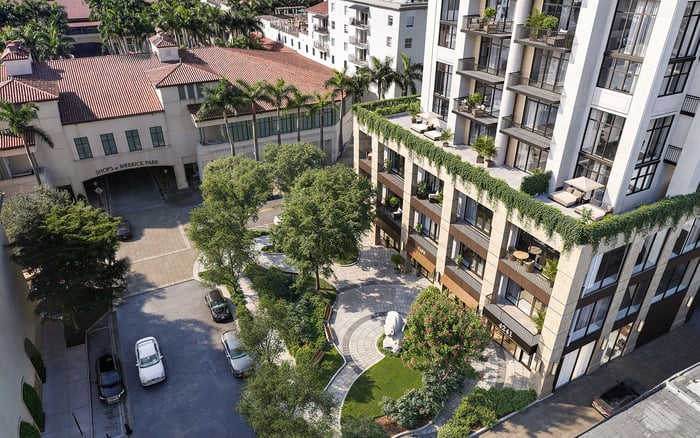
For a buyer considering Cora Merrick Park, these are due-diligence questions, not statements about the property’s services. The objective is a documented sequence from arrival to the residence, with responsibility clearly assigned at each step.
Caregiver access requires two plans: where the resident can be transported and where the caregiver can leave a vehicle. Do not assume one parking arrangement covers both.
When a disabled-parking permit is used in a Coral Gables city garage, the permit holder must be in the vehicle. Be prepared to present the permit and identification when exiting. The permit may be used only when its holder is being transported; it does not authorize a caregiver to use it independently for personal errands.
Municipal-garage pricing is $1 per 24 minutes or portion thereof, with an $18 daily maximum. Confirm current charges before relying on that figure. Private facilities may charge drivers displaying disabled-parking permits, and municipal rules do not establish private pricing.
Ask residential management about recurring caregiver credentials, overnight parking, shift changes, vehicle-height restrictions, and fees. Confirm where a resident may be dropped off and whether someone can remain with them while the driver parks. Request written terms rather than treating a verbal accommodation as permanent policy.
A useful viewing follows the journey from vehicle to living room. Review the proposed drop-off, doors, thresholds, elevator approach, and route into the home against the resident’s actual mobility requirements. Confirm dimensions wherever equipment clearance matters.
When comparing The Village at Coral Gables with other residences, apply the same route-based questions without presuming a particular layout or accessibility feature. Ask where equipment can be stored without obstructing circulation and how deliveries or visiting care teams are admitted.
Eligible North Gables residents with disabilities may qualify for an on-street accessible parking space. The program requires a current permanent Florida disabled-parking permit or wheelchair license plate; temporary permits are not eligible. Confirm eligibility before treating this as a solution for a prospective address.
A high-floor residence calls for a separate operational conversation. Ask management which elevators, if any, have backup power, what that power supports, and what operating limits apply. Request clarification about stretcher access, emergency-entry arrangements, any designated refuge areas, and after-hours assistance.
Treat every answer as building-specific. Do not infer elevator availability from the presence of a generator or assume staff can physically assist a resident. Ask how outages and service interruptions are communicated and how the household should coordinate its individual needs with building procedures.
Review the plan with the resident’s care team when medical equipment or assisted movement is involved. Do not improvise stair transfers or assume an elevator is appropriate during an emergency. Obtain the building’s applicable instructions and follow emergency personnel’s directions for the situation.
Miami-Dade’s Emergency & Evacuation Assistance Program supports residents who need specialized transportation or whose medical needs prevent independent evacuation. Those needs can include skilled nursing, assistance with daily living, and electricity-dependent life-saving medical equipment. Residents with mobility challenges are encouraged to register because evacuation may require additional time.
For a part-time household, discuss registration and individual arrangements before a storm threatens. Confirm how seasonal occupancy affects the household’s planning, and do not treat registration as a substitute for a personal care plan. Do not presume building backup power covers medical equipment inside a residence.
Revisit the access sheet at each seasonal return and whenever mobility, caregivers, or building procedures change. For municipal accessibility questions, the Coral Gables ADA Coordinator is reachable at [email protected], 305-722-8686 for voice calls, or 305-442-1600 for TTY/TDD. The goal is quiet preparedness: a home whose practical arrangements receive the same attention as its design.
Explore Coral Gables residences with a more considered ownership checklist at MILLION.
If branded residences are on your mind — as a home or as an allocation — we would be glad to share what we are seeing, privately.
Begin a quiet conversationIt is at 5000 University Drive, Coral Gables, FL 33146, and operates 24 hours a day, 365 days a year. Call 911 for a medical emergency.
No. Treat it as a mapped local emergency option, not a guaranteed ambulance destination or the closest facility to every address.
Baptist Health Urgent Care is at 10 Giralda Avenue, Suite 100, Coral Gables, FL 33134. It accepts walk-ins and lists daily hours of 9 a.m. to 9 p.m.; confirm hours before visiting.
The permit may be used only when its holder is being transported. A caregiver cannot use it independently for personal errands.
The permit holder must be in the vehicle and should be prepared to present the disabled-parking permit and identification when exiting.
Not necessarily. Private facilities may charge drivers displaying disabled-parking permits, so confirm the facility’s terms separately.
The listed rate is $1 per 24 minutes or portion thereof, with a daily maximum of $18. Confirm current pricing before relying on it.
Ask which elevators have backup power, what operating limits apply, and how emergency access and outages are handled. Do not assume a generator guarantees elevator availability or power for in-home medical equipment.
The program supports residents needing specialized transportation or whose medical needs prevent independent evacuation. Relevant needs include skilled nursing, assistance with daily living, and electricity-dependent life-saving medical equipment.
No. The program requires a current permanent Florida disabled-parking permit or wheelchair license plate, and eligibility must be confirmed for the resident.