A buyer-focused comparison of Una Residences and The Residences at Mandarin Oriental, Miami, distinguishing garage capacity from parking rights, valet convenience from liability protection, and planned EV infrastructure from installed charging equipment.
For a luxury condominium buyer, the garage is part of a residence’s daily usefulness. A graceful arrival matters, but so does knowing where a second vehicle belongs, who may retrieve it, and whether charging will be available when needed. When several owners share a residence or different household members use it, those questions become especially important.
The comparison between Una Residences Brickell and The Residences at Mandarin Oriental, Miami turns on a precise distinction: an amenity’s presence does not establish an individual owner’s entitlement. Una’s garage specifications emphasize scale and access. Mandarin Oriental’s offering language more explicitly addresses allocation to every residence.
The useful question is not simply which property offers parking. It is which documents define the spaces, services, costs, and responsibilities attached to the particular residence under consideration.
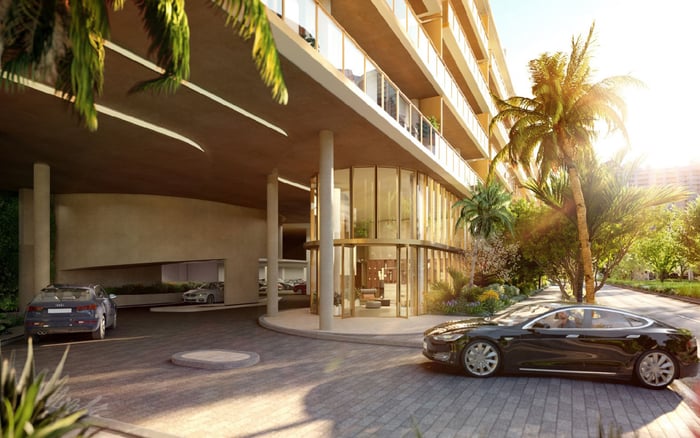
Una is located at 175 SE 25th Road in South Brickell. Its April 2025 construction specifications describe a three-level underground garage accommodating approximately 236 vehicles for roughly 135 residences. Those figures describe the planned garage’s scale, not independently verified current operating conditions.
The distinction matters. Total vehicle capacity cannot be translated into a contractual space count for an individual buyer. It does not establish that each residence receives two spaces, that every space is available for resident self-parking, or that a particular purchase includes ownership of a specific bay.
Una’s amenities include both valet service and self-parking. Its garage specifications also include private access and EV-charging stations. Together, these features suggest more than one way to manage arrival and vehicle use, but essential allocation questions remain unresolved.
Before signing, request the residence-specific parking assignment and confirm the number and location of spaces. Whether those spaces are deeded, assigned, or limited common elements remains unestablished. Buyers should also ask whether assignments can change and what transfer rights accompany them.
On Brickell Key, Mandarin Oriental expressly describes allocated self-parking space(s) for every residence, alongside valet parking service. That is the clearer affirmative allocation language in this comparison. It connects self-parking to each residence rather than describing only a building-wide amenity.
However, “space(s)” does not establish a uniform number of spaces. Nor should “allocated” be read as “deeded” or treated as a contractual guarantee without examining the governing purchase and condominium documents. A buyer with several vehicles still needs a residence-specific answer.
A private storage unit is also described for each residence. This is separate from parking allocation: a storage unit should not be understood as additional vehicle accommodation. Confirm its dimensions, ownership status, access conditions, and permitted contents independently.
Keep tower-specific commitments separate throughout the review. The South Tower offering language should not be extended to another tower’s storage locations or amenities. For a shared household, clarity about the precise residence and applicable documents is more valuable than a generalized project-level assurance.
The largest wording difference concerns electric vehicles. Mandarin Oriental describes “planned infrastructure for dedicated EV-charging stations for every residence.” This is more specific about intended residence-level allocation than Una’s description of EV-charging stations, but it remains an infrastructure statement.
It does not establish that every residence receives a fully installed charger at closing. Buyers should identify what is actually delivered: supporting electrical infrastructure, charging equipment, installation authorization, or some combination. Installation responsibility, separate metering, electricity billing, and maintenance charges remain unresolved.
At Una, the EV provision likewise does not define charger-to-residence assignments, simultaneous charging capacity, fees, or guest-use rules. A household with two electric vehicles should therefore ask whether both can charge within its parking allocation and whether charging access is exclusive, shared, scheduled, or otherwise controlled.
For either property, request an EV operating policy and a written description of installation costs and ongoing charges. Planned infrastructure and usable charging at handover are distinct purchase considerations. Neither should be assumed simply because an EV amenity is included.
Both properties describe valet parking service. Detailed vehicle-damage liability terms, insurance limits, deductibles, exclusions, and claims procedures remain unestablished for both. That uncertainty does not demonstrate that an operator lacks insurance or disclaims responsibility.
The appropriate response is document review. Request the valet agreement, insurance certificate, and written damage-reporting procedure. Ask who receives a claim, which reporting deadlines apply, and how the vehicle’s condition is recorded at handover. Clarify the responsibilities of the valet operator, management, and owner rather than assuming one party covers every circumstance.
For a residence used by several people, authorization deserves equal attention. Ask how co-owners, household members, and guests are identified and who is authorized to release a vehicle. Confirm whether different procedures apply to resident and visiting vehicles.
Self-parking may appeal to buyers who prefer to retain their keys. Its availability alone, however, does not settle access rules, overnight arrangements, or the relationship between assigned spaces and valet operations. Those details belong in the buyer’s review, not in an inferred promise of flexibility.
A useful comparison begins with the household’s actual vehicles and users. Identify the required space count, charging needs, preferred access arrangements, and periods when several owners may be present together. Then compare written provisions against that same set of requirements.
Buyers also considering The Residences at 1428 Brickell can apply this checklist without assuming its parking arrangements resemble either property discussed here. The same discipline applies when evaluating Cipriani Residences Brickell: confirm each residence’s terms independently rather than carrying expectations from one address to another.
For Una and Mandarin Oriental, request the condominium declaration and rules, parking assignment, valet agreement and insurance certificate, and EV operating policy before signing. Keep storage documentation separate. Where several owners will share use, establish their internal arrangements only after understanding the building’s permissions and restrictions.
Mandarin Oriental offers clearer language about self-parking allocation and planned dedicated EV infrastructure for every residence. Una’s distinguishing specifications concern garage scale, private access, and the combination of valet, self-parking, and EV amenities.
That is a difference in specificity, not proof that one property will better serve every buyer. The stronger fit is the residence whose documented parking rights, charging arrangements, storage provisions, and valet procedures match the household’s needs without relying on interpretation.
For a discreet exploration of South Florida residences through the lens of your ownership priorities, connect with MILLION.
If branded residences are on your mind — as a home or as an allocation — we would be glad to share what we are seeing, privately.
Begin a quiet conversationUna Residences is located at 175 SE 25th Road in South Brickell, Miami.
Una’s April 2025 garage specifications describe three underground levels accommodating approximately 236 vehicles for roughly 135 residences. These figures are not confirmation of current operating conditions or individual parking rights.
No, the building-wide capacity does not establish a residence-by-residence space count. Whether spaces are deeded, assigned, or limited common elements remains to be confirmed.
Yes, Mandarin Oriental describes allocated self-parking space(s) for every residence. This does not establish a uniform space count or deeded ownership.
Yes, both Una and Mandarin Oriental describe valet service alongside self-parking.
The described provision is planned infrastructure for dedicated EV-charging stations for every residence. That does not establish delivery of a fully installed charger at closing.
Charger-to-residence assignments remain unestablished. Simultaneous charging capacity, charging fees, and guest-use rules also require confirmation.
Installation responsibility, electricity billing, separate metering, and maintenance charges remain unresolved. Buyers should obtain written terms before signing.
Yes, a private storage unit is described for each residence, separate from parking allocation. Dimensions, ownership status, and access conditions should be confirmed for the applicable residence and tower.
Request the valet agreement, insurance certificate, and written claims procedure, including damage-reporting deadlines. Unestablished liability terms do not mean that either operator lacks insurance.