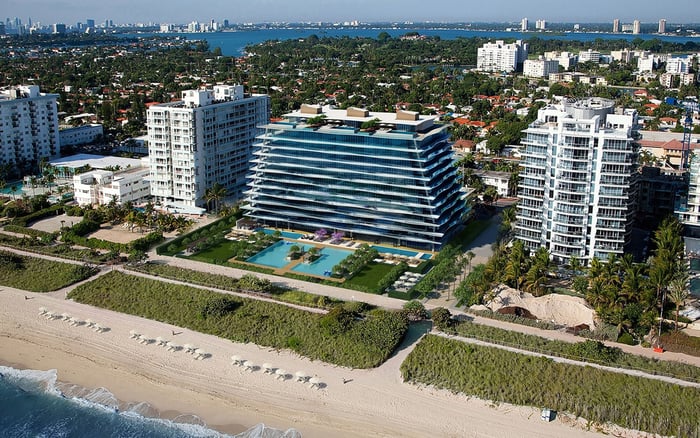
A Surfside acquisition can anchor a Florida domicile plan, but the strongest file aligns intent, ownership, timing, official records, and evidence that prior Swiss residency has ended.

For an international buyer moving from Zurich, a Surfside residence can serve as the physical center of a Florida domicile plan. On its own, however, it does not establish domicile. The legal concept combines residence in Florida with a genuine intention to make the state the permanent home.
That distinction should shape the transaction from the outset. A buyer may be drawn to the discretion of Arte Surfside or consider Ocean House Surfside, but the documentary record must extend well beyond the deed. The strongest file aligns the home, official identification, tax records, estate documents, daily life, and departure from Switzerland.
This edition of MILLION Buyer's Guides treats the residence as the organizing fact. Investment objectives may remain relevant, but official descriptions should not characterize the property as a vacation or second-home residence if it is intended to be the permanent home. Consistency carries more weight than any isolated form.
Ownership structure warrants review before the contract reaches closing. Florida homestead eligibility generally requires the applicant to hold qualifying legal or equitable title, occupy the property on January 1, and intend in good faith to make it a permanent residence. A structure selected for estate planning, privacy, asset protection, or cross-border tax reasons should therefore be coordinated with homestead objectives before the deed is finalized.
Timing is equally important. The standard homestead application deadline is March 1 for a property owned and occupied as the primary residence on January 1 of that tax year. Closing after January 1 may affect the first year in which the buyer plans to claim the exemption. This should be modeled before selecting a completion date, particularly when considering a future residence such as The Delmore Surfside.
Homestead creditor protection and the property-tax exemption are distinct concepts. The former may arise when qualifying property becomes the owner's domicile; the latter requires a separate application. Advice should address each independently.
Florida law permits a resident to file a sworn Declaration of Domicile with the circuit-court clerk in the county of residence. For a Surfside resident, that means Miami-Dade County. The declaration should identify the Florida address as the permanent home. If the buyer retains other residences, it should describe the Florida residence as the predominant and principal home.
The declaration is signed under oath before a notary or another official authorized to take affidavits, then recorded by the clerk. It is meaningful evidence, not a substitute for conduct.
A practical sequence is to record the declaration, obtain a Florida driver's license, register vehicles in Florida, register to vote if eligible, and apply for homestead when qualified. International buyers should not register to vote unless eligible. The remaining steps still contribute to a coherent file.
The Surfside address should also appear consistently on federal tax returns, estate-planning documents, banking records, insurance materials, and other official correspondence. Florida authorities may consider the declaration, driver's license, vehicle registration, voter registration, and federal return address when assessing intent. No single factor is conclusive.
A polished Florida file should document not only arrival, but also the end of the former residence. Preserve dated Swiss deregistration records, documents concerning the termination or sale of the prior primary home, and other evidence establishing when Swiss residency ended. Florida homestead documentation may request proof of the previous residence outside the state and the date that residency ceased.
Former residence-based benefits and registrations also warrant review. Where applicable, ending prior voter registration, vehicle registration, or residence-linked tax benefits helps avoid a record in which two jurisdictions appear to be the principal home.
A buyer choosing an oceanfront home at Fendi Château Residences Surfside should apply the same discipline to practical records. Insurance, banking, tax filings, and correspondence should support permanent residence rather than quietly characterize the property as occasional use.
A benchmark of 183 Florida days per year is often used for planning. Day count is useful, but it does not replace a primary Florida home, credible intent, and consistent documentation. Travel records should complement, rather than contradict, the broader domicile narrative.
Retain the recorded declaration, deed, closing statement, homestead application, Florida identification and vehicle records, address-change confirmations, estate documents, and evidence ending Swiss residency. Keep dated copies in one secure file, supported by a chronology that begins before closing and continues through the first homestead application.
The objective is not volume, but alignment. A clean record allows every major document to answer the same questions: Where is the permanent home? When did the move occur? What actions support that intention?
Does buying a Surfside residence automatically create Florida domicile? No. Domicile requires both Florida residence and intent to make Florida the permanent home.
Where should a Surfside owner file a Declaration of Domicile? The declaration should be filed with the appropriate circuit-court clerk in Miami-Dade County.
What if the buyer keeps a home in Zurich? The Florida residence should be treated and declared as the predominant and principal home, with conduct and records supporting that position.
When does January 1 matter for homestead? The applicant generally must own and occupy the home as a primary residence on January 1 for that tax year.
What is the standard homestead filing deadline? The standard deadline is March 1 for a qualifying home owned and occupied on January 1.
Should ownership structure be reviewed before closing? Yes. Homestead eligibility depends on qualifying legal or equitable title, so the deed structure should be coordinated in advance.
Is spending 183 days in Florida enough? Not alone. The benchmark should be supported by a primary Florida home, intent, and consistent documentary evidence.
Must an international buyer register to vote? Only if eligible. A declaration, Florida identification, vehicle registration, address consistency, and homestead may still be relevant.
Which Zurich departure records should be retained? Keep Swiss deregistration records, prior-home sale or termination documents, and dated evidence showing when Swiss residence ended.
Are homestead creditor protection and the tax exemption identical? No. They are distinct, and creditor protection may arise from domicile rather than the exemption application itself.
When you're ready to tour or underwrite the options, connect with MILLION.
If branded residences are on your mind — as a home or as an allocation — we would be glad to share what we are seeing, privately.
Begin a quiet conversation