A buyer-focused guide to balancing pedestrian convenience and discretion when moving from Manhattan habits to South Florida luxury living.
For a Manhattan buyer, walkability is not a novelty. It is the basic choreography of daily life: coffee without a car, dinner without logistics, a quick meeting without surrendering the day. In South Florida, the challenge is not finding energy. It is choosing where that energy feels elegant rather than exposed.
Brickell is often the first comparison point because it offers Miami’s clearest urban rhythm. Still, the Manhattan-to-Brickell move should not be treated as a simple exchange of one vertical neighborhood for another. South Florida has a different relationship to weather, water, arrival, views, valet culture and outdoor space. A home can sit close to restaurants and offices yet still feel private if the building manages access, circulation and exposure with discipline.
The right question is not, “Can I walk?” It is, “What do I pass through before I arrive home, and how much of my life is visible once I do?”
A polished walkable address is not measured by distance alone. It is measured by the quality of the route, the frequency of use and the friction removed from daily life. A buyer who walks to a morning workout, keeps meetings nearby and dines locally needs a different setting than someone who wants occasional pedestrian access but spends most days moving between home, airport, club and boat.
Before choosing a building, map three versions of the day: weekday morning, weekday evening and weekend. If each route feels natural, shaded where possible, intuitive and pleasant, the location has real value. If the walks exist only on paper, the premium may not translate into lived luxury.
In Brickell, buyers often seek a balance between centrality and a composed residential threshold. A project such as 2200 Brickell may appeal to those who want a Brickell address while still thinking carefully about how the home separates public life from private routine. The same buyer might consider Una Residences Brickell if the preference leans toward a more residential interpretation of the area’s waterfront identity.
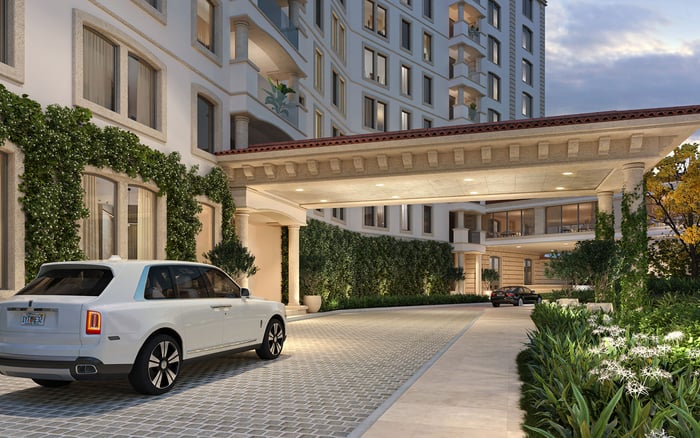
Privacy is often misunderstood as height, acreage or a guarded entrance. In a walkable district, it is more subtle. It begins at the curb. How visible is the drop-off? How compressed is the lobby? Are residential entries distinct from more public uses? Does the elevator sequence feel calm, or does it funnel too many daily interactions through the same space?
For former Manhattan residents, a busy lobby can feel normal. In South Florida, where the home is often expected to function as a retreat, that same busyness can feel less acceptable. Privacy is not isolation. It is control over transition.
Study the arrival experience at different times of day. A building that feels serene at noon may feel theatrical at dinner hour. A tower with excellent walkability may still be the wrong choice if every return home feels like a public event. Conversely, a quieter entry sequence can make a central address feel surprisingly discreet.
Brickell is best approached as a series of micro-environments rather than one uniform market. The appeal is obvious: an urban setting, strong pedestrian habits and proximity to dining, services and professional life. The caution is equally clear: the more central the address, the more important the building’s internal privacy becomes.
A Brickell buyer should look closely at stack orientation, terrace exposure, amenity placement and how the residence handles sound and sightlines. A high-floor home may offer visual distance, but that alone does not create discretion. The more valuable test is whether private rooms, terraces and service areas are protected from the neighboring tower, the amenity deck and the street-level gaze.
This is where new construction can be compelling, not because newer is automatically better, but because contemporary planning may address the modern buyer’s desire for wellness, work-from-home privacy and more intentional indoor-outdoor living. Still, the finish package matters less than the daily feeling of leaving and returning.
Not every Manhattan buyer wants to recreate Manhattan. Many want the ability to walk without the sensation of being constantly on display. In that case, the search can expand beyond Brickell into residential districts where walkability is more village-like, waterfront-oriented or selectively urban.
Coconut Grove is a useful mental model for this buyer, especially when privacy, greenery and a slower cadence matter. A residence such as Four Seasons Residences Coconut Grove may enter the conversation for those comparing a walkable neighborhood feeling with a more residential sense of calm. Some clients even keep search shorthand tabs labeled Coconut Grove, Bay Harbor, Miami Beach and Fort Lauderdale to separate these lifestyle questions before comparing individual homes.
Bay Harbor Islands can be compelling for buyers who want a smaller-scale rhythm near shops and dining while avoiding the intensity of a denser urban core. The Well Bay Harbor Islands illustrates the kind of address that can invite a quieter interpretation of access, where the appeal is not spectacle, but ease.
The best private homes in walkable neighborhoods share a few traits. They make arrival graceful. They reduce unnecessary crossings between residents, guests, service providers and the public. They offer outdoor space that feels usable, not merely decorative. They preserve sightline discipline from primary rooms. They make parking, rideshare, package handling and guest reception feel ordered rather than improvised.
For condo buyers, the elevator experience is central. A private or semi-private elevator sequence can materially change how a residence feels, especially in a lively district. For townhouse and villa buyers, the equivalent is the threshold: gate, garden, setback, entry court or garage sequence.
Noise should also be evaluated emotionally, not just technically. Some buyers enjoy the faint pulse of a city below. Others want silence once the door closes. Neither preference is more sophisticated. The mistake is paying for walkability and then discovering that the home does not provide enough contrast.
South Florida’s luxury map rewards nuance. Fort Lauderdale, Palm Beach, Boca Raton, Surfside, Bay Harbor Islands, Coconut Grove, Miami Beach and Brickell each offer different ways to combine convenience and retreat. The best choice depends less on prestige shorthand and more on how often the buyer wants to step into public life.
In Fort Lauderdale, for example, the conversation may tilt toward boating, waterfront access, dining and a more relaxed urban rhythm. Sixth & Rio Fort Lauderdale can be considered in that broader context, particularly by buyers who want a city setting without necessarily choosing Miami’s highest-intensity corridors.
The larger lesson is that walkability should support identity, not perform it. A buyer who values privacy should not feel forced into isolation. A buyer who values energy should not accept exposure as the price of convenience.
The finest walkable South Florida residence performs a quiet trick. It gives you access when you want it, then allows the home to disappear from public view. Friends can arrive easily. Dinner is close. A walk is natural. Yet once inside, the residence feels composed, sheltered and entirely your own.
That is the true Manhattan-to-Brickell translation: not density for density’s sake, but a more intentional version of urban living. South Florida gives buyers the chance to keep the convenience they love while adding light, air, water, terraces and a stronger sense of retreat. The winning address is the one that lets both ideas coexist without compromise.
Is Brickell the closest South Florida equivalent to Manhattan living? Brickell is often the most intuitive comparison for urban-minded buyers, but the lifestyle is shaped by South Florida’s climate, waterfront setting and arrival culture.
Can a walkable building still feel private? Yes. Privacy depends on entry sequence, elevator design, sightlines, amenity placement and how well the building separates public and residential life.
Should I prioritize distance to restaurants or the quality of the route? The route matters more. A slightly longer walk that feels pleasant and natural can be more valuable than a short walk through a hectic setting.
Are high floors always more private? Not always. Height can help with visual separation, but neighboring towers, terrace exposure and amenity views can still affect privacy.
Is Coconut Grove a good alternative to Brickell? It can be, especially for buyers who want walkable moments with a more residential and relaxed atmosphere.
How should I compare Bay Harbor Islands with Miami Beach? Think in terms of pace, exposure and daily routine. Bay Harbor Islands may feel quieter, while Miami Beach can offer a more visible coastal lifestyle.
What should Manhattan buyers inspect during a showing? Walk the surrounding blocks, enter through the real arrival path, test the lobby rhythm and study views from primary rooms and terraces.
Does new construction guarantee better privacy? No. New construction may offer modern planning advantages, but the specific building design and residence orientation matter most.
Can Fort Lauderdale work for a buyer who wants walkability? Yes, if the chosen address aligns with the buyer’s daily dining, waterfront, boating or cultural routine.
What is the simplest rule for choosing the right home? Choose the address that makes daily life easier while making private life feel calmer, not more exposed.
To compare the best-fit options with clarity, connect with MILLION.
If branded residences are on your mind — as a home or as an allocation — we would be glad to share what we are seeing, privately.
Begin a quiet conversation