A buyer-focused editorial on why California luxury owners are increasingly drawn to Miami and South Florida for lifestyle, privacy, design, and long-term flexibility.

For California luxury buyers, Miami is rarely a simple change of address. It is a reassessment of how a home should support daily life, family rhythm, business access, wellness, privacy, and leisure. South Florida offers a different expression of luxury: less dependent on ceremony, more connected to water, light, indoor-outdoor living, and global energy.
The decision often begins with climate and lifestyle, but it rarely ends there. Buyers coming from Los Angeles, San Francisco, Silicon Valley, Orange County, or Montecito are accustomed to strong design culture and sophisticated service. They are not looking for novelty. They are looking for a home that feels resolved, efficient, and emotionally rewarding.
Miami, Fort Lauderdale, Palm Beach, Boca Raton, and the barrier island communities each answer that desire differently. The strongest searches are not simply about the largest residence or the most dramatic view. They are about finding a setting that makes an owner’s life feel more fluid.
Miami offers a rare combination of international access, waterfront living, architecture, dining, private clubs, art, and year-round outdoor culture. For a California buyer who wants urban energy without surrendering resort ease, that mix can be compelling.
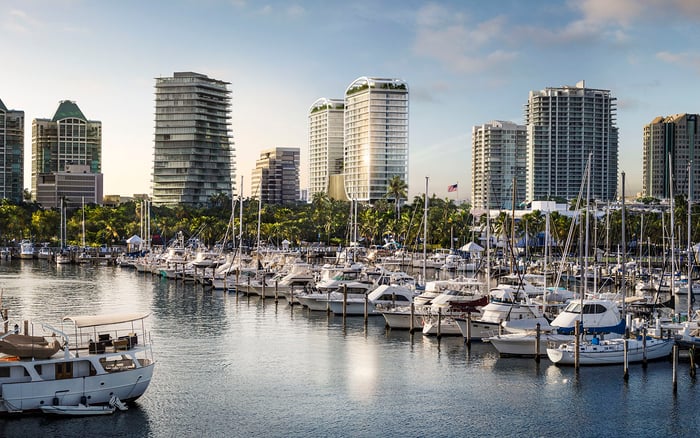
Brickell appeals to buyers who want density, skyline drama, walkability, and proximity to the business core. Miami Beach offers a more sensory proposition, with ocean air, historic character, hotel-level service, and a social rhythm that can move from quiet mornings to high-design evenings. Coconut Grove is softer and more residential, with mature landscaping, marina culture, and a sense of privacy that appeals to families and creative principals.
The vocabulary of the search has become precise: Miami Beach for sand and architectural atmosphere, Brickell for vertical city living, Coconut Grove for leafy discretion, Fort Lauderdale for yachting access, Palm Beach for heritage calm, and new construction for simplified ownership.
Many California buyers have owned beautiful homes that required constant management. South Florida’s luxury condominium and branded residence market can offer a more streamlined alternative. Full-service buildings, private elevators, wellness amenities, security, valet, resident lounges, pools, fitness programming, and concierge support are not simply indulgences. For a bi-coastal owner, they reduce friction.
That ease is especially important for buyers who do not expect to be in residence every day of the year. A well-managed building can make the difference between a second home that feels effortless and one that quietly becomes another operating company. For principals with demanding schedules, the value of reliability is difficult to overstate.
The same thinking applies to single-family homes. Gated settings, modern infrastructure, staff accommodations, protected outdoor areas, and strong property management are often as important as the first impression. The best South Florida homes understand that luxury is not only what the owner sees. It is also what the owner does not have to think about.
California buyers tend to be visually literate. They understand architecture, landscape, light, materials, and the difference between expensive and considered. That has raised the bar in South Florida, where the strongest residences now pair glamour with restraint.
The most successful interiors are not trying to imitate California. They draw from South Florida’s natural assets: broad terraces, reflective water, tropical planting, sunrise and sunset exposures, and a looser relationship between indoor and outdoor rooms. Pale stone, warm woods, integrated kitchens, deep loggias, shaded dining areas, and calm primary suites often resonate more than overt opulence.
This is where Miami can feel particularly persuasive. A buyer can choose a glass residence above the financial district, a beachfront home with hotel-level amenities, a gardened enclave near the bay, or a more discreet waterfront address north or south of the city. The variety allows a move to feel tailored rather than reactive.
South Florida is social, but its luxury market also understands discretion. For high-profile buyers, privacy is rarely a single feature. It is a sequence of protections: arrival, parking, elevators, sightlines, staff access, boating access, security, and the ability to host without exposure.
California buyers often know exactly where their privacy pain points have been. They may want fewer public-facing entries, better separation between family and entertaining spaces, quieter service circulation, or a building where the resident experience feels controlled rather than crowded. In the ultra-prime segment, these details can matter as much as square footage.
The best Miami searches therefore begin with lifestyle choreography. Where does the owner arrive? Where do guests gather? How does staff move? Where are children, pets, trainers, chefs, and security accommodated? A residence that answers those questions elegantly will often outperform one that merely photographs well.
Not every California buyer wants the center of Miami. Some want proximity to the city without the pulse. Others want a quieter coastal environment, more space, or a more traditional expression of wealth.
Fort Lauderdale can appeal to yacht owners and buyers who prioritize water access, newer waterfront homes, and a less compressed urban feel. Boca Raton offers club culture, private residential enclaves, schools, and a polished family environment. Palm Beach carries a different tone altogether: quieter, more established, more formal, and highly attentive to legacy ownership.
This continuum is one of South Florida’s great strengths. A buyer can calibrate the search from high-rise energy to oceanfront retreat to estate privacy without leaving the region. That breadth gives South Florida an advantage over markets where the luxury experience is narrower or more geographically constrained.
The first question is not price. It is use. A primary residence, seasonal home, investment-oriented condominium, yacht base, family compound, and pied-a-terre each require a different strategy.
For condominium buyers, building culture is critical. Two towers with similar views can feel entirely different depending on service style, resident profile, amenity programming, pet policies, guest protocols, and the tone of common spaces. For single-family buyers, the evaluation should include elevation, maintenance exposure, insurance considerations, dock configuration where relevant, and the practicalities of managing the property when the owner is away.
Neighborhood fit is equally important. A buyer who loves the energy of Brickell may find Palm Beach too quiet. A buyer seeking Palm Beach discretion may find central Miami too visible. The best decision is the one that aligns with daily behavior, not just aspirational imagery.
At the highest level, buyers do not move only for efficiency. They move because a place changes how life feels. South Florida’s strongest argument is emotional: the morning light, the water, the ability to dine outside in winter, and the sense that business and leisure can coexist without apology.
For California owners, that emotional shift can be powerful. Miami does not ask them to abandon sophistication. It offers another version of it: more coastal, more international, more immediate, and often more adaptable to the way modern wealth is lived.
Is Miami the only South Florida market California buyers consider? No. Many buyers also evaluate Fort Lauderdale, Boca Raton, Palm Beach, and nearby coastal enclaves based on lifestyle and privacy needs.
Why do California buyers often start with Miami? Miami offers a blend of waterfront living, global culture, dining, design, and business access that makes it a natural first stop.
Is Brickell a good fit for former California residents? Brickell can suit buyers who want walkability, skyline views, services, and proximity to Miami’s business core.
What makes Miami Beach different from mainland Miami? Miami Beach offers ocean proximity, resort atmosphere, historic character, and a more leisure-oriented daily rhythm.
Are full-service condominiums popular with relocating buyers? Yes. They can simplify ownership through security, amenities, maintenance support, and lock-and-leave convenience.
Should buyers consider single-family homes instead? Yes, especially if they want more privacy, outdoor space, staff areas, or a stronger sense of residential permanence.
How important is privacy in this market? Very important. Arrival sequence, elevator access, sightlines, staff circulation, and security all shape the lived experience.
Is new construction always the better choice? Not always. New construction can offer ease and modern systems, while select resale homes may offer location, scale, or character.
What should bi-coastal owners prioritize? They should prioritize management, service, security, airport access, and a residence that remains effortless when they are away.
What is the smartest way to begin a South Florida search? Start with lifestyle, frequency of use, privacy needs, and neighborhood fit before focusing on individual properties.
When you're ready to tour or underwrite the options, connect with MILLION.
If branded residences are on your mind — as a home or as an allocation — we would be glad to share what we are seeing, privately.
Begin a quiet conversation