A discreet buyer’s guide to selecting a South Florida residence around collector-fair calendars, private-club adjacency, privacy, access, and long-term lifestyle fit.
For collectors who treat major fairs as part of a broader social, cultural, and acquisition calendar, a South Florida residence is rarely chosen by address alone. The more revealing question is rhythm. How does the household arrive, host, rest, move between previews and dinners, and return to privacy when the week becomes dense?
Private-club adjacency can be a genuine advantage, but only when it aligns with how the buyer actually lives. A club across the water, a short drive from home, or woven into a larger resort-style environment may each serve a different temperament. For some households, Art Basel is simply shorthand for a season when the private residence must perform at a higher level: discreet arrivals, seamless entertaining, quick wardrobe changes, family comfort, and enough separation from the social circuit to preserve calm.
The strongest South Florida base is not necessarily the closest one to a single fair venue. It is the one that makes the collector feel most in command of time.
Private-club adjacency can mean several things. It may be proximity to golf, marina culture, beach service, wellness amenities, dining rooms, or a members-only social ecosystem. A buyer should decide whether the club is central to daily life or simply a preferred extension of the residence during peak season.
If the club is central, repeated movements should feel effortless. That includes valet choreography, guest drop-off, security comfort, and the ability to return home without feeling exposed. If the club is occasional, the stronger choice may be a more private condominium or estate environment with substantial in-house amenities, where the club functions as a selective social layer rather than a daily dependency.
This distinction matters because luxury buyers often overvalue nominal proximity and undervalue friction. Five minutes can feel long if arrivals are awkward. A greater distance can feel easy if the route is predictable and the building staff understands the household’s cadence.
Brickell appeals to buyers who want an urban base with dining, skyline energy, waterfront views, and fast access to the city’s financial and cultural corridors. During collector-fair weeks, it can suit those who prefer a polished high-rise environment, private elevators or controlled arrivals where available, and a residence that feels like a sophisticated city apartment rather than a seasonal retreat.
A project such as Baccarat Residences Brickell fits the buyer who wants a branded residential experience within the Brickell context, especially when hospitality cues, water views, and evening convenience matter. For another buyer, The Residences at 1428 Brickell may speak to the desire for a more private-feeling vertical address in the same urban orbit.
The tradeoff is intensity. Brickell is not the quietest answer, and that is precisely why some collectors like it. It works best when the buyer wants the residence connected to the city’s pulse, not removed from it.
For buyers who want the fair-week circuit to feel close but not consuming, the beach corridor can provide a softer daily rhythm. The appeal is not only sand or views. It is the ability to move between cultural events and a more residential atmosphere, with the ocean acting as a psychological buffer.
In Miami Beach, The Perigon Miami Beach may interest buyers who want new-era coastal living without losing access to the city’s social calendar. Farther north, Surfside offers a different tone, often quieter and more residential, with projects such as The Delmore Surfside appealing to those who prize discretion and a less performative sense of luxury.
The key question is how often the buyer expects to cross back into the busiest parts of the city. If the answer is nightly, the beach may require more logistical planning. If the answer is selective attendance, with mornings reserved for wellness, calls, or family, it can be an elegant compromise.
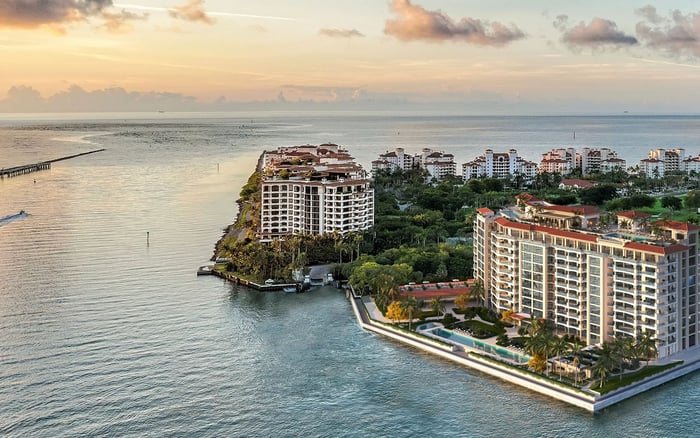
Some collectors do not want their residence to participate in the public energy of fair week at all. They want to enter the circuit when they choose, then retreat to a setting that feels materially separate. For this buyer, Fisher Island can represent the private-enclave mindset: controlled access, resort-style calm, and a sense of removal that is difficult to replicate in more urban neighborhoods.
A residence such as The Residences at Six Fisher Island belongs in conversations where privacy, island atmosphere, and a club-adjacent lifestyle are core requirements rather than add-ons. It is not the default choice for every collector. It is the choice for someone who values separation as part of the luxury proposition.
The question is whether that separation energizes or constrains the owner. Buyers who thrive on spontaneity may prefer a more immediately connected address. Buyers who view privacy as the primary amenity may find the enclave logic compelling.
Not every collector’s South Florida life revolves around Miami. Palm Beach and West Palm Beach can be attractive to buyers who think in terms of season, family, philanthropy, design, dining, and a quieter social rhythm. The relationship to major fairs may be more occasional, with Miami accessed for selected events rather than treated as the center of gravity.
In this context, The Ritz-Carlton Residences® West Palm Beach may appeal to buyers who want service, refinement, and a base that works beyond the collector calendar. The advantage is composure. The potential compromise is distance from Miami’s densest fair-week activity.
For many ultra-premium buyers, that is not a compromise at all. It is the point. A residence should not be optimized only for a handful of high-volume evenings. It should support the months between them.
Coconut Grove speaks to buyers who want greenery, privacy, schools or family continuity where relevant, and a more relaxed residential cadence. It can be a strong counterpoint to the sharper urbanity of Brickell and the more visible social posture of some beach addresses.
A project such as Four Seasons Residences Coconut Grove can suit buyers who want service and brand confidence within a neighborhood that feels rooted and less transient. For collectors who entertain selectively, the Grove can offer a refined home base that does not announce itself too loudly.
The evaluation should focus on route discipline. If a buyer will frequently move among the Grove, Miami Beach, Brickell, and private-club settings, the residence must justify its softer atmosphere by providing a meaningful daily reset.
Before choosing a base, buyers should simulate the week they actually expect to live. Arrive at the residence at the hour you would return from dinner. Consider where a driver waits, how guests enter, how art advisors or family members are received, and whether the staff experience feels intuitive. Walk the amenity areas at times that approximate real use. Notice whether the building feels calm or performative.
For collectors, storage and display planning also matter. Not every residence is equally suited to large-format works, sensitive materials, lighting control, or discreet movement of valuable objects. These details should be discussed early, especially when the home is expected to function as both residence and cultural salon.
Finally, consider the afterglow. The best base should remain desirable when the tents, previews, dinners, and satellite events subside. A purchase made for a week should still feel intelligent for the season.
Should I choose the closest residence to a collector fair? Not automatically. The stronger choice is the residence that minimizes friction across arrivals, hosting, privacy, and recovery time.
Is Brickell a good base for collectors? Brickell can work well for buyers who want an urban waterfront environment, dining access, and skyline energy during the season.
Why do some collectors prefer Miami Beach or Surfside? These areas can offer a coastal reset while remaining connected to Miami’s cultural and social calendar.
When does Fisher Island make sense? It suits buyers who place exceptional value on privacy, controlled access, and a distinct retreat from public fair-week intensity.
Can Palm Beach work for a Miami fair calendar? Yes, for buyers who attend selectively and prioritize a longer-season lifestyle over nightly proximity to Miami events.
How important is private-club adjacency? It is important when the club complements daily life, but less valuable if the route, access, or social fit creates friction.
Should collectors prioritize in-building amenities or nearby clubs? The strongest answer often blends both, with private residential amenities for daily ease and clubs for selective social use.
What should I evaluate during a private showing? Study arrival sequence, elevator privacy, guest flow, staff polish, garage access, amenity atmosphere, and evening quiet.
Do art collectors need special residence considerations? They should consider lighting, wall proportions, climate comfort, delivery logistics, and discretion around valuable objects.
What is the best South Florida base overall? The best base is personal: it should support the owner’s fair calendar, club life, privacy expectations, and year-round rhythm.
For a confidential assessment and a building-by-building shortlist, connect with MILLION.
If branded residences are on your mind — as a home or as an allocation — we would be glad to share what we are seeing, privately.
Begin a quiet conversation