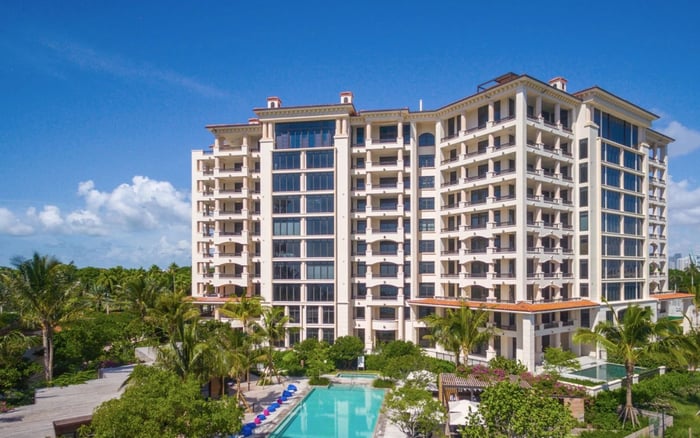
For Hamptons buyers considering Fisher Island, the strongest acquisition structure balances offer certainty with post-closing liquidity. Cash removes lender friction, while tailored portfolio financing can preserve invested capital and fund the ownership plan.

For a Hamptons owner purchasing on Fisher Island, the cash-versus-financing question is rarely one of basic affordability. It is a question of execution, liquidity, and the role the new residence will play within a broader balance sheet.
Cash offers the cleanest path to closing. It eliminates lender underwriting, appraisal risk, and financing-contingency delays-advantages that can matter when a seller prizes certainty or multiple buyers are competing. Yet committing substantial capital to a single residence can reduce liquidity precisely when taxes, furnishings, improvements, reserves, and other opportunities begin to demand attention.
Portfolio financing changes the equation. A private bank or portfolio lender may tailor underwriting for a high-net-worth buyer whose assets are substantial but whose income does not conform to conventional retail formulas. The objective is not simply to add leverage. It is to preserve flexibility without diminishing the offer’s credibility.
Cash is most compelling when speed, certainty, and minimal transaction friction outweigh every other consideration. It can streamline the offer, eliminate financing conditions, and serve as a negotiating tool-even for a buyer who could readily qualify for a loan.
That advantage may be particularly relevant when pursuing a distinctive resale opportunity or considering residences such as Palazzo del Sol and Palazzo della Luna. The projects themselves do not dictate the financing choice. Rather, the buyer should assess the seller’s priorities, the competitive landscape, and the value of removing third-party dependencies from the transaction.
Cash is not costless, however. Its hidden price is opportunity cost. Capital withdrawn from an investment portfolio is no longer available for other investments or near-term commitments. A buyer should therefore model not only the closing, but also the first several years of ownership.
Portfolio financing can retain cash for carrying costs, design work, renovations, reserves, taxes, and future acquisitions. It may also allow a buyer to avoid selling securities solely to fund the purchase, thereby preserving market exposure.
The trade-off is greater complexity. Financing introduces borrowing costs, documentation, underwriting, debt service, and potentially an appraisal. When securities are pledged, market declines can affect collateral values and create collateral-call risk. Securities-backed facilities, jumbo mortgages, portfolio loans, and home-equity structures are not interchangeable. Each depends on different collateral and presents distinct legal, tax, and risk considerations.
Customized private-bank underwriting can nevertheless make a financed offer faster and more credible than conventional assumptions might suggest. Preparation is essential. A lender relationship, organized financial documentation, a clear collateral plan, and realistic timing should be established before negotiations become urgent.
A second-home purchase should be evaluated as both a property decision and a liquidity event. A finished residence intended for immediate use may call for a different reserve profile than a home expected to undergo significant design work. Likewise, a buyer considering The Residences at Six Fisher Island may approach capital planning differently from someone evaluating The Links Estates at Fisher Island, depending on personal plans and transaction circumstances.
The essential question is how much liquidity must remain after closing. The answer should account for expected carrying costs, improvements, furnishings, insurance, taxes, debt service where applicable, and a reserve for future opportunities. With a waterfront acquisition, preserving optionality can be as important as securing the property itself.
Existing home equity may also provide liquidity for the down payment or closing costs. This approach is distinct from borrowing against securities and should be evaluated separately rather than grouped under the broad label of portfolio financing.
Some buyers use cash to strengthen the acquisition, then arrange mortgage or portfolio financing after closing to restore liquidity. This blended structure separates the offer strategy from the long-term capital strategy.
The approach can be elegant, but it should not be improvised. The buyer must understand whether subsequent financing will be available, how the property and borrower will be underwritten, which costs will apply, and how much liquidity will actually be restored. Closing in cash does not guarantee favorable refinancing terms afterward.
Conversely, a prepared borrower may determine that financing from the outset provides sufficient certainty. If a private bank can underwrite the buyer quickly and the contract remains credible to the seller, retaining capital may outweigh the incremental simplicity of cash.
The final choice should be tested against four priorities: transaction speed, competitive pressure, post-closing liquidity, and the intended use of capital. If certainty is paramount and liquidity remains ample, cash may be the disciplined answer. If the purchase would force asset sales or constrain reserves, tailored financing may be the more prudent course.
The strongest plan is property-specific and coordinated among the buyer’s legal, tax, wealth-management, and lending advisers. It should also include a downside case: higher carrying costs, delayed improvements, market volatility, or an unexpected need for capital. On Fisher Island, the strategic objective is clear: preserve flexibility after closing without compromising the certainty required to acquire the right residence.
Why do sellers often prefer cash? Cash eliminates lender underwriting, appraisal risk, and financing-contingency delays, improving certainty and closing speed.
Is cash always the strongest offer? Not necessarily. A well-prepared private-bank or portfolio-financed offer may still be fast and reliable.
What is the principal drawback of paying cash? The purchase can concentrate capital in a single property and leave less liquidity for ownership costs or other investments.
What can portfolio financing help preserve? It can preserve cash for taxes, furnishings, improvements, reserves, and continued investment exposure.
Is a securities-backed facility the same as a mortgage? No. They involve different collateral, underwriting, costs, and risks, including potential collateral calls with securities-based borrowing.
Can buyers with uneven income obtain tailored financing? Buyers with substantial assets but uneven income may find customized private-bank underwriting more suitable than conventional lending.
When does a blended strategy make sense? It may suit a buyer seeking cash-like acquisition strength who plans to restore liquidity through financing after closing.
Should renovation costs affect the decision? Yes. Significant design or improvement spending can make preserving post-closing cash especially important.
Can equity in another home fund the purchase? Existing home equity may provide purchase liquidity, but it is distinct from borrowing against an investment portfolio.
Who should review the final structure? Property-specific legal, tax, wealth-management, and lending professionals should assess the structure before commitments are made.
For a discreet conversation and a curated building-by-building shortlist, connect with MILLION.
If branded residences are on your mind — as a home or as an allocation — we would be glad to share what we are seeing, privately.
Begin a quiet conversation