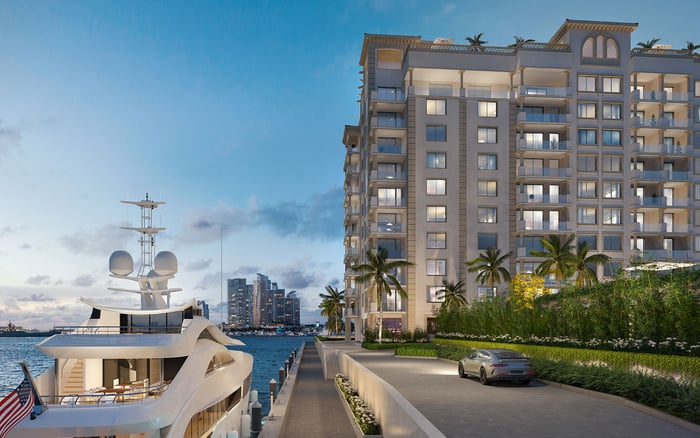
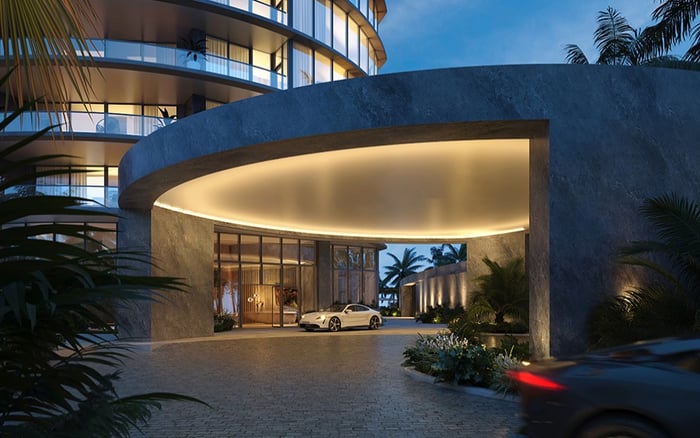
For private aviation users, a Surfside residence should be evaluated as one link in a longer arrival chain. Airport drive estimates matter, but service, privacy, garage access, staffing and real-world transfer tests often determine whether ownership feels genuinely seamless.
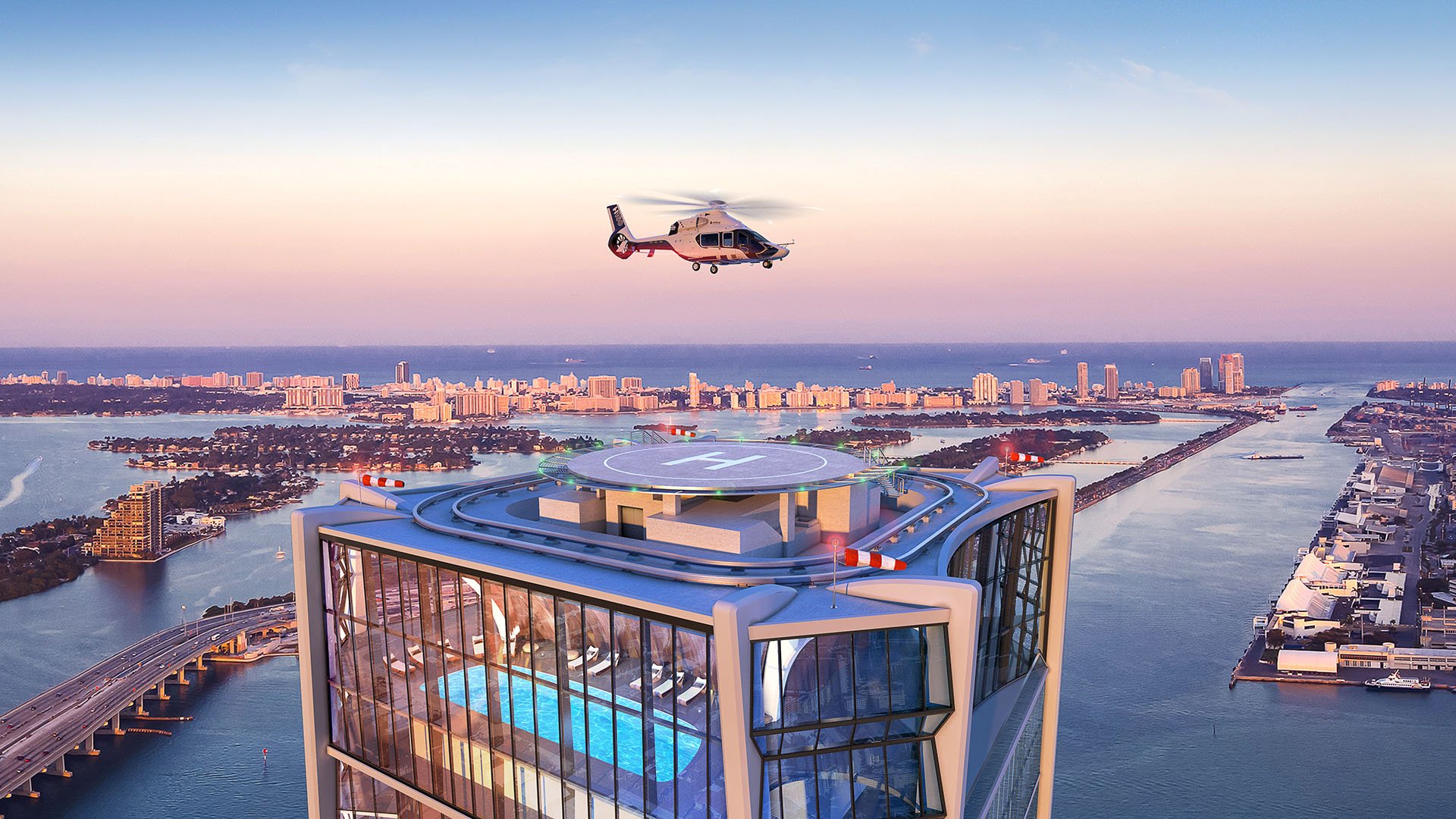
For a private aviation buyer, the relevant journey does not end at the airport perimeter. It extends from the aircraft door to the vehicle, through the ground transfer, into the building and, finally, to the residence. A short map distance can be undermined by traffic, an exposed arrival sequence, slow valet handling, or unclear procedures for luggage and household staff.
That distinction is essential in Surfside. Estimated ground-transfer times from The Surf Club Four Seasons are approximately 20 minutes to Miami International Airport and 15 minutes to Fort Lauderdale-Hollywood International Airport, subject to traffic. These figures are useful orientation points, not guaranteed transfer windows, and should be tested during the owner’s usual departure and arrival hours.
Dedicated on-site aircraft landing infrastructure would present a materially different proposition by removing the ground-transfer leg. Buyers should not interpret general references to aviation access as evidence that a residence has a helipad or other dedicated landing facility. The correct question is not simply, “How close is the airport?” but, “How controlled is every step between the aircraft and my front door?”
The two-tower The Surf Club Four Seasons Surfside occupies 9001 and 9111 Collins Avenue and forms part of the Four Seasons Private Residences portfolio. Its branded service model is particularly relevant to owners who want their residence supported before arrival and after departure. Active listings ranged from $5.7 million to $31.9 million as of May 26, 2026, offering a broad snapshot rather than a guarantee of current availability.
Seaway at The Surf Club presents a different proposition. The ultra-luxury boutique oceanfront condominium is identified at 9149 Collins Avenue, while another project description uses 9149 and 9165 Collins Avenue. It is listed as sold out, meaning buyers may need to pursue resale or privately offered inventory. Its disclosed project range of $3.75 million to $37 million provides historical context, not an assurance of current pricing.
At 8778 Collins Avenue, The Delmore Surfside is described as spanning two acres with 200 feet of beachfront. Those dimensions merit attention from buyers who associate discretion with a substantial site and a sense of separation. They do not, by themselves, establish aviation-specific services, so transfer and staffing procedures still require direct confirmation.
Surf Row Residences at 8800 Collins Avenue comprises eight private beach homes planned with three to five bedrooms and approximately 3,500 to 5,600 square feet of interior space. Each is described as having more than 2,000 square feet of private outdoor living space. Private garages and enclosed front yards may be especially compelling for discreet car-to-door movement, reducing the number of shared spaces encountered upon arrival.
Aviation-oriented ownership often comes down to three priorities. The first is service continuity: can the residence be prepared, stocked, and monitored while the owner is airborne? The second is discretion: can the driver reach a controlled arrival point with minimal public exposure? The third is resilience: can management accommodate delayed flights, late arrivals, and extended absences without improvisation?
Branded residences may appeal when hospitality-style coordination is central, while a lower-density building or private-home format may better suit owners who value fewer shared touchpoints. Neither model is automatically superior. The right choice depends on whether the household prefers an active service layer or a quieter physical sequence.
Broader Surfside comparisons can sharpen that preference. A buyer touring Arte Surfside can use it as another local reference point for residential scale and arrival experience, while Ocean House Surfside can form part of the same practical review. The objective is not to infer aviation capabilities from positioning, but to inspect how each property actually receives an owner, vehicle, guests, and luggage.
Begin with a timed drive in both directions during realistic travel periods. Record building exit time separately from road time. A theoretically efficient transfer loses value if retrieving the car, loading baggage, or clearing the porte cochère introduces uncertainty.
Then ask management to explain, in specific terms, whether it coordinates secure drivers, charter-related requests, luggage handling, residence preparation, and late-night arrivals. Confirm how preauthorized household employees enter, where they park, and whether vendors can prepare the home without the owner’s presence. For a second-home buyer, extended-absence management can be as important as the ceremony of arrival.
Inspect the physical sequence personally. Note garage privacy, elevator access, visibility from the street, the distance from vehicle to residence, and any handoff between valet and private driver. Buyers considering Surf Row should examine the practical benefit of its private garages and enclosed yards. Buyers considering The Surf Club should distinguish the value of branded service from the separate question of actual transfer performance.
Surfside belongs in the practical side of Buyer's Guides because lifestyle and logistics are inseparable at this level. Oceanfront beauty may establish desire, but repeatable movement establishes usability. A residence that accommodates the household’s most demanding itinerary will usually feel more luxurious than one selected on estimated drive time alone.
Before choosing, rank the household’s nonnegotiables: the fastest tested transfer, the least visible arrival, the strongest management layer, private garage access, or the simplest lock-and-leave routine. Evaluate each residence against the same itinerary rather than allowing architecture or amenities to alter the standard.
Finally, request written clarification of the procedures that shape aviation-linked ownership. Concierge capabilities, driver access, staff credentials, and absence care can change over time. The strongest purchase decision combines a residence the buyer wants emotionally with an arrival system tested operationally.
Does Surfside provide convenient access to both major airports? Estimated ground-transfer times from The Surf Club are about 20 minutes to MIA and 15 minutes to FLL, subject to traffic.
Are those airport times guaranteed? No. Buyers should test each route in both directions during their typical travel windows.
Does aviation access mean a Surfside building has a helipad? No. Airport proximity and dedicated on-site landing infrastructure are materially different concepts.
Which residence has explicit estimates to both MIA and FLL? The Surf Club Four Seasons is the only residence presented here with estimates to both airports.
Why can a private garage matter to aviation users? It may enable a more discreet car-to-door sequence and reduce reliance on shared arrival spaces.
What makes Surf Row relevant to privacy-focused buyers? Its eight-home format, private garages, and enclosed front yards may support a house-like arrival.
Is Seaway at The Surf Club available from the developer? It is listed as sold out, so buyers may need to explore resale or privately offered inventory.
What should buyers verify with building management? Confirm driver procedures, luggage handling, staff access, residence preparation, and extended-absence care.
Is branded management automatically best for frequent flyers? Not necessarily. It may suit buyers who prioritize service, while others may prefer fewer shared touchpoints.
What is the most useful pre-purchase test? Rehearse the complete trip from residence to airport during the hours the household actually travels.
For a confidential assessment and a building-by-building shortlist, connect with MILLION.
If branded residences are on your mind — as a home or as an allocation — we would be glad to share what we are seeing, privately.
Begin a quiet conversation