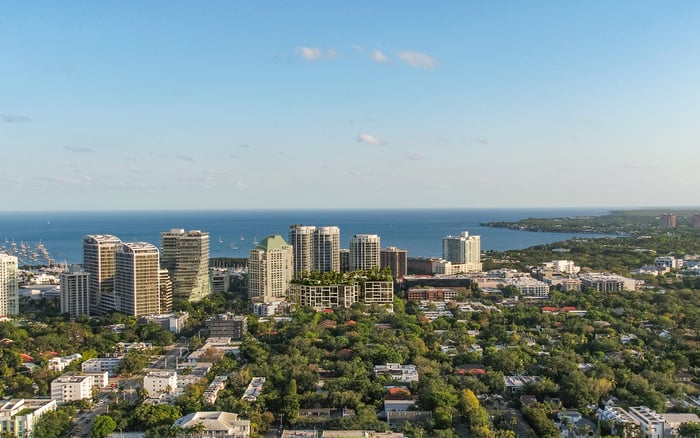
For London buyers moving into Coconut Grove, serious wine storage is not a decorative afterthought. It is a climate, power, envelope, flood, and ownership-structure question that should be evaluated before contingencies expire.

For the London buyer, Coconut Grove can feel immediately intuitive: leafy streets, village rhythm, bay access, dining, boating, and a softer residential tempo than Miami’s denser urban core. Yet the infrastructure logic of a South Florida home is fundamentally different. A wine collection that lived comfortably in a cool London house, a lower-level room, or a semi-passive storage environment should be reassessed from first principles before it is entrusted to a Coconut Grove address.
Fine wine storage is less about a decorative room and more about stable conditions. Repeated heat spikes and swings can age wine prematurely, and Miami’s heat and humidity make that risk more than theoretical. In Coconut Grove, a wine room should be treated as a mechanical system, not as millwork, glass, or a backdrop for entertaining. The buyer’s question is not simply, “Is there a cellar?” It is, “What keeps it stable when the sun is intense, the power flickers, the air is saturated, and a storm interrupts normal service?”
That distinction matters whether the search begins with a detached home, a boutique condominium, or new construction. A buyer comparing Arbor Coconut Grove with more private Estates & Single-Family options is not only comparing architecture and floor plans. The more exact comparison is between building systems, alteration rights, service pathways, and the ability to keep a collection protected when the home is under stress.
In South Florida, standard residential air-conditioning should not be presumed adequate for serious wine storage. Comfort HVAC is designed around human occupancy, not the cooler, steadier conditions that wine typically requires. A dedicated wine-cellar cooling unit should be evaluated for the room’s volume, insulation, door openings, glass area, heat loads, and access frequency.
Humidity deserves equal attention. In a humid coastal climate, vapor barriers, insulation, condensate control, drainage, and service access are not engineering footnotes. They are central to value preservation. A showpiece glass wine room beside a dining area may be visually seductive, but glass can introduce additional heat load and solar-gain concerns, especially in a modern residence with large exposures.
The most valuable inspection question is simple: is the cellar connected to ordinary home HVAC, or does it have a dedicated wine-cellar system? If the answer is unclear, assume further investigation is required. For an existing cellar, ask for monitoring history showing temperature and humidity behavior over time. A beautifully lit room that has never been monitored is a display case, not yet a proven storage environment.
Storm-season planning should shape a buyer’s expectations for power continuity in South Florida. Backup power planning often focuses on the kitchen, primary suite, elevators, security, and comfort cooling. A serious collector should place cellar cooling, controls, alarms, and dehumidification in the same conversation.
The issue is not only whether a home has a generator. It is what the generator actually supports, how loads are prioritized, where equipment is placed, and whether the wine system is on the protected circuit. Battery backup may assist with controls or monitoring in some configurations, but a buyer should not assume it can carry mechanical cooling without specialist review.
Detached homes may offer more flexibility for generators, condensers, mechanical yards, and future upgrades, but they also require early review of local rules and approvals. In Coconut Grove, mechanical placement, additions, and cellar retrofits should be studied before enthusiasm outruns feasibility. A buyer considering The Lincoln Coconut Grove or a custom private residence should ask the same practical question: where do the systems live, and how will they be serviced after a storm?
Coconut Grove’s appeal is inseparable from its relationship to Biscayne Bay, lush streets, and indoor-outdoor living. Waterfront proximity and tropical landscaping are part of the Lifestyle, but they also require disciplined due diligence. Address-specific flood exposure should be checked before relying on below-grade or low-lying wine storage. In South Florida, the basement-style cellar familiar to some London owners can be complicated by groundwater, waterproofing, humidity, stormwater behavior, and post-storm access.
Building envelope matters as well. Buyers should review impact-resistant windows, doors, and relevant local approvals in hurricane-prone homes. A residence with extensive glazing may call for more careful solar-gain management around a showpiece wine room than a shaded masonry home. Window treatments, room orientation, insulated partitions, and door specifications can influence the cooling load and stability of the cellar.
In condominium settings, the envelope may be largely controlled by the building, while private alterations may be governed by association rules. A buyer comparing Four Seasons Residences Coconut Grove with The Well Coconut Grove should review not only finish packages and views, but also alteration approvals, dedicated condenser possibilities, emergency power coverage, and whether a private wine room can be added or modified without creating compliance issues.
For a high-value collection, the due-diligence team should be assembled early. That team should include HVAC, electrical, generator, waterproofing, and wine-cellar specialists before contract contingencies expire. A general inspection is rarely enough. The cellar, if present, should be tested as a system; if absent, the proposed location should be evaluated for feasibility.
Ask for documentation: equipment details, maintenance records, temperature and humidity logs, electrical panel schedules, generator load schedules, condensate routing, waterproofing details, and any approvals tied to prior alterations. If the home is new construction, request clarity on what is included, what is optional, and what future changes would require association or municipal approval.
For a detached Coconut Grove home, prioritize mechanical access, generator placement, service pathways, and envelope quality. For a condo, prioritize building resilience, rules, emergency power, and the ability to perform specialized work without disturbing shared systems. For a Waterfront residence, add flood exposure and post-storm access to the short list of non-negotiables.
The most elegant answer may not be the largest wine room. It may be the most stable, most serviceable, and most intelligently backed-up room in the home. For a London buyer, that is the quiet luxury of South Florida ownership: beauty supported by infrastructure that understands the climate.
Can I use standard air-conditioning for a Coconut Grove wine room? Not for a serious collection. A dedicated wine-cellar system is typically the safer approach because comfort HVAC is not designed for wine storage conditions.
Is there one exact target condition for wine storage? Stability matters as much as any single target. Avoiding repeated heat spikes and fluctuations is central to protecting the collection.
Why is humidity such a concern in South Florida? Humidity affects corks, labels, condensation, and building assemblies. Vapor barriers, insulation, drainage, and dehumidification should be reviewed together.
Should a wine cellar be on generator power? For a high-value collection, the cooling system, controls, alarms, and related dehumidification should be part of backup power planning.
Are basement-style cellars practical in Coconut Grove? They can be complex. Flood exposure, groundwater, waterproofing, and humidity control should be studied before relying on below-grade storage.
What should condo buyers check before adding a wine room? Review association rules, alteration approvals, condenser options, electrical capacity, and whether emergency power can support the intended system.
Does glass around a wine room create problems? It can increase heat load and solar-gain concerns. The design should be reviewed for insulation, exposure, door seals, and cooling capacity.
When should specialists be brought into the purchase process? Before contingencies expire. HVAC, electrical, generator, waterproofing, and wine-cellar specialists can identify risks that a standard inspection may miss.
What documents should I request for an existing cellar? Ask for equipment details, maintenance records, temperature and humidity logs, electrical information, condensate routing, and any alteration approvals.
Why is Coconut Grove attractive to wine-focused buyers? Coconut Grove pairs lush residential character, bay access, dining, and entertaining culture with the opportunity to create highly tailored home infrastructure.
For a tailored shortlist and next-step guidance, connect with MILLION.
If branded residences are on your mind — as a home or as an allocation — we would be glad to share what we are seeing, privately.
Begin a quiet conversation