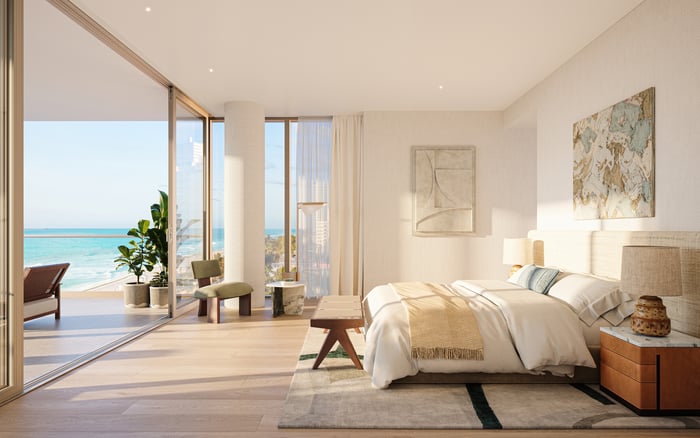
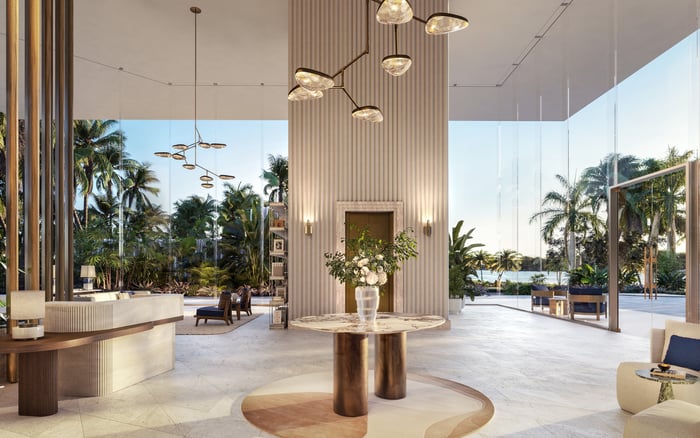
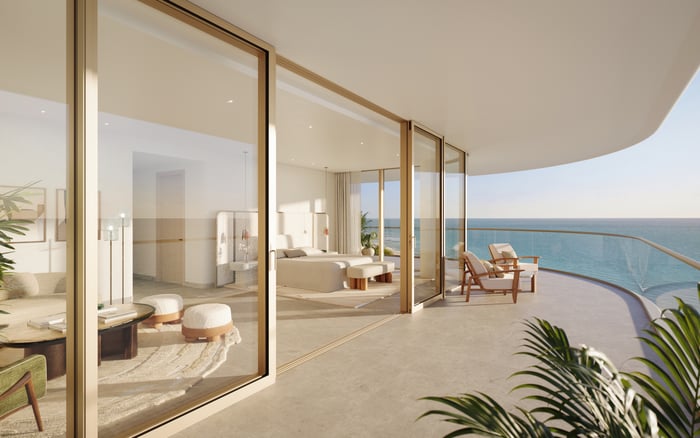
A buyer-oriented look at The Perigon Miami Beach, its scarce Mid-Beach oceanfront positioning, resale durability thesis, and the depth of domestic, international, and local upgrade demand.
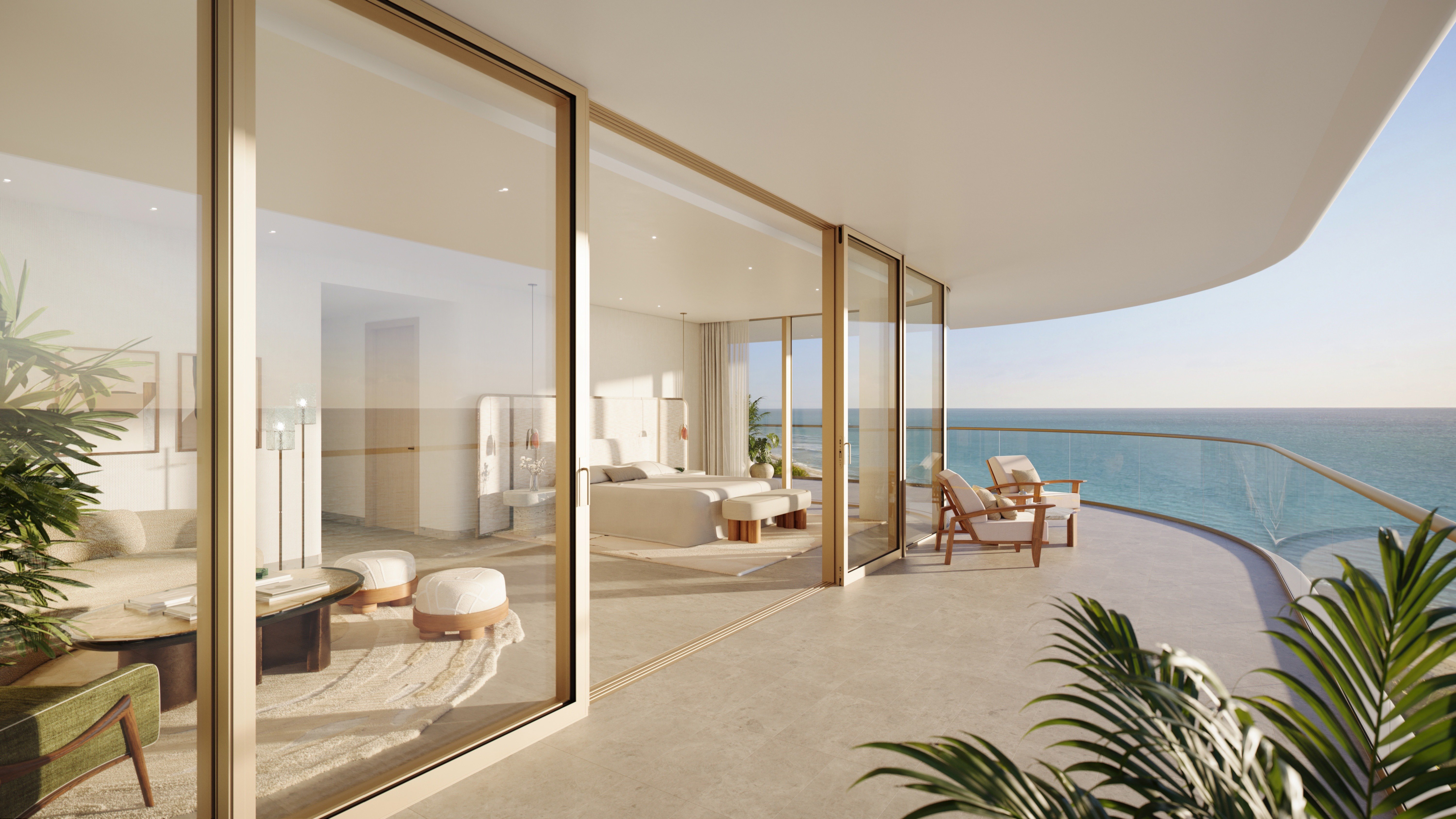
The strongest long-term argument for The Perigon Miami Beach is not simply that it belongs to the newest wave of luxury condominium development. Newness is perishable. The more durable case is that it occupies a scarce true-oceanfront setting along the Mid-Beach Collins Avenue corridor, where large, prime development opportunities are difficult to replicate.
That distinction matters for sophisticated buyers. In Miami Beach, resale strength is rarely about looking compelling at launch. It is about whether a building can remain legible as a superior asset after the initial marketing cycle has passed. The Perigon is positioned as a design-forward oceanfront condominium rather than a conventional high-density resort tower, giving it a clearer lane in a market where many beachfront buildings compete on views, amenities, and address prestige.
For readers organizing a search around Miami Beach, oceanfront, resale, new-construction, and investment priorities, the question is not whether The Perigon Miami Beach is luxurious. The more important question is whether its architecture, density, service culture, and location can help it avoid becoming interchangeable with older Collins Avenue inventory.
Mid-Beach offers a particular kind of balance. It is close enough to South Beach to benefit from Miami Beach’s cultural and hospitality energy, yet removed enough to feel more residential than the most heavily trafficked southern corridors. To the north, quieter beachfront enclaves offer privacy, but sometimes with a more insulated daily rhythm. The Perigon’s position between these poles creates a more nuanced buyer proposition.
This location can be especially meaningful for buyers who want an oceanfront residence that functions both as a retreat and as a practical South Florida base. They may not want the full resort atmosphere of a larger tower, but they also may not want to feel disconnected from restaurants, private clubs, design districts, and the social fabric of Miami Beach. In that sense, Mid-Beach supports The Perigon’s intended identity as a global trophy that remains livable.
The broader Miami Beach luxury conversation includes architecturally significant oceanfront residences such as 57 Ocean Miami Beach and Faena House Miami Beach. The Perigon enters that dialogue through low-density, design-led living rather than commodity beachfront scale.
A conventional resale analysis often begins with price per square foot. For The Perigon, that lens may be too narrow. Its positioning is less about commodity comparison and more about relative quality, scarcity, architectural distinction, and trophy-asset appeal.
That does not make price discipline irrelevant. High-net-worth buyers still scrutinize value, especially as carrying costs, insurance, climate considerations, and building quality become more prominent in purchase decisions. But in the upper tier of Miami Beach oceanfront product, the most durable buildings often create a reason to be chosen that cannot be reduced to a spreadsheet.
The Perigon’s challenge, and its opportunity, is to make that difference visible over time. If buyers perceive it as another luxury tower on Collins Avenue, future resale performance could be pulled into broader beachfront comparables. If the building is understood as part of Miami Beach’s newer category of art architecture and low-density luxury, it may command a more selective buyer set.
That is why experiential differentiation matters. Layouts, arrival sequence, amenity design, service rhythm, privacy, and the feeling of daily life can all influence whether a residence behaves like a generic unit or a specific asset. The most resilient resale stories are usually attached to buildings that buyers can describe in one sentence.
The Perigon’s buyer pool is expected to draw from several overlapping audiences. The first is the high-net-worth and ultra-high-net-worth buyer seeking a South Florida oceanfront residence with design credibility and long-term scarcity. For this audience, Miami Beach is not merely a vacation market. It is a lifestyle and capital-preservation market, especially when the residence can serve family, business, and social uses.
A second audience is the domestic buyer relocating or consolidating from higher-cost U.S. states. Tax motivation may be part of that decision, but it is rarely the only driver at this level. Buyers are also weighing climate, lifestyle access, private aviation convenience, schools or family proximity, and the ability to establish a more permanent South Florida presence.
A third audience is international. Miami remains a globally recognized coastal market, and for some international buyers, a prime oceanfront condominium can function as a hard-asset hedge. The appeal is not simply the apartment itself, but the clarity of ownership in a branded global destination, with liquidity potential tied to a broad future buyer pool.
The fourth audience may be local upgrade buyers. These are owners who already understand Miami Beach oceanfront living but want to move out of older buildings with dated layouts, aging amenity packages, or less compelling service experiences. This segment can be particularly important because it is informed, comparison-driven, and often willing to pay for a building that solves practical daily frustrations.
The Perigon is not alone in benefiting from the market’s shift toward more curated beachfront living. Buyers evaluating it may also consider established or emerging residences such as Shore Club Private Collections Miami Beach and The Ritz-Carlton Residences® Miami Beach, depending on their preferred balance of service, architecture, privacy, and neighborhood tone.
What separates The Perigon’s thesis is the combination of Mid-Beach oceanfront scarcity and a design-led, low-density profile. That profile can be powerful if it produces a sense of ownership intimacy. In an ultra-premium market, fewer residences and a more controlled lifestyle environment can support the emotional logic of buying. It can also help protect against the anonymity that sometimes weakens larger high-density towers.
Still, buyers should remain clear-eyed. Resale durability will depend on execution, building quality, operating discipline, and how future purchasers perceive the total cost of ownership. A beautifully positioned asset can lose momentum if its carrying costs feel misaligned with service, maintenance, or long-term confidence. The inverse is also true: a building that earns trust operationally can deepen its buyer pool with each resale cycle.
For long-term owners, the most important indicators will be qualitative as much as quantitative. Does the building become known as a top-tier residential address rather than just a new project? Do local upgrade buyers keep it on their short list? Do international buyers understand it quickly? Does the service program feel polished but not theatrical? Does the architecture age with restraint?
These are the details that can shape exit value. In Miami Beach, the best resale positions often emerge from a mix of scarcity and memory. Buyers remember the building that feels different, calmer, more private, better composed, or more difficult to replace. The Perigon’s long-term value proposition rests on becoming that kind of reference point.
The cautious conclusion is that The Perigon should be understood as a positioning thesis, not a guaranteed resale forecast. Its advantages are clear: scarce oceanfront land, Mid-Beach balance, architectural ambition, low-density luxury, and potential appeal across domestic, international, and local buyer groups. Its test will be whether those advantages remain evident after the market has moved beyond the novelty of launch.
What is the core resale thesis for The Perigon Miami Beach? Its thesis centers on scarce true-oceanfront supply in Mid-Beach, combined with design distinction and low-density luxury positioning.
Is The Perigon Miami Beach more of a lifestyle purchase or an investment purchase? It is best viewed as both lifestyle-driven and asset-conscious, with investment logic tied to scarcity, quality, and future buyer depth.
Why does Mid-Beach matter for long-term value? Mid-Beach sits between South Beach energy and quieter northern beachfront enclaves, giving buyers a balanced residential setting.
Who is the likely buyer for The Perigon Miami Beach? Likely buyers include high-net-worth domestic purchasers, international buyers, and local owners upgrading from older beachfront buildings.
Does The Perigon compete mainly on price per square foot? Its positioning is less about commodity pricing and more about quality, scarcity, architecture, and trophy-asset appeal.
How does older beachfront inventory affect The Perigon’s positioning? Older buildings can make The Perigon’s newer layouts, design approach, and lifestyle program more meaningful to upgrade buyers.
What could challenge future resale performance? Operating costs, insurance, climate considerations, building quality, and buyer scrutiny could all shape future resale demand.
Is The Perigon Miami Beach considered low density? It is positioned within Miami Beach’s newer low-density luxury category, with design and privacy central to its appeal.
Why might international buyers consider The Perigon? International buyers may see it as a hard-asset hedge in a globally recognized coastal market with strong lifestyle appeal.
What should buyers watch after completion? Buyers should watch service consistency, operating discipline, resale reception, and whether the building remains differentiated over time.
When you're ready to tour or underwrite the options, connect with MILLION.
If branded residences are on your mind — as a home or as an allocation — we would be glad to share what we are seeing, privately.
Begin a quiet conversation