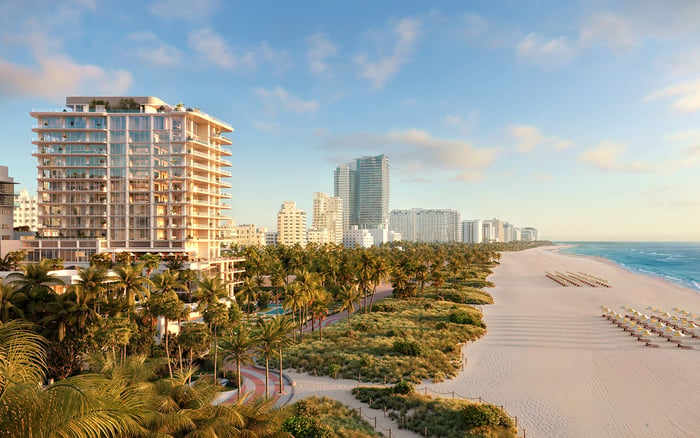
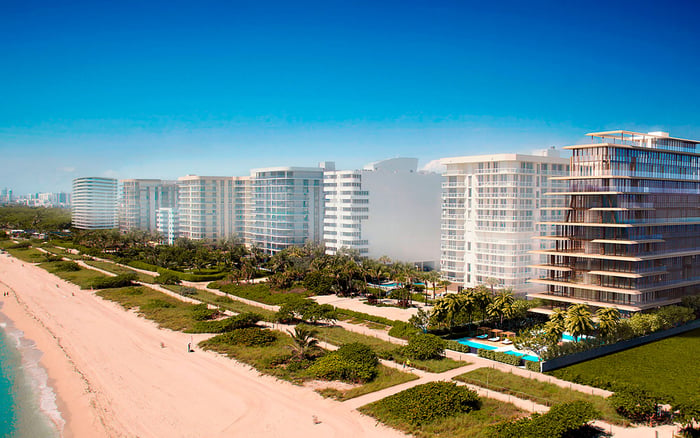
A discreet buyer’s guide to evaluating Eighty Seven Park Surfside, from oceanfront exposure and design pedigree to condominium documents, insurance, maintenance, and resale strategy.

Eighty Seven Park Surfside occupies a distinct place in the South Florida luxury conversation: a recently delivered, ultra-luxury oceanfront condominium at 8701 Collins Avenue, positioned at the transition between Surfside and Miami Beach’s North Beach neighborhood. For buyers, that setting is not backdrop. It is the asset.
The tower’s appeal begins with direct Atlantic Ocean frontage, a rare beachfront condition that shapes light, sound, privacy, maintenance, insurance, and future resale. With the Atlantic to the east and public green space or park adjacency to the west, the property has a dual character uncommon along this stretch of coastline. Buyers evaluating Eighty Seven Park Surfside should treat location as a core diligence category, not a lifestyle footnote.
This is a Buyer's Guides article, but it is also a Design & Architecture conversation. The project is associated with Renzo Piano’s minimalist design language, which may appeal to high-net-worth buyers seeking design pedigree, quiet luxury, and a beachfront address that feels restrained rather than theatrical.
At this level, the building’s reputation can open the door, but the individual residence determines the purchase thesis. Before reserving, buyers should review the specific exposure, elevation, view corridor, terrace configuration, and relationship to beach and park activity.
A higher floor may live differently from a lower one. An east-facing outlook may feel entirely different from a residence with more layered views toward the park. Terrace depth, orientation, privacy, and wind exposure should be experienced in person whenever possible. Morning light, afternoon glare, and the rhythm of nearby public spaces can change how a home functions day to day.
This same discipline applies when comparing neighboring Surfside properties such as The Delmore Surfside and The Surf Club Four Seasons Surfside. The name on the entrance matters, but value is ultimately residence-specific.
Oceanfront ownership is one of South Florida’s most prized luxuries, but it is not passive. Salt-air exposure, hurricane resilience, insurance costs, and long-term maintenance obligations should be reviewed before moving from interest to commitment.
The question is not whether an oceanfront building is desirable. It clearly is. The question is whether the buyer has examined the full ownership profile with the same seriousness applied to the view. Coastal exposure can affect finishes, mechanical systems, exterior elements, association planning, and the long-term cost structure of the condominium.
For buyers focused on Oceanfront and Beach-access living, this is the central trade: irreplaceable proximity to the Atlantic in exchange for a more rigorous diligence process. A careful review should include how the association plans for future maintenance, how insurance coverage is structured, and whether reserve planning appears aligned with the property’s coastal setting.
Before moving from reservation to contract, buyers should request the condominium documents, budgets, reserve information, insurance coverage details, and current association financials. These are not formalities. They are the financial architecture of ownership.
A polished residence can distract from the quieter questions that determine long-term confidence. What are the recurring association costs? What obligations are already known? How are reserves positioned? What insurance coverage is in place? What maintenance expectations come with a recently delivered luxury oceanfront tower?
Buyers should also go beyond generic market commentary and perform property-specific diligence across structural, legal, regulatory, financial, insurance, and resale factors. For many ultra-premium buyers, the right advisory team will include counsel, an insurance professional, a qualified inspector or engineer where appropriate, and a real estate advisor who understands Surfside, Miami Beach, and the broader luxury condominium market.
The building’s location at the edge of Surfside and North Beach gives it a distinct identity. Surfside carries a quieter residential profile, while Miami Beach adds depth through culture, dining, hotels, and the broader coastal lifestyle. The combination can be compelling for buyers who want beachfront calm without feeling detached from Miami’s energy.
Still, corridor perception matters. Resale demand may depend on luxury-market cycles, association costs, insurance trends, and buyer perception of the Surfside and North Beach setting. A buyer reserving today should already be asking how a future buyer will understand the same residence.
Comparable thinking can extend south along Miami Beach, where oceanfront and near-ocean luxury buyers may also examine 57 Ocean Miami Beach or The Perigon Miami Beach. The point is not to flatten distinct properties into one category, but to understand how design, address, beach access, and operating costs interact across the market.
Renzo Piano’s association with Eighty Seven Park adds an important layer to the buyer equation. Minimalist design is often most powerful when it is quiet, with architecture serving light, landscape, and proportion rather than spectacle. For some buyers, that restraint is the luxury.
This design identity may support long-term appeal among collectors of architecture, second-home buyers, and end users seeking a refined oceanfront retreat. But design pedigree should still be paired with practical review. A beautiful tower can be the right purchase only when the residence, documents, costs, and exit strategy all align.
In other words, Eighty Seven Park Surfside should be evaluated as both an architectural object and a condominium investment. That dual lens is especially important in South Florida, where waterfront lifestyle, insurance, maintenance, and buyer sentiment all influence value.
Before reserving, start with a private walk-through focused on light, sound, privacy, and views. Visit the residence at different times if possible. Study the terrace as an outdoor room, not a marketing feature. Consider how beach activity and park adjacency may feel from the actual elevation being considered.
Next, move into documents. Review budgets, reserves, insurance, rules, association financials, and any ownership restrictions that may affect use or resale. Ask direct questions about maintenance planning in a coastal environment. If the residence is intended as a second home, confirm how that lifestyle fits with building policies and personal service expectations.
Finally, define the exit thesis. Who is the likely future buyer? Will they prioritize design pedigree, direct ocean frontage, Surfside calm, Miami Beach proximity, or all of the above? The strongest purchase decisions are made when emotional conviction is supported by disciplined underwriting.
Where is Eighty Seven Park Surfside located? Eighty Seven Park Surfside stands at 8701 Collins Avenue, at the transition between Surfside and Miami Beach’s North Beach neighborhood.
What is the main lifestyle appeal of the building? The primary draw is direct Atlantic Ocean frontage, with public green space or park adjacency to the west.
Why should buyers review the exact residence before reserving? Exposure, elevation, view corridor, terrace configuration, and proximity to beach or park activity can materially affect daily living and value.
Is Eighty Seven Park considered older Surfside condominium stock? It is framed as a recently delivered luxury tower rather than an older Surfside condominium asset.
What design identity is associated with the project? The tower is associated with Renzo Piano’s minimalist design language, which may appeal to buyers seeking architectural pedigree.
What coastal risks should buyers evaluate? Buyers should consider salt-air exposure, hurricane resilience, insurance costs, and long-term maintenance obligations.
Which documents should be requested before contract? Buyers should request condominium documents, budgets, reserve information, insurance coverage details, and current association financials.
Why does exit strategy matter before buying? Resale demand can be influenced by luxury-market cycles, association costs, insurance trends, and perception of the Surfside and North Beach corridor.
Is the building best suited to end users or investors? It may appeal to high-net-worth buyers seeking design pedigree, ocean views, and a rare beachfront setting, but each buyer should underwrite personal use and resale.
What is the best way to shortlist comparable options for touring? Start with location fit, delivery status, and daily lifestyle priorities, then compare stacks and elevations to validate views and privacy.
If you'd like a private walkthrough and a curated shortlist, connect with MILLION.
If branded residences are on your mind — as a home or as an allocation — we would be glad to share what we are seeing, privately.
Begin a quiet conversation