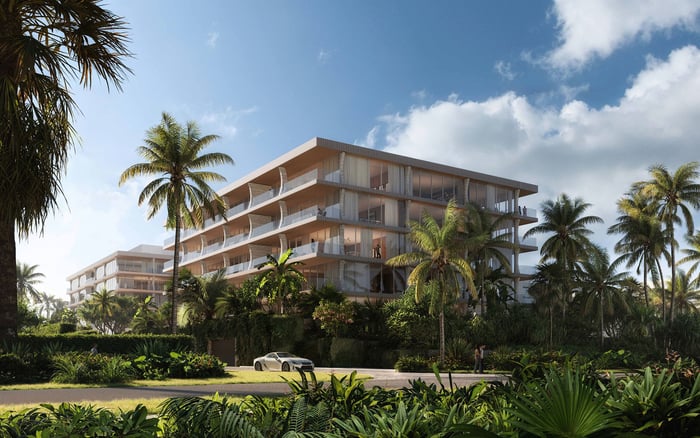
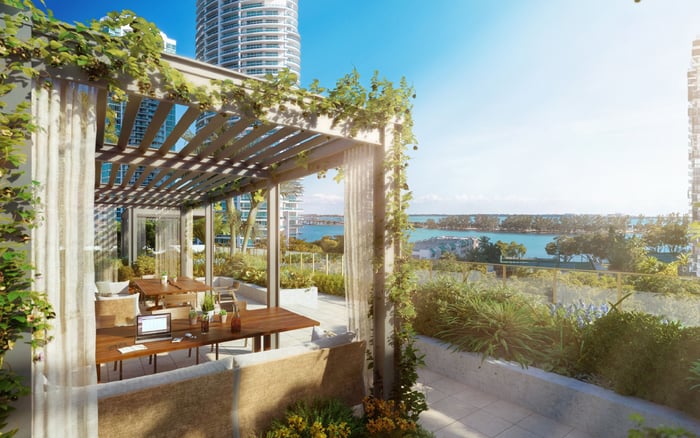
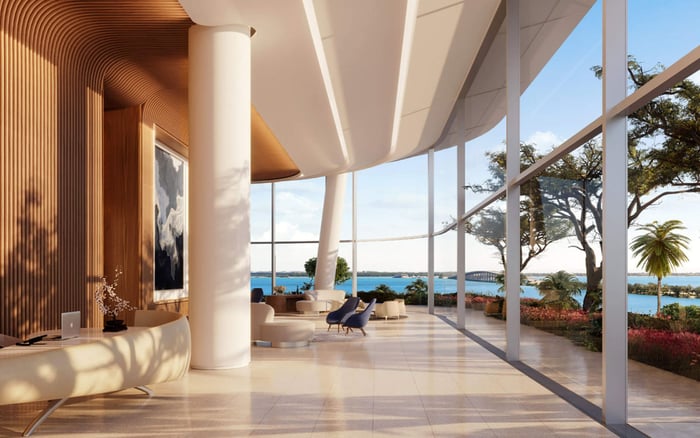
A refined buyer’s guide to evaluating porte-cochère privacy across South Florida, with emphasis on sightlines, arrival choreography, staffing, architecture, and daily discretion.
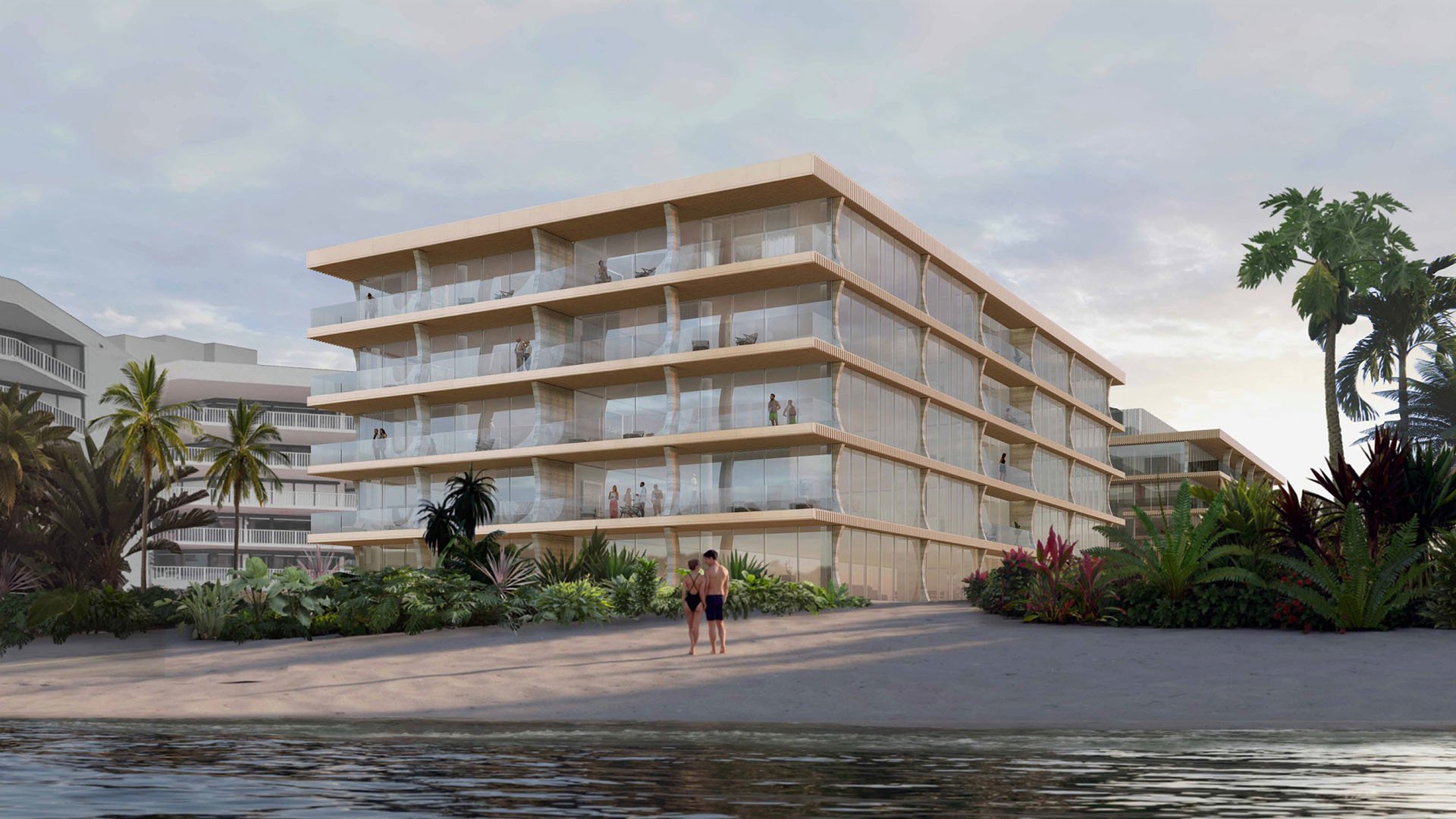
For many luxury buyers, a porte-cochère is first understood as an architectural courtesy: a covered place to arrive, unload luggage, greet staff, or move from car to lobby without weather exposure. In South Florida’s most discerning residential conversations, however, it is better understood as a privacy instrument. The question is not simply whether the arrival is beautiful. It is whether the arrival protects the resident’s rhythm.
A well-considered porte-cochère can soften the transition between public life and private space. It can help a resident step out of a car without feeling staged, photographed, interrupted, or observed from too many angles. It can give guests a composed arrival while providing drivers, security, valet personnel, and building staff with clear choreography. It can also expose weaknesses. If the approach is too visible, too congested, too theatrical, or too closely tied to public pedestrian movement, the experience may feel exposed even when the architecture appears grand.
In Miami, Fort Lauderdale, and Palm Beach, privacy is not a single condition. It is a sequence. It begins at the curb, continues through the turning radius, pauses at the covered drop-off, and concludes only when the resident has crossed into a controlled interior zone. Buyers who evaluate that entire sequence tend to understand the difference between a dramatic entrance and a discreet one.
The most important privacy question is also the simplest: who can see the arrival? A porte-cochère may be shaded, sculptural, and impeccably finished, yet still be compromised if it is exposed to lobby seating, passing pedestrians, neighboring terraces, street-facing restaurant activity, or service movements.
Sophisticated buyers should walk the approach slowly and look outward from the car’s likely stopping point. The view from inside the vehicle is often more revealing than the view from a brochure image. If a resident can see directly into social areas, those areas may also see back. If the drop-off aligns with a busy sidewalk, every arrival becomes part of the street scene. If cameras, concierge desks, valet stands, or waiting zones are positioned without discretion, the design may prioritize operational control over personal ease.
A private arrival does not need to feel hidden. In fact, the best examples often feel open, calm, and legible. What matters is controlled visibility. The resident should sense that the building understands the difference between recognition and exposure.
Miami’s luxury residential experience is frequently defined by motion: cars, guests, staff, deliveries, events, dining, fitness, wellness appointments, and social circulation all converging within a compact urban pattern. In that context, porte-cochère privacy depends heavily on choreography.
For a buyer comparing a Brickell tower with a Miami Beach residence, the essential question is how the arrival sequence absorbs activity. Does the drop-off feel like an elegant threshold, or does it behave like a traffic valve? Is there enough room for a second car without forcing a resident to wait in public view? Can staff manage luggage and guests without crossing paths with unrelated arrivals? Does the route from car to elevator feel intuitive and protected?
Urban glamour can be extremely appealing, but privacy in that setting should be designed, staffed, and maintained. A dramatic driveway succeeds only if it preserves composure during ordinary use. The measure is not the perfect quiet moment. The measure is how the entrance performs when the day is active.
In Fort Lauderdale, buyers often think about privacy through the lens of movement between home, car, water, and social life. Even when the porte-cochère itself is inland or street-facing, the broader residential pattern may include boating plans, guest arrivals, family schedules, and service coordination. The arrival zone should make those layers feel effortless rather than exposed.
The key is separation without stiffness. A refined residence allows residents, guests, vendors, and staff to move with clarity. If every function relies on the same covered area, the porte-cochère can become a stage for domestic logistics. If circulation is divided too aggressively, the experience can feel institutional. The right balance is a graceful front-of-house arrival paired with disciplined back-of-house movement.
Buyers should also consider timing. A private arrival at midday may feel different in the evening, during rain, or when several households return at once. Privacy is therefore not only architectural. It is operational. The staffing model, valet protocol, lighting design, and queue management all shape whether the porte-cochère feels serene or exposed.
Palm Beach expectations tend to reward understatement. In this context, porte-cochère privacy is less about spectacle and more about restraint, proportion, and separation from unnecessary attention. The most successful arrivals feel natural, not performative. They acknowledge formality while preserving the resident’s desire to move quietly through daily life.
A buyer should ask whether the entrance supports a private routine. Can a resident arrive without becoming part of a lobby tableau? Is the covered area scaled for elegance rather than display? Are guest arrivals handled with polish while family arrivals remain easy and unforced? Is the transition from exterior to interior immediate enough to feel protected, but not so abrupt that it loses hospitality?
Palm Beach discretion is often about what is omitted: excessive signage, unnecessary theatrical lighting, crowded waiting areas, and visual friction between residents and the public realm. A porte-cochère that appears calm at first glance may be doing the most sophisticated work.
When evaluating a porte-cochère, buyers should think in layers. The first layer is approach: the turn-in, sightline from the street, and feeling of separation from public movement. The second is pause: where the car stops, who stands nearby, and how luggage, children, pets, or guests are handled. The third is transfer: the path from vehicle to door, lobby, elevator, or private vestibule. The fourth is retreat: how quickly the resident reaches a controlled interior environment.
Materials matter, but they are secondary to sequence. Stone, lighting, water features, landscaping, and ceiling height can create a gracious mood, yet they cannot compensate for poor circulation. Similarly, a modestly scaled covered arrival may feel exceptionally private if the movement is well screened and calmly staffed.
For search and comparison purposes, buyers may organize notes under terms such as gated community and new construction, but the deeper analysis should be experiential. How does the arrival feel when you are tired, when guests are present, when luggage is being unloaded, or when privacy matters most? Luxury is often most visible in these small moments.
A serious buyer should request a walk-through of the full arrival path, not just the lobby. Ideally, that evaluation should include the drive-in, drop-off, staff greeting point, elevator path, guest handling, valet procedure, and service separation. If the residence is not yet complete, plans and renderings should be studied with the same practical questions in mind.
Ask where visitors wait. Ask how ride-share or chauffeured arrivals are handled. Ask whether the porte-cochère serves residents only or multiple functions. Ask how packages, vendors, and service providers are routed. Ask whether cameras and staff positions are discreetly integrated. Ask how the entrance performs during peak arrival periods.
The answers will not always be visible in the architecture. They may reside in staffing, governance, resident culture, and building discipline. The best porte-cochère is not merely photogenic. It is a promise that the residence will protect the owner’s time, privacy, and sense of arrival every day.
What is porte-cochère privacy? It is the degree to which a covered arrival protects residents and guests from unnecessary visibility, congestion, and interruption.
Why does it matter in luxury real estate? It affects daily comfort, guest experience, family movement, and the way a residence separates public exposure from private life.
Is a larger porte-cochère always more private? No. Scale can help, but privacy depends more on sightlines, circulation, staffing, and how the arrival sequence is controlled.
What should Miami buyers watch for? They should focus on choreography, especially how the entrance handles cars, guests, staff, and active urban surroundings.
What should Fort Lauderdale buyers prioritize? They should consider how arrival privacy coordinates with lifestyle patterns, guest movement, service access, and daily logistics.
What defines a strong Palm Beach arrival? Restraint, composure, and discretion are key, with an emphasis on calm movement rather than theatrical display.
Can landscaping improve porte-cochère privacy? Yes, when used thoughtfully. Planting, walls, and lighting can soften visibility without making the arrival feel closed or defensive.
Should buyers evaluate the porte-cochère at different times? Yes. The same entrance can feel different during rain, evening arrivals, staff transitions, or moments of heavier activity.
How does staffing affect privacy? Staff positioning, greeting protocol, valet flow, and luggage handling can either preserve discretion or make arrivals feel exposed.
What is the best sign of a well-designed private arrival? It feels calm, intuitive, and protected without requiring explanation or constant correction.
For a discreet conversation and a curated building-by-building shortlist, connect with MILLION.
If branded residences are on your mind — as a home or as an allocation — we would be glad to share what we are seeing, privately.
Begin a quiet conversation