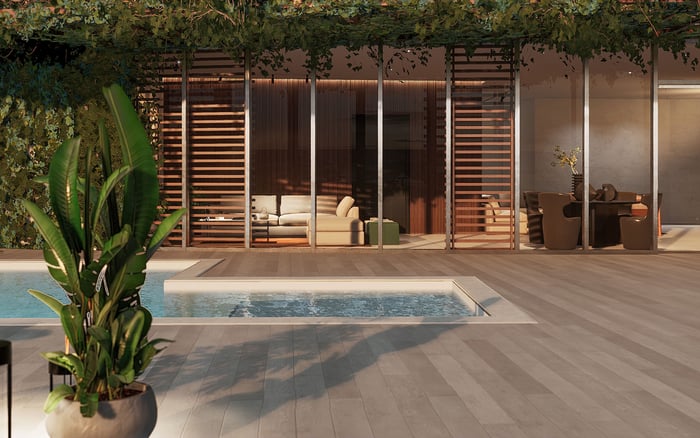
A practical private-showing guide for evaluating wheelchair-friendly circulation in South Florida luxury residences, from arrival and elevators to baths, kitchens, terraces, pools, marinas, and modification risk.

In a private showing, wheelchair-friendly circulation should be evaluated as a lived sequence, not as a collection of attractive features. A wide foyer means little if the garage threshold is abrupt. A generous primary suite may still fall short if the bathroom turn is tight. A resort-style amenity deck can become irrelevant if the elevator, gate, or terrace door interrupts the route.
Begin before the front door. Test the path from valet, guest parking, or private garage to the residence. Continue through the entry, foyer, elevator lobby, principal rooms, bedrooms, bathrooms, outdoor areas, and emergency exit paths. In a condominium, also test the route from the residence to the lobby, mail area, fitness center, spa, pool, marina, dining terrace, beach path, and staff or service zones the buyer expects to use.
For South Florida buyers comparing Brickell, Surfside, Aventura, and nearby luxury markets, the essential question is not whether the home appears spacious. It is whether circulation remains continuous, unobstructed, stable, and comfortable under real conditions.
A showing can be elegant and still highly technical. Carry a compact tape measure, use the wheelchair or mobility device that will actually be used, and move through the home at an unhurried pace. Measure the real usable path after accounting for console tables, sculpture pedestals, planters, door swings, rugs, and furniture placement.
Doorways deserve special attention. Do not rely on the door leaf size alone. Measure the open passage, then test whether there is enough maneuvering clearance to approach, push, pull, pass through, and turn beside the door. A beautiful pivot door, powder room door, or terrace slider can become a daily obstacle if the approach space is poorly planned.
Turning space is just as important as straight-line movement. Test whether a wheelchair user can enter, rotate, reverse, and reposition in foyers, kitchens, bathrooms, closets, elevator lobbies, bedroom circulation zones, and terrace entries. Where space feels constrained, repeat the movement more than once and note whether the turn requires awkward contact with walls, furniture, cabinetry, or fixtures.
Surface quality is part of luxury, but it is also part of usability. Floors and ground surfaces should feel stable, firm, and controlled under real use. During a showing, flag thick rugs, loose mats, uneven stone, deep gravel, glossy wet exterior surfaces, or decorative transitions that interrupt movement. A marble gallery may photograph beautifully, while a loose runner at the elevator entry becomes the problem encountered every day.
Level changes are equally important. Test the front entry, garage entry, balcony track, shower threshold, pool deck transition, and any step between indoor and outdoor entertaining areas. Small changes can still affect daily comfort when they appear at the most-used points of the home.
If a ramp is present or proposed, evaluate more than its appearance. Test whether the approach feels controlled, whether the route is wide enough for the actual mobility device, and whether there is enough level space to pause, align, and turn safely. A ramp that is too steep, too narrow, or awkwardly placed can feel ceremonial rather than usable.
In high-rise and multi-level residences, the elevator is not a convenience. It is part of the circulation system. Test call-button reach, door timing, cab size, backing space, turning space, and whether the elevator actually connects every level and amenity the buyer intends to use. In a private home elevator, also evaluate the sill transition, gate operation, and backup planning during outages.
Reach should be tested throughout the showing. Switches, thermostats, elevator controls, smart-home panels, intercoms, appliance controls, door hardware, and window shades should be reachable from a seated position for the person who will use them. Operable parts should also feel intuitive and manageable without awkward force or movement.
This is where luxury technology can either help or hinder. A centralized smart-home interface may be elegant, but only if the screen is reachable and intuitive. A heavy designer door handle may look tailored, but it should still be easy to operate.
Bathrooms are the most common place where apparent luxury and wheelchair circulation diverge. Test the approach to the vanity, toilet, shower, tub, linen storage, and dressing area. Watch for narrow toilet compartments, raised tubs, glass shower thresholds, vanities that block approach space, and tight turns between fixtures. If future grab bars or shower changes may be needed, ask qualified professionals to evaluate whether the room can support the buyer’s plan.
Kitchens require the same scrutiny. Large square footage does not guarantee usability. Test approach space at sinks, cooktops, wall ovens, refrigerators, dishwashers, islands, pantries, wine storage, and breakfast areas. A dramatic island can improve entertaining while narrowing the most important working route.
Outdoor living needs its own showing script. In South Florida, the terrace is often as important as the great room. Test terrace doors, pool decks, summer kitchens, garden paths, docks, beach access, gates, drainage grates, and surface changes after considering rain, sand, salt air, and glare. Oceanfront homes may offer spectacular views, but the daily route to water, shade, and dining must be reviewed with the same rigor as the interior.
For a major purchase, classify every issue before emotions take over. Some items may be simple modifications: removing loose rugs, changing lever hardware, adjusting furniture, replacing a threshold, or relocating a control panel. Others may be structural or association-controlled: narrow corridors, elevator dimensions, common-area stairs, garage slopes, beach access routes, or exterior door systems.
In condominium and multifamily settings, confirm which elements are inside the residence, which are part of common areas, and which require association or professional review before changes can be made. A route that depends on shared doors, elevators, garages, lobbies, pool decks, or beach access should be evaluated beyond the private unit itself.
Before contract deadlines pass, ask the right professionals to confirm what can be changed, who must approve it, and whether the finished result will truly work. The best showing is not just visual. It is a rehearsal for daily life.
What should I test first during a wheelchair-friendly private showing? Start with the full route from arrival or parking to the residence, then continue through primary rooms, bathrooms, outdoor spaces, amenities, and exits.
Is a wide room enough to confirm wheelchair-friendly circulation? No. You need clear routes, usable doors, turning space, reachable controls, and transitions that work together.
Should I bring a tape measure to the showing? Yes. A tape measure helps confirm whether doors, corridors, turns, thresholds, and furniture layouts work for the actual mobility device.
Why should I test the actual wheelchair or mobility device? The home should be judged by the way the buyer will live in it. A route that looks generous may feel different with the actual chair, scooter, walker, or caregiver support.
Which doors deserve the closest review? Entry doors, bathroom doors, bedroom doors, elevator doors, powder room doors, closet doors, and terrace sliders often reveal circulation issues during a showing.
Are terraces and pool decks part of the test? Yes. Outdoor circulation should include terrace entries, pool decks, summer kitchens, garden paths, docks, gates, beach paths, and surface changes.
How should I evaluate a ramp during a showing? Check whether the slope feels manageable, whether the route is wide enough, and whether there is level space to pause, align, and turn.
Do elevators need to be tested even in luxury buildings? Yes. Test button reach, door timing, cab size, sill transitions, backing or turning space, and whether the elevator reaches all intended areas.
What issues are often easier to modify after purchase? Hardware, rugs, furniture placement, minor thresholds, and some controls may be easier than structural stairs, narrow corridors, or common-area barriers.
Who should confirm whether changes are feasible? An accessibility consultant, architect, contractor, attorney, association representative, or building official can help verify practical constraints and modification options.
When you're ready to tour or underwrite the options, connect with MILLION.
If branded residences are on your mind — as a home or as an allocation — we would be glad to share what we are seeing, privately.
Begin a quiet conversation