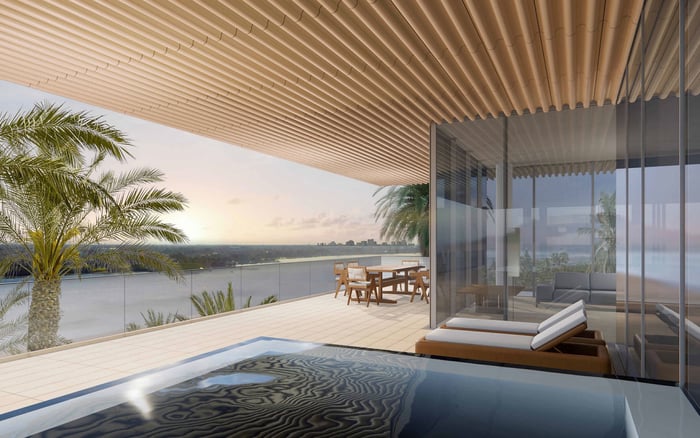
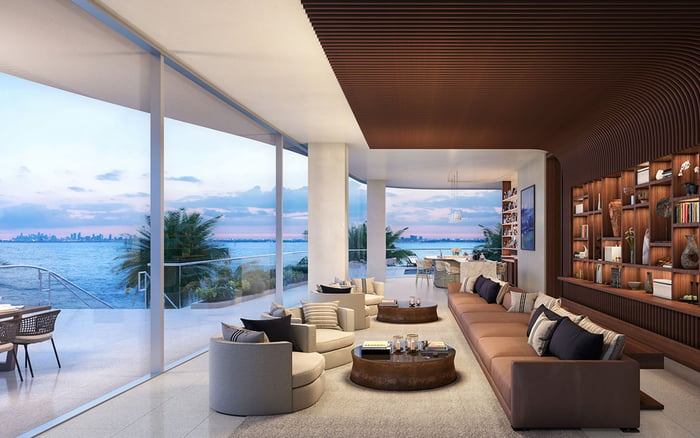
A practical luxury-buyer guide to reading roof-rights ambiguity during a private showing, before it becomes a negotiating, legal, or lifestyle problem.

In South Florida luxury real estate, the roof can be one of the most compelling parts of a residence. It may promise a private sunset terrace, a skyline dining room, a plunge pool, a summer kitchen, or simply the psychological lift of owning the highest usable plane in the building. Yet the phrase “roof rights” is often used casually, and casual language is not enough for a serious buyer.
A private showing is the moment to separate atmosphere from authority. The view may be immediate, but the rights behind it are contractual, architectural, operational, and sometimes sharply limited. A buyer considering a penthouse in Brickell, a coastal residence, or a boutique building with a roof deck should treat the roof as a separate due-diligence asset, not merely an extension of the floor plan.
The goal is not to interrogate the room. It is to listen precisely, ask elegantly, and identify whether the seller, developer representative, or listing team can describe the roof arrangement without contradiction. If the explanation shifts from “private” to “exclusive use” to “shared but rarely used,” the showing has already produced valuable information.
Begin with the simplest question: what does roof rights mean in this residence? The answer should identify whether the area is owned, assigned for exclusive use, shared as a common amenity, reserved for building systems, or subject to future alteration.
A deeded private roof area is different from an exclusive-use common element. A shared rooftop amenity is different from a private terrace attached to one residence. Air rights, development rights, access rights, and maintenance rights are also distinct concepts. The language matters because it affects privacy, resale confidence, improvement potential, insurance exposure, and the daily experience of ownership.
During the showing, ask the representative to describe the rights in plain language first, then ask which document confirms that description. The strongest answers tend to be calm and specific. The weakest rely on lifestyle phrasing: “It is basically yours,” “No one else really goes there,” or “The building has always treated it that way.” In a luxury transaction, habit is not title.
Do not evaluate a roof only from the roof. Walk the entire access sequence. Is it reached by an internal stair, a private elevator stop, a service corridor, a locked common stair, or an exterior passage? Who controls the lock? Can staff, management, vendors, neighbors, or emergency personnel access the same area?
Access is often where the truth becomes visible. A space described as private may require passage through a common hallway. A rooftop described as shared may have a portion that appears informally claimed by one residence. A dramatic roof terrace may sit beside mechanical equipment, elevator overruns, drainage infrastructure, or safety barriers that limit furnishing and entertaining.
Ask whether the access path can be changed, whether additional locks require approval, and whether guests may use the path without the owner present. For buyers who entertain often, privacy is not only about square footage. It is about circulation, sound, lighting, and the ability to move between interior and exterior spaces without feeling exposed.
Penthouse marketing often encourages buyers to assume the roof is part of the residence. That assumption deserves careful testing. A roof directly above a top-floor home may still be a common element, a maintenance zone, or an amenity area with limited hours and rules. Conversely, a smaller private terrace may carry stronger practical value if its rights are clearly documented and its access is direct.
Ask whether any roof area is included in the legal description of the residence, assigned by governing documents, or merely shown on sales material. Then ask whether the area can be furnished, landscaped, shaded, lit, or improved. A roof without improvement rights may still be beautiful, but it should be valued differently from a roof that supports a full outdoor living program.
For new-construction buyers, this conversation should happen early, before finish selections and lifestyle assumptions become emotionally fixed. For resale buyers, it should happen before the offer gains momentum. In both cases, the showing should produce a checklist for counsel and building management, not a final legal conclusion.
The most useful private-showing questions are practical. Who cleans the roof? Who maintains waterproofing? Who repairs drains? Who pays for damage caused by furniture, planters, cooking equipment, or wind events? Are there rules on umbrellas, pergolas, heaters, outdoor kitchens, speakers, glass railings, or temporary structures?
A roof is not a typical room. It is part lifestyle space and part building envelope. Maintenance, water intrusion, wind exposure, fire safety, and structural load all matter. A buyer does not need to resolve every technical issue during a showing, but the representative should be able to identify which approvals govern changes.
Ask whether there have been prior disputes or special rules affecting rooftop use. The answer may be simple, but the manner of response is instructive. Hesitation is not proof of a problem, but it may identify an area for document review. In the luxury market, ambiguity is not always a dealbreaker. Unpriced ambiguity is the danger.
In neighborhoods where outdoor living carries a premium, from Brickell towers to waterfront enclaves, owners may create informal customs over time. A planter arrangement, lounge setup, or private dinner pattern may appear established. Still, precedent is not the same as permission.
Ask whether current use has written approval. If a grill, spa, pergola, cabana, or exterior lighting package is in place, ask whether it was approved and whether that approval transfers to a purchaser. Some permissions may be personal, conditional, revocable, or dependent on continued compliance.
Search language can also obscure the issue. A buyer may see terms such as Miami Beach, Sunny Isles, roof deck, private roof, sky terrace, or outdoor penthouse living and assume comparable rights across very different buildings. The showing should reset the conversation around the actual residence, the actual documents, and the actual rules.
If the roof is central to the purchase decision, do not let it remain an aesthetic feature in the offer strategy. Ask your advisory team to convert the issue into transaction language. That may include document review, confirmation of use rights, review of association or condominium rules, improvement approvals, insurance considerations, and clarification of responsibility for maintenance or repairs.
The more valuable the roof is to your lifestyle, the more precisely it should be treated in the negotiation. If the seller represents that a roof area is private, exclusive, improved, transferable, or capable of future enhancement, those concepts should be tested before deadlines become uncomfortable.
A refined buyer does not need to be adversarial. The tone can remain discreet and collaborative. The message is simply that the roof is material to value. In South Florida, where outdoor space can define the emotional premium of a residence, clarity is not a formality. It is part of the asset.
What should I ask first about roof rights? Ask what the phrase means for that exact residence and which governing document confirms it.
Is a private roof the same as exclusive use? Not always. Private, deeded, exclusive-use, and shared common areas can carry different rights and responsibilities.
Can I rely on what I see during the showing? Use what you see as a clue, not a conclusion. Visible use should be matched to written approval.
Should I ask about roof maintenance? Yes. Clarify who maintains waterproofing, drains, surfaces, railings, and any approved improvements.
Can I add a kitchen, spa, pergola, or landscaping? Treat every improvement as approval-dependent until documents and building rules confirm otherwise.
Does top-floor ownership automatically include roof rights? No. A residence may sit below a roof area without owning or controlling that roof area.
Why does access matter so much? Access reveals privacy, control, guest movement, service needs, and whether other parties can enter the same space.
Should roof rights affect my offer? If the roof materially shapes value or lifestyle, its clarity should influence negotiation and contingencies.
Who should review the roof-rights documents? A qualified real estate attorney and appropriate building professionals should review the relevant documents.
What is the best way to shortlist comparable options for touring? Start with location fit, delivery status, and daily lifestyle priorities, then compare stacks and elevations to validate views and privacy.
To compare the best-fit options with clarity, connect with MILLION.
If branded residences are on your mind — as a home or as an allocation — we would be glad to share what we are seeing, privately.
Begin a quiet conversation