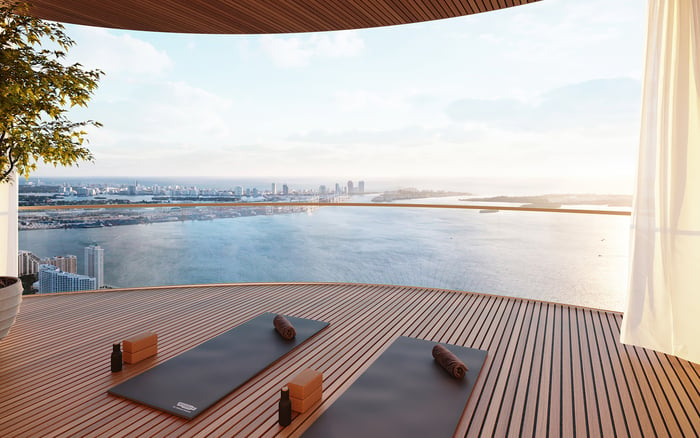
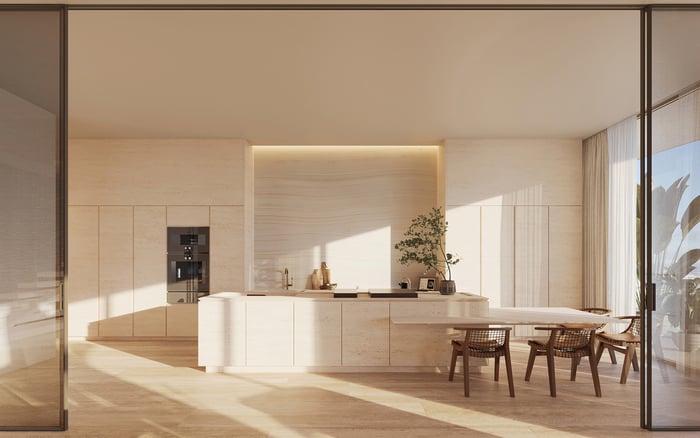
A buyer-focused editorial on how The Residences at 1428 Brickell treats arrival, controlled circulation, and curated seclusion as defining luxuries in Brickell.
In Brickell, luxury has always carried a particular tension. The neighborhood is energetic, vertical, and deeply connected, yet its most discerning buyers often want the opposite sensation when they come home: calm, discretion, and an immediate retreat from the public rhythm of the city. That is the setting in which The Residences at 1428 Brickell becomes especially relevant.
Rather than treating entry as a functional threshold, the project positions arrival as part of the residence itself. The experience begins before a resident reaches the private home, with controlled vehicular access, choreographed entry, and circulation designed to separate the resident pathway from the public streetscape. In a dense urban environment, that distinction is not a minor amenity. It is a form of psychological luxury.
This is where Brickell’s private arrival culture becomes more than a design phrase. It reflects a buyer expectation that the transition from city to home should feel intentional, protected, and composed. The best new towers are no longer judged only by views, finishes, or amenity decks. They are also being evaluated through the quality of the first five minutes.
For many buyers, the most revealing moment in a residential tower is not the model residence. It is the arrival. A building can offer exquisite interiors, but if the resident experience begins with exposure, congestion, or a lobby that feels overly public, the private-home narrative is weakened.
At The Residences at 1428 Brickell, controlled vehicular access is central to the project’s positioning. The entry sequence is highly choreographed, creating a deliberate movement from Brickell Avenue into the building. That choreography matters because it gives the resident a sense of progression: from public avenue, to protected arrival, to lobby, to elevator, to home.
This is not the same as simply having a porte cochere or attended entrance. The larger idea is curated seclusion. The building’s luxury story emphasizes discretion and calm, beginning before residents enter their own residences. In a market where multiple towers compete for attention, the arrival ritual becomes a differentiating asset.
Nearby, projects such as 2200 Brickell and Cipriani Residences Brickell also sit within a district where the transition from street to residence is increasingly scrutinized by buyers. The conversation is not only about being in Brickell. It is about how privately one can live within Brickell.
The private-arrival conversation is part of a larger shift in luxury condominium design. Privacy is no longer limited to square footage, a high floor, or a primary suite tucked away from entertaining areas. It is being embedded into circulation.
The Residences at 1428 Brickell supports that idea through limited homes per floor and direct elevator access, both of which reduce resident exposure and create a more controlled daily rhythm. These details influence how a building feels over time. Fewer shared encounters, more direct movement, and clearer separation between resident and public zones can make the tower feel less like a hotel and more like a true private address.
That distinction is important in Brickell. Some buyers are attracted to the area precisely because of its urban convenience. They want proximity, skyline energy, dining, finance, and movement. But they do not necessarily want a residential arrival that feels performative, crowded, or open to constant public interaction.
The appeal of 1428 Brickell is that it frames privacy as an experience, not merely as a promise. The building’s circulation concept separates resident pathways from the public streetscape, reinforcing a sense of removal without asking buyers to leave the urban core.
In South Florida’s ultra-premium market, status has become less about overt display and more about controlled access. The most sophisticated buyers often recognize luxury in what is withheld: fewer interruptions, less exposure, quieter movement, and a building that understands the value of discretion.
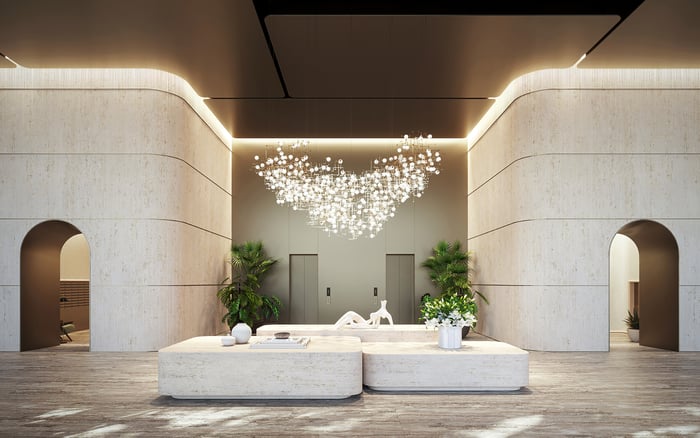
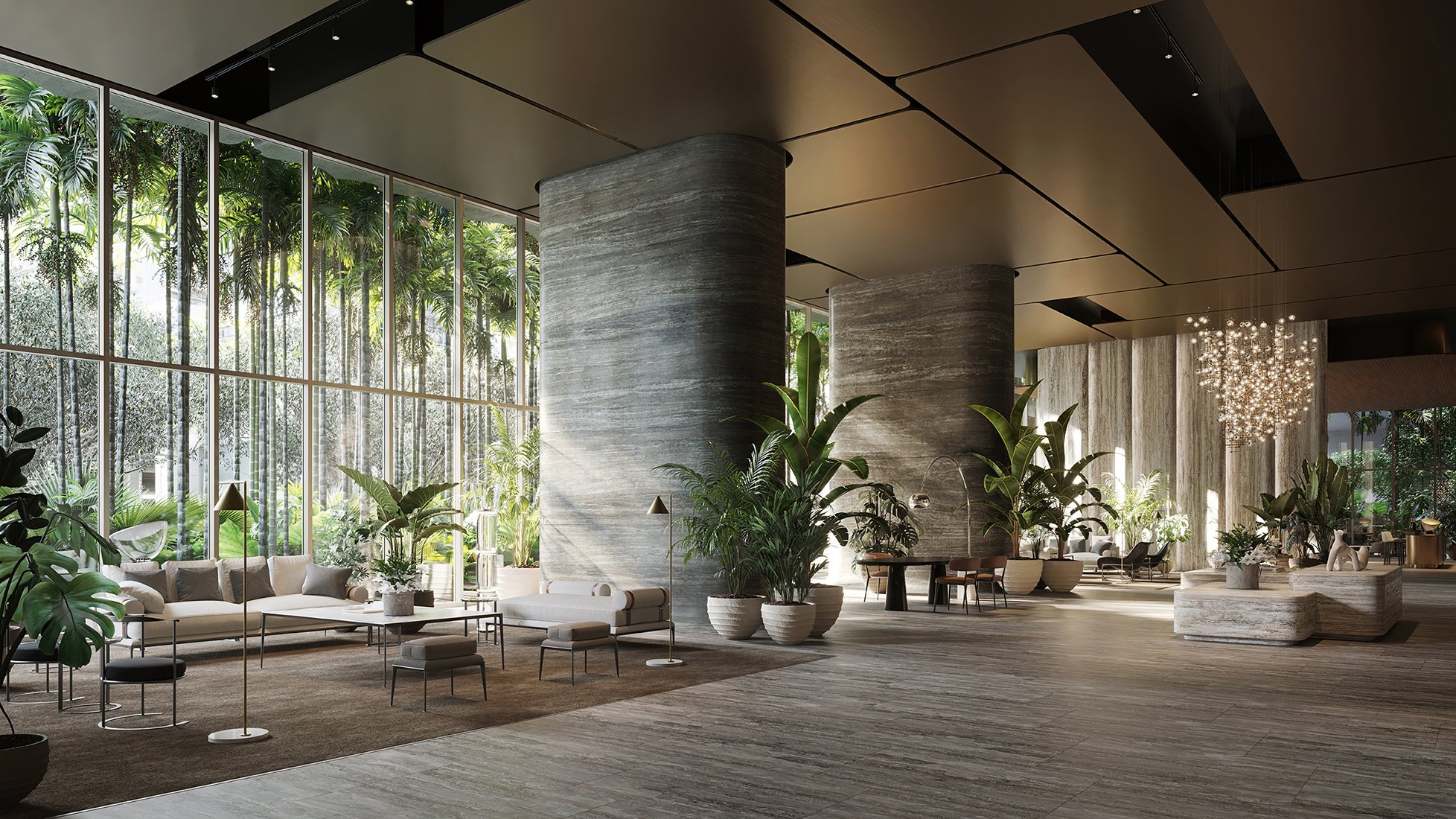
That is why the lobby moment matters. At The Residences at 1428 Brickell, the lobby is not treated as a pass-through public space. It belongs to the larger arrival experience, the point at which the outside city is absorbed and quieted. For a resident, this can become a daily ritual of decompression.
The same buyer may appreciate the architectural presence of Baccarat Residences Brickell or the waterfront calm associated with Una Residences Brickell, yet still evaluate each building through a practical lens: How do I arrive? Who shares that path? How quickly do I move from the car to my residence? How much of my daily life is visible?
These questions are shaping the new definition of Brickell luxury. The answers are often found not in the most photographed spaces, but in the sequence of movement residents experience every day.
For buyers comparing Brickell towers, private arrival should be evaluated with the same seriousness as floor plan, exposure, and amenity programming. The issue is not whether a building is luxurious in appearance. The issue is whether the resident journey feels protected from start to finish.
A well-resolved arrival sequence should create separation from the street without feeling cold. It should be efficient without feeling transactional. It should offer service without making the experience feel public or hotel-like. In the case of The Residences at 1428 Brickell, the emphasis on controlled access, direct circulation, limited homes per floor, and curated seclusion makes the project a useful case study in how Brickell towers are beginning to sell privacy as something that starts at the curb.
For buyers tracking new-construction and pre-construction opportunities, this is a meaningful filter. A top project in Brickell is increasingly expected to feel ultra-modern not only in its design language, but also in how intelligently it manages exposure, movement, and calm.
The Residences at 1428 Brickell fits the private-arrival conversation because it understands that luxury is not a single room or finish. It is a sequence. It starts with the vehicle approach, continues through the entry, carries into the lobby, and follows the resident through controlled vertical circulation.
In a neighborhood defined by density, the ability to create quiet separation is valuable. Brickell gives buyers access to the city. The most compelling residential towers give them a way to step out of that city without leaving it.
That is the essence of private arrival culture. It is not isolation. It is selective permeability: the ability to enjoy the urban center while preserving the private rhythm of home.
What does private arrival culture mean in Brickell? It refers to the way luxury towers treat the transition from public street to private residence as part of the residential experience.
How does The Residences at 1428 Brickell fit this idea? It emphasizes controlled access, choreographed entry, private circulation, and a calmer sequence from Brickell Avenue to the home.
Why is controlled vehicular access important? It helps create a more discreet and protected arrival, reducing the feeling of exposure at the curb.
Is the lobby part of the luxury experience? Yes. In this context, the lobby is treated as a composed residential moment rather than a simple pass-through space.
Do limited homes per floor matter for privacy? Yes. Fewer homes per floor can reduce resident exposure and support a quieter daily rhythm.
What role does direct elevator access play? It supports private circulation by making the journey from arrival to residence more controlled and direct.
Who is most likely to value this type of building? Buyers who want Brickell’s urban convenience without a highly public or hotel-like residential arrival experience.
Is private arrival only about architecture? No. It also includes service, circulation, access control, and the psychological comfort of moving privately.
How should buyers compare arrival experiences? They should look at how the building manages the curb, lobby, elevators, and resident pathways as one continuous sequence.
Why is this especially relevant in Brickell? Brickell is dense and urban, so the ability to create calm separation from the street becomes a meaningful luxury feature.
For a tailored shortlist and next-step guidance, connect with MILLION.
If branded residences are on your mind — as a home or as an allocation — we would be glad to share what we are seeing, privately.
Begin a quiet conversation