Emergency power is becoming a defining cost variable in South Florida wellness residences, where code compliance, humidity control, elevator access and full habitability can carry very different budgets.
In South Florida, the most revealing question in a wellness-led residence may not be how many treatment rooms, plunge pools or meditation gardens it offers. It may be what still works when utility power fails.
That question is no longer peripheral. Florida’s current building code framework requires emergency-power planning to be coordinated across building, electrical, mechanical, flood, accessibility and life-safety requirements. In Miami-Dade and Broward, High-Velocity Hurricane Zone conditions add another layer, particularly where generator rooms, louvers, rooftop equipment, supports or exterior penetrations intersect with the hurricane envelope.
For buyers, the distinction is straightforward but financially significant: code-minimum backup is designed primarily around life safety. Wellness-grade backup aims to preserve habitability. The distance between those two standards can change the real cost of ownership.
Life-safety systems focus on protection from fire, smoke and related hazards. They keep essential emergency functions operating, but they do not necessarily keep a residence comfortable, dry, connected or fully usable. A condominium may satisfy required emergency functions while leaving owners without air conditioning, advanced filtration, refrigeration, certain water systems or amenity access during an outage.
Electrical standards also affect more than the generator line item. Transfer equipment, wiring separation, load classification and distribution all influence what can be backed up and how much infrastructure is required. Expanding from life-safety loads to owner-comfort loads can alter switchgear scope, electrical-room planning, riser strategy and maintenance obligations.
That is why buyers comparing wellness-forward projects such as The Well Bay Harbor Islands should look beyond amenity language and ask what “resilience” actually includes. Air, water, light, thermal comfort, sound, movement and peace of mind all depend, in practice, on continuous electrical service.
In South Florida’s climate, backed-up cooling is not merely a comfort upgrade. Moisture control is central to mold prevention, and indoor-air quality depends on ventilation, filtration, controls, fans and mechanical systems that need power to function.
A wellness residence that promotes cleaner air but cannot energize key ventilation and filtration components during a prolonged outage has a gap between brand promise and operating reality. Backing up those systems can require larger generation capacity or battery storage, additional transfer capacity, more sophisticated controls and clear load prioritization.
This is especially relevant in low-rise and boutique environments such as The Well Coconut Grove, where the wellness narrative may feel intimate and residential. The engineering still has to answer a hard question: which spaces remain cool, filtered and dehumidified, and for how long?
Elevator backup is often framed as a luxury convenience, but in certain buildings alternative power for elevators is also an accessibility and statutory design issue. For high-rise buyers, it becomes a daily-life question: can residents, staff, medical support and supplies move safely when the grid is down?
In vertical neighborhoods such as Brickell, where buyers may consider residences like The Residences at 1428 Brickell, elevator resilience can shape both project design and perceived value. It may affect emergency-generator capacity, transfer equipment, ventilation, life-safety coordination and operating protocols.
For owners, the point is not simply whether “the building has a generator.” The point is whether that generator supports one elevator, multiple elevators, service operations, cooling, water, security, communications and the systems that make the property feel habitable rather than merely compliant.
Emergency power is not just an electrical specification. It is a real-estate decision about space.
Generators, switchgear, fuel systems, batteries and transfer equipment may need elevated or flood-protected locations. That can redirect valuable square footage away from parking, storage, back-of-house areas or amenities. In coastal and bayfront settings, the location of utility equipment must also be considered against wind, flood and envelope requirements.
Waterfront design intensifies the trade-off. Intake and exhaust routes, acoustic treatment, generator-room ventilation and exterior louvers must be coordinated with hurricane-resistant assemblies. When backup infrastructure modifies the exterior envelope, approved components and careful detailing matter. The better this is resolved early, the less likely resilience becomes an expensive late-stage compromise.
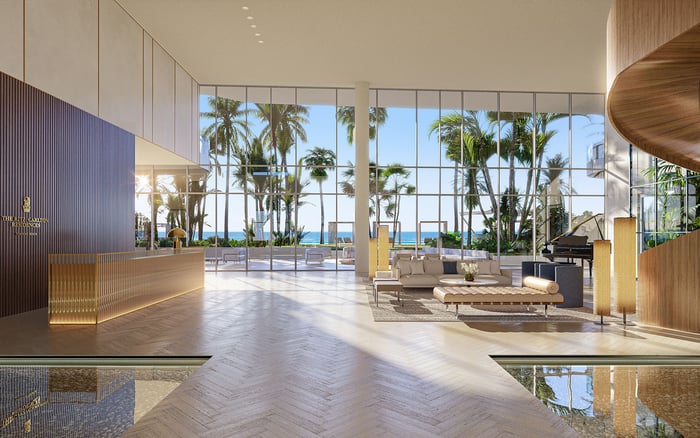
In Miami Beach, projects such as The Ritz-Carlton Residences® Miami Beach illustrate why buyers should treat resilience as part of the architecture, not as a mechanical afterthought. Backup power affects massing, service design, acoustics, maintenance access and the lived experience of calm after a storm.
Full-building backup can materially change project economics. Larger generator or battery capacity may require broader transfer-switch scope, greater fuel and runtime planning, ventilation, acoustic control, testing, maintenance and ongoing professional oversight. Those costs do not disappear after closing. They live in association budgets, service contracts, inspections and reserve planning.
Battery systems can reduce certain operating characteristics, but they introduce their own safety, siting, fire-protection and permitting considerations. Solar-plus-storage strategies may be compelling for some residences, yet they still require disciplined engineering around load management, battery location, heat, access and emergency response.
Generators bring another layer: fuel logistics, exhaust separation, intake placement, carbon monoxide safety, noise and runtime. In a dense luxury setting, the most expensive solution may be the one that was not coordinated early enough.
New-construction buyers should request a plain-English description of backed-up loads. Does emergency power cover only life-safety functions, or does it also support elevators, domestic water, refrigeration, Wi-Fi and telecom rooms, access control, garage systems, selected HVAC, dehumidification and amenity operations?
They should also ask about runtime assumptions. A building that can bridge a short interruption is different from one designed to remain livable through an extended outage. Fuel storage, replenishment access, battery duration and load-shedding protocols all shape the answer.
Lifestyle is increasingly measured by continuity. The strongest wellness-led residence is not the one with the longest amenity menu. It is the one whose systems support health, calm and access when the environment outside is least predictable.
Does code-compliant emergency power mean full-building backup? No. Code compliance usually centers on required life-safety and accessibility functions, while full-building backup is a broader owner-experience decision.
Why does wellness make emergency power more expensive? Wellness programs often rely on HVAC, filtration, controls, water systems, lighting and connectivity, which can expand the backed-up load profile.
Should buyers ask what the generator powers? Yes. The critical question is not whether a generator exists, but which systems it supports and for how long.
Are elevators always backed up in luxury residences? Not always in the same way. Requirements and design choices vary, so buyers should ask how many elevators operate during an outage.
Why is humidity control part of resilience? In humid South Florida, cooling and dehumidification help protect indoor environmental quality and reduce moisture-related risk.
Do batteries simplify emergency-power planning? They can help, but they also introduce safety, siting, fire-protection, heat and permitting considerations.
How does flood risk affect backup power? Utility systems may need elevated or protected locations, which can change space planning, construction complexity and cost.
Why do hurricane-zone rules matter for generators? Exterior rooms, louvers, supports and penetrations must be coordinated with wind-resistant envelope requirements.
What should associations budget for after closing? Maintenance, testing, inspections, fuel planning, service contracts and reserves can all be part of the long-term cost.
What is the buyer takeaway? Treat emergency power as wellness infrastructure, not as a checklist amenity.
For a confidential assessment and a building-by-building shortlist, connect with MILLION.
If branded residences are on your mind — as a home or as an allocation — we would be glad to share what we are seeing, privately.
Begin a quiet conversation