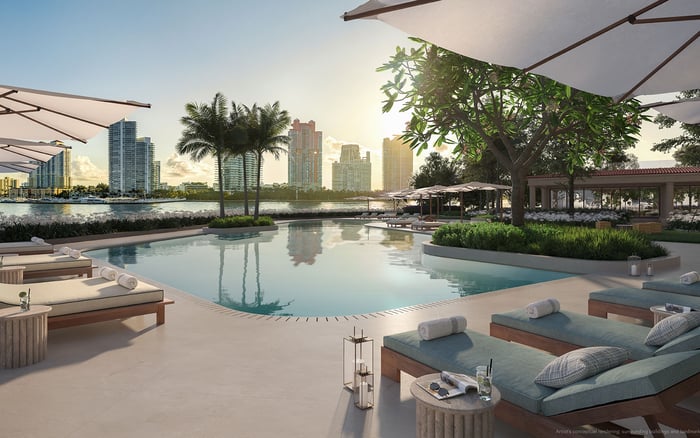
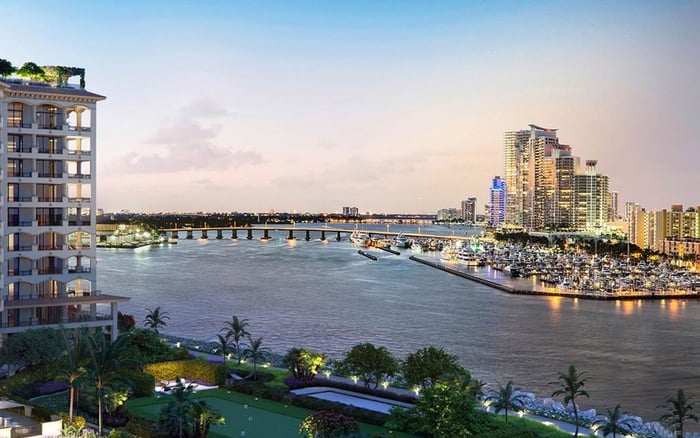
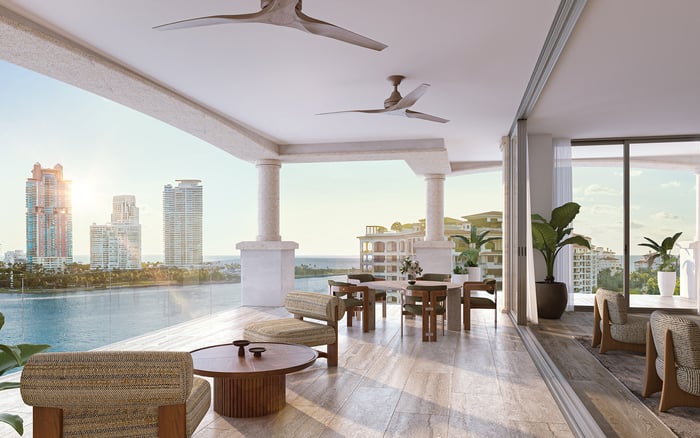
South Florida’s newest ultra-luxury residential language is becoming quieter, more controlled and more operationally refined. Continuum Club & Residences North Bay Village and The Residences at Six Fisher Island show how privacy, resident-only services and managed access are replacing spectacle as the region’s most valuable amenities.
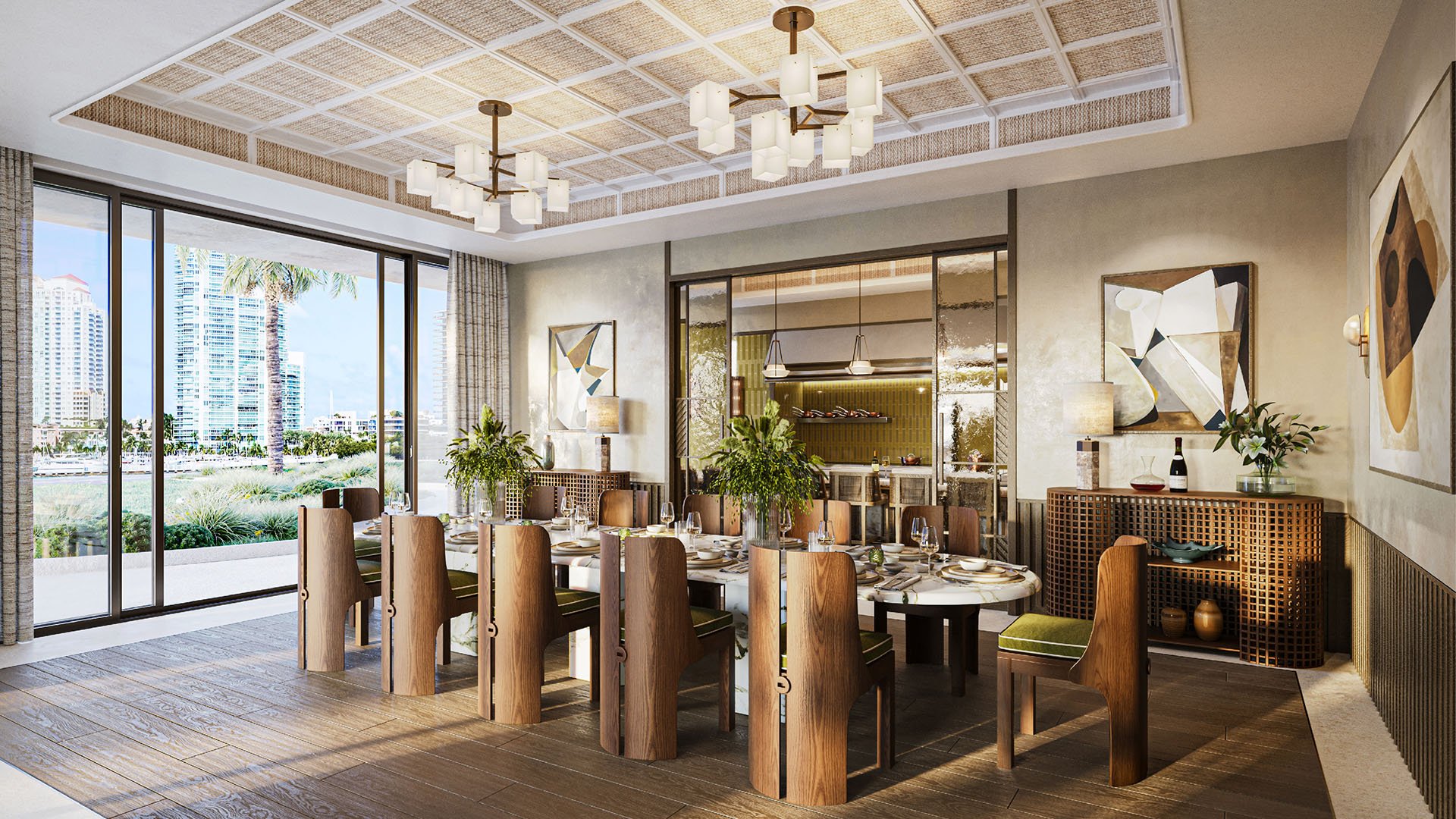
South Florida has long understood visible luxury. Oceanfront towers, branded lobbies, marina arrivals and destination restaurants have helped define the region’s high-end residential market. Yet a quieter priority is shaping the next tier of demand: the ability to live exceptionally well without becoming part of a public scene.
That shift is visible in Continuum Club & Residences North Bay Village and The Residences at Six Fisher Island. Each project reflects a hybrid model that sits between the conventional condominium and the private club. The emphasis is not simply on amenities, but on who uses them, how residents and guests move through the property and how service is calibrated around a defined residential community.
For globally mobile, high-net-worth buyers, this distinction matters. Privacy is no longer a passive benefit of a large residence or a prestigious address. It is increasingly an operating philosophy, shaped by controlled entry points, managed circulation, resident-focused programming and staff cultures built around confidentiality.
Continuum Club & Residences North Bay Village represents a specific version of the discreet residential model. Its setting gives it a bayfront position in an emerging neighborhood rather than the more visible resort corridors associated with Miami Beach. That difference is central to the appeal. The project can speak to waterfront living while offering a lower-profile residential rhythm.
North Bay Village is not presented here as an escape from Miami, but as a more managed way to access it. The buyer still wants proximity, water views and a connected South Florida life. What changes is the tolerance for crowds, outside foot traffic and the constant permeability of hotel-style luxury.
In that sense, Continuum’s relevance is not only architectural or locational. It is operational. The value proposition favors a resident-first environment, where amenities are intended primarily for the people who live there rather than a broader public audience. Nearby residential conversations, including Shoma Bay North Bay Village, reinforce how the area is being read as a more residential bayfront alternative within Miami’s luxury map.
The Residences at Six Fisher Island expresses the same broader idea through a different site strategy. Fisher Island already carries an exclusivity narrative tied to restricted island access and a naturally secluded setting. The residential operations model therefore begins with geography. Arrival is more selective, circulation is more contained and the island context itself supports a quieter form of luxury.
This does not mean the project is simply relying on the Fisher Island name. Its significance is that it translates island privacy into a service structure. The model prioritizes layered access rights, guest management and services shaped around a defined resident body. The luxury is not in being seen entering the building. It is in knowing the building has been designed to limit unnecessary exposure.
That is why Fisher Island remains one of the clearest laboratories for ultra-private residential living in South Florida. Projects such as The Links Estates at Fisher Island also speak to the island’s enduring appeal among buyers who view access control as part of the lifestyle proposition rather than a secondary security feature.
The older luxury playbook often treated visibility as value. A buzzing lobby, a destination restaurant or a heavily photographed amenity deck could create energy around a building. For some buyers, that remains attractive. But for the upper end of the market, especially those managing public profiles, family offices, frequent travel and multiple residences, constant activation has limits.
Discreet residential operations answer a different question: how does a building reduce friction? That means fewer uncontrolled encounters, fewer public-facing venues and greater attention to protocols. Resident-focused dining and wellness programming can matter more than a restaurant that becomes a local destination. A quiet arrival sequence can matter more than theatrical entry design. A staff member trained in confidentiality can be more valuable than a visible hospitality flourish.
Security also changes under this model. The point is not to create a fortress-like mood. It is to layer access and manage resident flow unobtrusively. The best version of this approach feels calm rather than defensive, with privacy embedded into the way daily life unfolds.
One of the defining traits of this category is the changing role of staff. In a conventional hospitality model, service is often performative, oriented toward memorable moments and visible attentiveness. In a discreet residential model, the service culture is closer to private household management. Protocol, memory, restraint and confidentiality become central values.
For a buyer, that difference is practical. Guest arrivals, deliveries, wellness appointments and dining preferences all become part of a managed residential ecosystem. The goal is not to overwhelm the resident with service, but to anticipate needs without increasing exposure.
This is where the private-club analogy becomes useful. A club is valuable because access is defined, behavior is understood and services are tuned to a known community. Continuum and Six Fisher Island both reflect that logic, though in different physical contexts. One uses the emerging bayfront privacy of North Bay Village. The other uses the established seclusion of Fisher Island.
The comparison also clarifies a broader market shift. Discretion is no longer confined to gated estates or legacy enclaves. It is becoming a design and operations principle within vertical residential development. Miami Beach, North Bay Village, Fisher Island and other luxury submarkets can all express privacy differently, depending on access, scale, circulation and amenity philosophy.
That nuance matters for buyers comparing buildings. A waterfront address alone does not guarantee privacy. A branded amenity program does not automatically create discretion. The key question is whether the project has been planned around resident control or public energy.
This is why the new generation of luxury buyers often evaluates operational questions as carefully as finishes. Who enters the building? How are guests handled? Are amenities primarily resident-facing? Does the property encourage outside traffic? Is security visible or seamlessly integrated? The answers may shape long-term livability as much as views, design or location.
The rise of discreet residential operations does not signal the end of glamorous South Florida living. Rather, it marks a refinement of what glamour means. For the most private buyers, the ultimate privilege is not a louder address, but a better-managed life.
Continuum Club & Residences North Bay Village and The Residences at Six Fisher Island demonstrate two routes to that result. One is an emerging bayfront strategy, using North Bay Village’s position to offer a more contained residential alternative near Miami’s core. The other is an island strategy, using Fisher Island’s restricted access and established exclusivity to intensify the private-club residential model.
Both point toward the same conclusion: in South Florida’s ultra-premium market, discretion is becoming measurable. It is measured in circulation, access, service culture, guest protocols and the absence of unnecessary public exposure.
What are discreet residential operations? They are building systems and service cultures designed around privacy, controlled access, resident-focused amenities and limited public exposure.
Why is Continuum Club & Residences North Bay Village relevant to this trend? It reflects a privacy-led, service-heavy model in a bayfront North Bay Village setting distinct from more public resort corridors.
How does The Residences at Six Fisher Island differ from Continuum? Six Fisher Island applies the same discreet-service logic through a naturally secluded island context with restricted access.
Are these projects traditional condominiums? They are better understood as hybrids between condominium living and private-club-style residential environments.
Why are high-net-worth buyers prioritizing privacy now? Many globally mobile buyers want services, amenities and access without the foot traffic associated with public-facing hospitality.
Does discreet living mean less service? No. It usually means more calibrated service, with staff protocols focused on confidentiality, anticipation and resident preference.
How does security work in this model? The preferred approach is layered and unobtrusive, using controlled access and resident-flow management rather than visible spectacle.
Why does location matter for discretion? North Bay Village offers emerging bayfront seclusion, while Fisher Island offers an established island-based privacy narrative.
Are public restaurants and nightlife part of this model? The model generally favors resident-focused dining and wellness programming over venues designed to attract outside traffic.
What should buyers ask before choosing this type of residence? Buyers should ask how guests are managed, who uses amenities, how circulation is controlled and how service protocols protect privacy.
For a confidential assessment and a building-by-building shortlist, connect with MILLION.
If branded residences are on your mind — as a home or as an allocation — we would be glad to share what we are seeing, privately.
Begin a quiet conversation