A practical buyer’s guide to assessing sightlines, tower spacing, future development risk, balconies, amenity exposure, and floor-plan privacy before purchasing in Midtown Miami.

Midtown Miami rewards buyers who think three-dimensionally. The neighborhood’s appeal comes from proximity, walkability, design energy, and a distinctly urban rhythm, but that same density makes privacy more nuanced than simply choosing a higher floor. In a vertical district, the real issue is not whether another tower exists nearby. It is whether that tower looks directly into the rooms where daily life happens.
For sophisticated buyers, privacy deserves the same scrutiny as views, finishes, parking, and building services. A residence can be beautifully planned, well priced, and well located, yet still feel compromised if its primary bedroom, terrace, or living room is exposed to a neighboring façade. In Midtown Miami, privacy is not a single feature. It is a relationship between glass, distance, angle, elevation, routines, and future development.
The first exercise is simple: stand where you will actually live. Look from the sofa wall, the dining area, the primary bedroom, the shower window if applicable, and the terrace edge. The most important view is not always the broad skyline frame. It may be the narrow diagonal sightline from a neighboring balcony or the direct alignment between two bedroom windows.
Separate scenic exposure from personal exposure. A residence may have an open view from the living room but a highly visible bedroom. Another may sacrifice some panorama yet feel serene because its glazing is angled away from adjacent towers. Privacy often depends on geometry rather than distance alone.
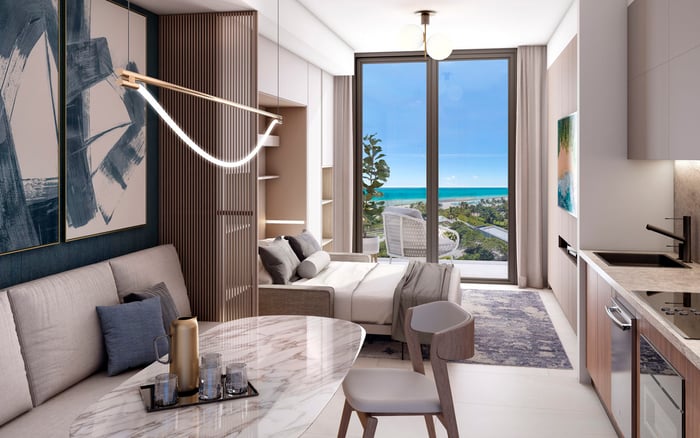
If the residence is not yet built, request the most detailed orientation materials available and study the plan as if it were already occupied. Ask which rooms face other façades, where balconies stack, and whether amenity levels create downward or upward visibility. A glossy rendering may convey atmosphere, but a buyer needs to understand the everyday field of vision.
A strong Midtown Miami floor plan creates a hierarchy between public and private rooms. Living spaces can tolerate more exposure because they are active and social. Bedrooms, baths, dressing areas, and workspaces require a different threshold. The best layouts protect those zones through setbacks, angled walls, internal corridors, deep terraces, or window placement.
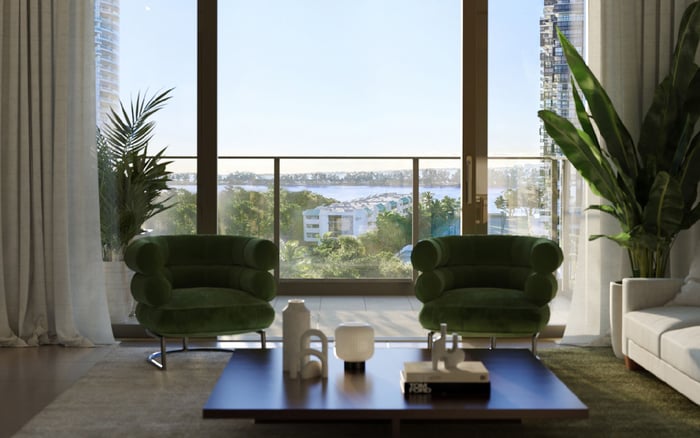
Do not evaluate privacy only from the center of a room. Walk the perimeter. A corner of glass may be spectacular at sunset yet exposed at night when interiors are illuminated. A deep balcony may buffer the living room, while a shallow terrace may place residents directly in the visual path of neighboring units. In some cases, an architectural fin, column, or offset slab can do more for privacy than extra square footage.
High floors deserve careful interpretation. They may lift a residence above some neighboring sightlines, but they can also align with amenity decks, rooftop areas, or upper-level residences in nearby towers. Elevation helps most when paired with favorable orientation. A lower floor with a protected outlook may feel more private than a higher floor facing a wall of glass.
Because Midtown Miami sits within a broader urban luxury corridor, buyers can sharpen their eye by looking at how privacy is handled in nearby neighborhoods. Edgewater, Downtown Miami, and Brickell each offer lessons in façade spacing, tower orientation, and the balance between view and exposure.
In Edgewater, projects such as EDITION Edgewater and Aria Reserve Miami can help buyers think about how waterfront orientation, tower form, and residence planning affect privacy expectations. The comparison is not about substituting one neighborhood for another. It is about training the eye to notice whether a building turns residences toward open corridors or toward neighboring glass.
Downtown Miami offers another useful lens. A tower like Waldorf Astoria Residences Downtown Miami sits within a high-rise context where buyers naturally think about vertical neighbors, long-range views, and the premium attached to protected exposures. Brickell is equally instructive. At The Residences at 1428 Brickell, buyers can consider how a dense financial district makes orientation, glazing strategy, and unit position central to the experience of privacy.
A current open view should never be treated as permanent unless the buyer has a clear basis for that confidence. In an evolving district, the parcel next door, the low-rise across the street, or the surface lot beyond the balcony may matter as much as the building already in place. The privacy question is therefore both present-tense and future-tense.
Ask what could reasonably be built on adjacent sites. Consider whether a future structure could rise into the same visual plane as the residence. Study whether the most private rooms depend on a gap that may not remain open. If a unit’s appeal depends on a single neighboring property staying low, that uncertainty should be priced into the decision.
This does not mean avoiding urban residences. It means purchasing with clear eyes. In Midtown Miami, the most resilient residences are often those whose privacy comes from orientation and plan logic, not merely from today’s absence of a neighbor.
Privacy changes after dark. During the day, reflective glass, shadows, and exterior brightness can make a residence feel more concealed. At night, interior lighting reverses the relationship. A living room that felt discreet at noon may become highly visible from an adjacent tower after dinner.
When possible, visit in the morning, late afternoon, and evening. Observe which neighboring windows are occupied, where amenity activity concentrates, and whether terraces across the way are frequently used. Listen as well as look. Visual privacy and acoustic privacy often overlap, especially where pool decks, outdoor lounges, or balcony lines face one another.
Buyers should also test how window treatments will function. If privacy requires blackout shades to be closed in the primary rooms every evening, that is a lifestyle tradeoff. The question is not whether shades exist. It is whether the residence feels comfortable when they are open.
Amenity decks are sometimes overlooked in privacy analysis because buyers focus on neighboring unit windows. Yet pools, fitness terraces, lounges, and outdoor dining areas can create sustained lines of sight. A residence facing an amenity level may experience more prolonged observation than one facing ordinary apartments, simply because people linger in shared spaces.
The best question is behavioral: who will be looking, from where, and for how long? A neighboring bedroom window may be occupied briefly. A pool deck may be active for hours. Conversely, an amenity view may be acceptable for buyers who prioritize energy and social atmosphere. Privacy is personal, and the right answer depends on how the owner intends to live.
Before committing, ask for plan materials that clarify orientation, window placement, balcony depth, and adjacent conditions. Request a conversation around the specific line from each major room to nearby towers or potential future sites. If touring a completed residence, take photos and videos from inside looking outward, then review them later with the lights on in your own mind.
Ask whether comparable lines in the building have resold or been leased with noticeable preferences for certain exposures. Avoid broad assumptions such as north is better, high is better, or corner is better. In Midtown Miami, a small rotation in the tower or a modest offset in the plan can materially alter the privacy experience.
Finally, be honest about your tolerance. Some buyers love the cinematic energy of an urban grid. Others want a sanctuary that feels visually quiet from the moment the elevator opens. The best purchase is not the one with the theoretical maximum view, but the one whose privacy matches the owner’s rituals.
What is the first privacy question to ask in Midtown Miami? Ask what each primary room directly faces today and what it may face in the future.
Are higher floors always more private? Not always. High floors can help, but orientation and alignment with neighboring towers often matter more.
Should I worry more about distance or angle? Both matter, but angle is often decisive because indirect sightlines can feel far more private than direct ones.
How should I evaluate balcony privacy? Stand at the usable seating area, not only the railing, and study who can see that space from nearby towers.
Can window treatments solve most privacy issues? They can help, but relying on closed shades every evening may reduce the pleasure of the residence.
Do amenity decks create privacy concerns? Yes. Pools, lounges, and fitness terraces can create longer periods of visibility than ordinary neighboring windows.
What if the adjacent parcel is currently low-rise? Treat it as a future variable and ask how a taller building could affect bedrooms, terraces, and living areas.
Is a corner residence always better for privacy? No. A corner can add light and view, but it may also increase exposure if both sides face neighboring glass.
How many visits should I make before deciding? If possible, visit during daylight and evening so you can understand privacy with different lighting conditions.
What is the ideal privacy profile for an urban buyer? The strongest profile combines protected bedroom sightlines, usable outdoor space, and views that do not depend solely on vacant neighboring land.
If you'd like a private walkthrough and a curated shortlist, connect with MILLION.
If branded residences are on your mind — as a home or as an allocation — we would be glad to share what we are seeing, privately.
Begin a quiet conversation