A buyer-focused look at how 619 Residences by Foster + Partners + Nobu Hospitality enters Brickell’s luxury conversation, where cultural access must be balanced with discretion, calm, and architectural control.
For the highest tier of Brickell buyers, the old shorthand of being “close to everything” is no longer sufficient. Access still matters, but access without control can quickly feel like exposure. The sharper question is whether a residence can place its owner near the city’s social, culinary, business, and design energy while still preserving the rituals of private life.
That is the conversation surrounding 619 Residences by Foster + Partners + Nobu Hospitality. The name places the project at the intersection of architecture and hospitality: two disciplines that shape not only how a building looks, but how it edits movement, arrival, atmosphere, and the transition from public city to private home.
In Brickell, that balance is especially important. The neighborhood is not a retreat in the conventional sense. It is a vertical urban environment where buyers often want proximity, immediacy, and a sense of cultural participation. Yet the luxury buyer is increasingly precise about where that participation begins and ends. The residence must offer access by choice, not access by default.
The most interesting aspect of 619 is not simply that it joins Brickell’s luxury field. It is that the pairing of Foster + Partners and Nobu Hospitality suggests a more layered idea of residential value. Foster + Partners brings the language of Design & Architecture into the buyer’s daily experience, where proportion, circulation, light, and threshold can become instruments of privacy. Nobu Hospitality brings a social vocabulary, but not necessarily a public one. The distinction matters.
For a certain buyer, branded living is not about collecting logos. It is about trusting a point of view. In the case of 619, the proposition appears to sit between architectural seriousness and hospitality fluency. That can be especially compelling in a district where the home has to perform multiple roles: urban base, private suite, setting for entertaining, and reset from the intensity just outside.
Brickell has enough energy. The premium is increasingly on filtration. A building that understands how to choreograph arrival, soften transitions, and keep social life intentional can feel more luxurious than one that simply amplifies the city around it. In that sense, 619 fits the broader evolution of Branded Residences, where the best examples are judged less by spectacle than by the quality of everyday control.
In South Florida luxury real estate, privacy is often misunderstood as distance. Gated estates, island addresses, and oceanfront compounds are one version of the answer, but they are not the only one. In Brickell, privacy has to be architectural and operational. It is less about retreating from the city entirely and more about determining how the city is encountered.
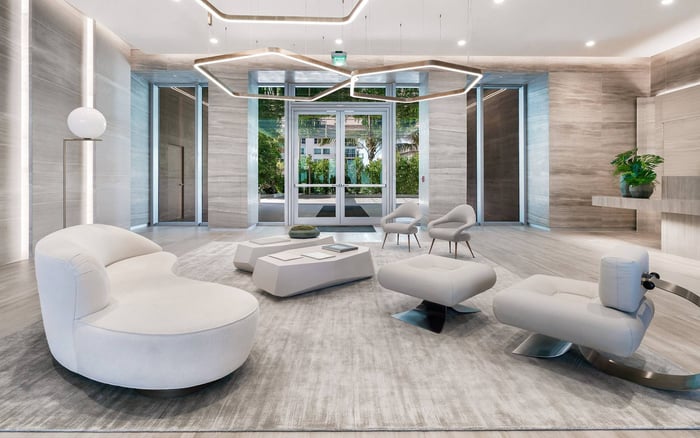
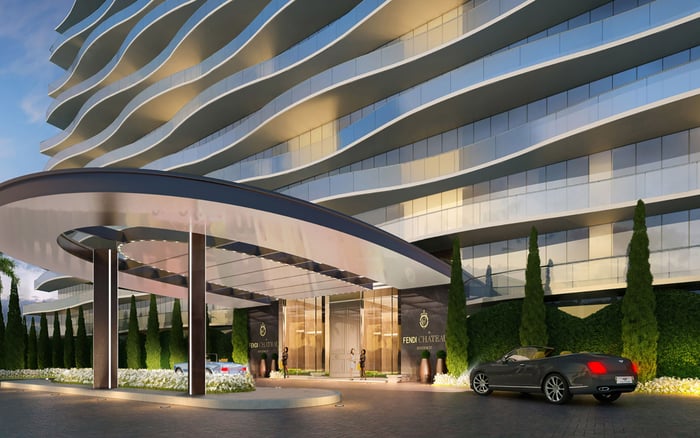
That is why arrival experience, resident circulation, service discretion, amenity placement, and acoustic calm matter so much in urban luxury. These are not decorative details. They determine whether a buyer feels observed or protected, rushed or composed, connected or overrun. The most successful high-rise residences make the elevator ride, the lobby sequence, and the threshold into the home feel like a gradual release from public life.
This is where 619’s positioning becomes relevant. The project is part of a Brickell market where buyers are comparing not only views and finishes, but also social temperature. They want access to culture without feeling that the building itself has become part of the crowd. A residence can be cosmopolitan and still be discreet. For many buyers, that combination is the highest expression of urban luxury.
619 Does not exist in isolation. It enters a Brickell landscape where each luxury project frames access and privacy differently. The Residences at 1428 Brickell speaks to buyers who evaluate the skyline through design, vertical living, and a highly refined residential identity. Its presence underscores how Brickell has moved beyond simple convenience into a more architectural kind of competition.
Nearby, Cipriani Residences Brickell illustrates another side of the same buyer psychology: the attraction of hospitality culture translated into private residential life. For clients who understand global service brands, the question becomes whether the hospitality layer enhances daily living without making the residence feel performative.
Then there is 2200 Brickell, which adds a different residential rhythm to the district’s conversation. Its relevance lies in how buyers are increasingly comparing not only towers, but lifestyles within the same urban frame. Lifestyle is no longer a vague amenity word. It is a practical measure of how a residence supports morning routines, private evenings, visiting guests, and the ability to step into the city selectively.
A project such as ORA by Casa Tua Brickell also reinforces Brickell’s growing relationship with culinary and social identity. In that context, 619’s association with Nobu Hospitality belongs to a broader shift: buyers are not merely buying square footage in Brickell. They are buying a curated relationship with the city’s cultural surface.
For new-construction buyers evaluating 619, the due diligence should be less about headline language and more about lived experience. How does the building receive residents? How clean is the separation between public energy and private circulation? Does the hospitality component feel resident-first? Are social spaces designed for choice rather than obligation? These are the questions that determine whether cultural access becomes an asset or a burden.
The best Brickell residences increasingly operate like private filters. They allow owners to be near the city without being consumed by it. They make it possible to host when desired, disappear when needed, and maintain a level of domestic quiet that feels rare in a dense urban setting. This is especially valuable for international owners, executives, collectors, and families who want Miami’s immediacy without sacrificing personal boundaries.
In this respect, 619’s appeal is not just about its collaborators. It is about timing. Brickell’s next phase of luxury is moving from “what is nearby” to “how does the building protect my relationship to what is nearby?” The distinction may sound subtle, but at the top end of the market it is decisive.
Cultural access has become one of Brickell’s core luxuries, but privacy is what keeps that access desirable. Without privacy, proximity becomes noise. Without access, privacy can feel static. The most compelling residences reconcile both, giving owners the city as an option rather than an intrusion.
619 Appears positioned for buyers who want that middle path. It belongs to a more mature conversation about urban luxury, one in which architecture, hospitality, and discretion are not separate selling points, but parts of the same residential promise. The result is a useful lens for evaluating Brickell overall: the strongest buildings are no longer only the most visible. They are the ones that make visibility optional.
Why does cultural access matter to Brickell luxury buyers? It allows owners to participate in the city’s dining, design, business, and social life without relying on a car-first lifestyle. The key is ensuring that access remains selective.
How does privacy work in a dense urban district? In Brickell, privacy is created through architecture, circulation, service design, and controlled arrival. It is less about distance and more about separation.
What makes 619 Residences relevant to this conversation? Its association with Foster + Partners and Nobu Hospitality places it at the intersection of design discipline and hospitality culture. That combination speaks directly to access with discretion.
Is branded residential living always about visibility? No. The strongest Branded Residences use brand identity to shape service, atmosphere, and trust, not merely recognition.
Why is Foster + Partners meaningful for buyers? The name signals an architectural lens, which can influence how buyers think about proportion, arrival, privacy, and long-term design value.
Why is Nobu Hospitality meaningful in a residential context? It suggests a hospitality sensibility that may appeal to buyers who value service, social ease, and curated experience. The important question is how privately that sensibility is delivered.
Should buyers compare 619 only with other Brickell projects? Brickell comparisons are essential, but buyers may also consider how the project fits broader South Florida preferences for privacy, service, and design.
What should buyers ask before committing to an urban luxury residence? They should ask how residents arrive, how guests are managed, how amenities are accessed, and where privacy is protected in daily routines.
Can a residence be social and private at the same time? Yes, if social spaces are optional, well placed, and resident-centered. Luxury comes from the ability to choose when to engage.
What is the main takeaway for 619 in Brickell? Its strongest positioning is the idea that cultural access and privacy do not have to compete. For the right buyer, they can reinforce each other.
If you'd like a private walkthrough and a curated shortlist, connect with MILLION.
If branded residences are on your mind — as a home or as an allocation — we would be glad to share what we are seeing, privately.
Begin a quiet conversation