International demand now anchors South Florida’s new-construction condo market, pushing developers toward hospitality-grade service, European-rooted branding, and a more curated design language. From Brickell to Miami Beach, the most successful launches increasingly translate global expectations into local product: privacy, discretion, wellness, and a lifestyle that feels immediately legible to buyers arriving from Latin America and Europe.
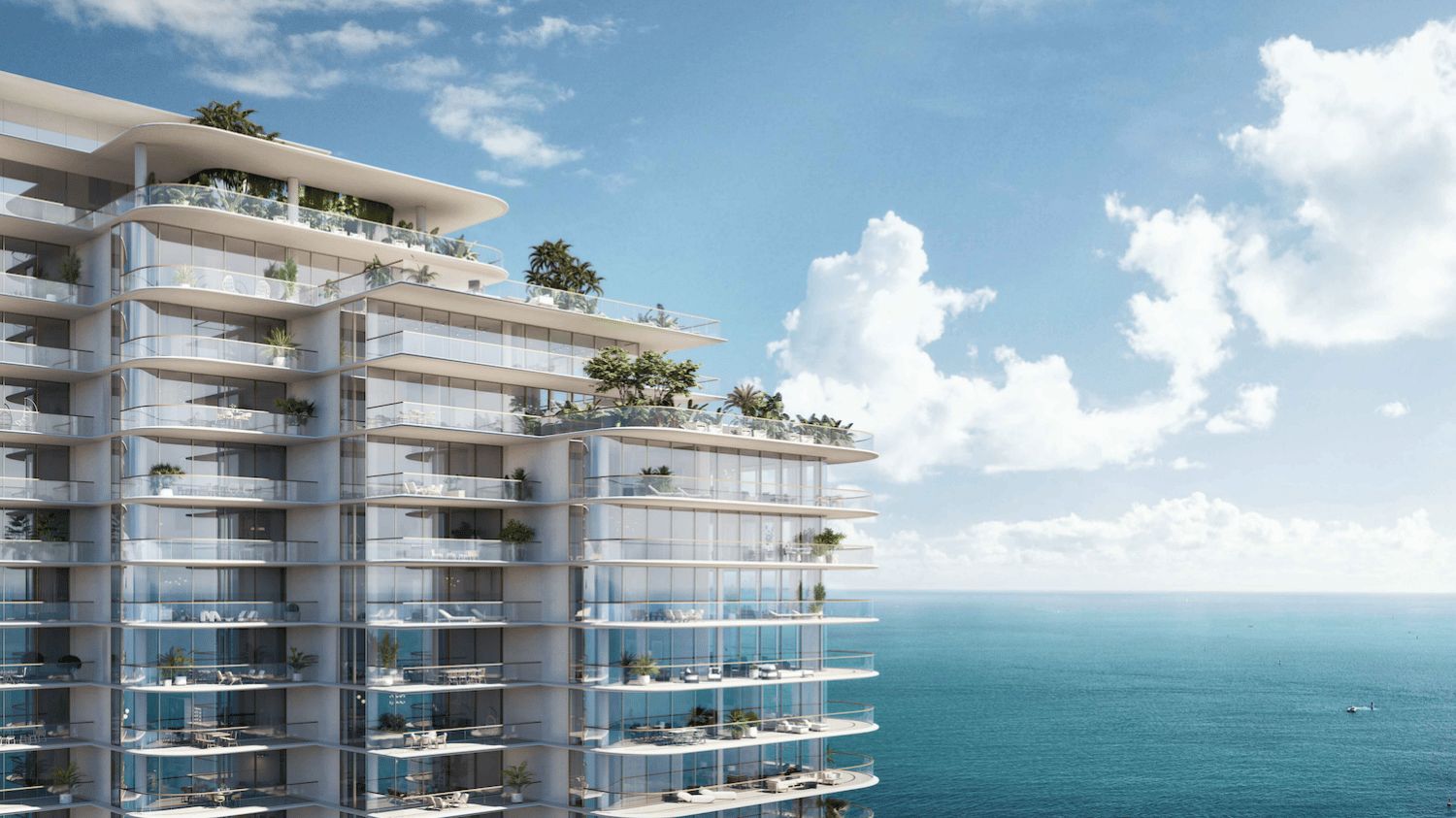
Miami’s luxury new-construction condo narrative is often framed around sunshine, taxes, and lifestyle. The more durable explanation is structural: demand has globalized, and the product has followed.
Miami REALTORS® reported that global buyers purchased 49% of South Florida new-construction units (July 2025). In a later update, Miami REALTORS® reported participation from buyers across 73 countries (November 2025). Taken together, those datapoints describe a market no longer calibrated primarily to a local, or even national, buyer. It is calibrated to a mobile, multilingual clientele that compares Miami not only to New York and Los Angeles, but also to Madrid, Milan, Mexico City, São Paulo, and London.
For developers, architects, and sales teams, that changes the brief. The question is no longer, “How many amenities can we fit?” It becomes, “Which lifestyle cues feel immediately credible to someone who may commit after one visit?” In an internationally driven market, the purchase decision is often about legibility and trust as much as it is about square footage.
That shift is also visible in how projects communicate. Global buyers arrive with a reference library: hotel experiences, service expectations, and an instinct for whether a concept is coherent. When the audience is international, marketing cannot rely on local shorthand. It has to translate a lifestyle in a way that feels recognizable on arrival, and deliverable after closing.
Latin American buyers remain a central force in Miami demand and marketing, widely covered as a persistent driver of the luxury and new-development segments. At the same time, an increasing wave of European buyers and European business presence has become a distinct theme in market reporting, with developers explicitly positioning projects and branding to appeal to European taste and capital.
These currents are not identical, but they frequently converge in what they require from a building: confidence, discretion, and a sense that operations will be consistent.
The most telling change is in the language of the sell. Instead of promising “more” in the abstract, many launches increasingly promise “better”: a clearer aesthetic, tighter detailing, and hospitality-caliber operations. This is also where Miami’s recent conversation around “quiet luxury” fits. MILLION Luxury has described quiet luxury in Miami architecture as a turn toward restraint, refined materials, and understated detailing, rather than maximalist finishes.
For a global buyer, restraint can read as confidence. It signals that the building is not chasing trends, and that the concept can live comfortably alongside other global addresses in a portfolio. At the same time, Miami still supports bolder expressions of luxury. The point is not that taste has narrowed, but that the most successful projects present a specific point of view and deliver it with discipline.
In a global buyer market, branded residences function as a form of due diligence in advance. The logic is straightforward: a recognized hospitality or fashion brand signals service standards, aesthetic direction, and status, even for buyers who do not yet know the local developer landscape.
Coverage of fashion-branded condos in Miami frames this category as more than a logo application. The brand can operate as a design driver, shaping materials, finishes, and the building’s visual identity. That is one reason the market can support concepts that are intentionally specific rather than broadly neutral.
Hospitality-rooted branding plays a different role. It promises a lived experience: arrival, daily rhythm, and a service culture that extends beyond the lobby. In the broader Miami pipeline, reporting highlights developers tying projects to European-rooted hospitality brands and narratives. The bet is that for a buyer arriving from abroad, “hospitality” reads as operational competence, not just a set of amenities.
This is also why branded residences have become a stronger value proposition than amenity volume alone. A pool deck photographs well, but brand alignment is designed to reassure: there is a standard, a script, and an expectation of consistency. For buyers navigating a market from a distance, that assurance can carry real weight.
Brickell remains the neighborhood where Miami’s globalization is easiest to see. It has the concentration of new towers, proximity to finance and business infrastructure, and a lifestyle ecosystem that supports full-time residents and second-home owners alike. In MILLION Luxury’s neighborhood guidance, Brickell’s appeal is frequently framed through this combination: vertical living paired with immediate access to dining, culture, and the core of the city.
What feels newer is the extent to which lifestyle programming is being imported into everyday residential life. A telling example is how Mediterranean and European dining culture is increasingly integrated into Brickell’s social rhythm, with reporting highlighting restaurant concepts that bring that sensibility to the neighborhood.
For buyers, the underwriting question in Brickell is less “Is the view compelling?” and more “Will the building operate like a private club in five years?” In an internationally driven market, owners expect a standard of consistency, discretion, and concierge capability that does not fluctuate with seasonality.
This is where Brickell’s best new-construction pitches have evolved. They emphasize not only what you can access, but how smoothly you can live: arrivals that feel controlled, staff that can execute quietly, and a resident experience that holds up well after the novelty of a launch fades. In a neighborhood defined by density and velocity, operational excellence becomes a luxury in its own right.
Miami Beach operates under a different logic. The most coveted product is often less about being in the center of everything and more about controlling one’s environment: controlled access, serene arrival sequences, and the ability to live beachfront without feeling exposed.
This is where ultra-luxury positioning and privacy-forward narratives become powerful. Luxury-market coverage has framed why global elites are choosing ultra-private $5 million-plus homes in Miami, emphasizing discretion and security alongside lifestyle.
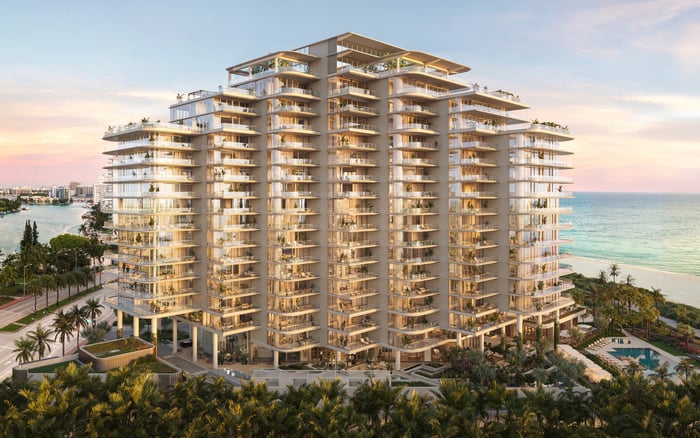
Within the new development set, The Perigon Miami Beach is marketed as an ultra-luxury beachfront residential project with a notable design pedigree, and with a high-touch amenity program positioned for buyers seeking privacy plus luxury services. For an international buyer, the appeal of Miami Beach is not only the ocean. It is the ability to own a resort-level experience while still maintaining residential privacy.
Miami Beach also shows how brand ecosystems can extend beyond a single tower. Casa Cipriani Miami Beach sits within a broader market movement toward hospitality-linked residential concepts. The expectation is less about “amenities” as square footage and more about service as culture: how the building feels at 7 a.m., how guests are received, and how seamlessly daily life is handled.
For those drawn to Miami Beach’s art-forward, design-conscious identity, Faena House Miami Beach represents another way the neighborhood expresses luxury: through curated aesthetic positioning that feels globally conversant. The common thread is not a single style. It is authorship. These projects aim to feel intentional, edited, and protected from dilution.
Miami is famous for extravagant amenities, and that remains part of the competitive landscape. MILLION Luxury has covered how luxury towers market marinas, wellness programs, and VIP services as defining features.
But as the buyer base internationalizes, the decision criteria shifts in subtle ways. Buyers still appreciate abundance, yet increasingly they underwrite whether the experience will be calm, private, and well managed.
That operational promise is what sophisticated buyers and their advisors listen for. Who is accountable for service delivery? What, exactly, will be staffed and managed day to day? Does the concept depend on a single signature venue, or is it built on consistent execution across the entire resident experience?
In this environment, narrative matters because narrative is often a proxy for discipline. Reporting on developers courting European buyers has noted a move toward European-rooted hospitality stories rather than simple amenity abundance. It is a more mature pitch, and global buyers respond to it because it signals a system, not a spectacle.
Miami’s luxury market is now broad enough to hold contradictions. Quiet luxury and fashion-house maximalism can both succeed, because both can be coherent.
Quiet luxury, as described in MILLION Luxury coverage, signals restraint and refined detailing. It tends to resonate with buyers who want interiors that will not date quickly, and who treat a Miami residence as one asset within a global portfolio.
Fashion-house maximalism can work for a different reason: it is unmistakable. In a market where many towers can appear interchangeable at first glance, a strong brand aesthetic reduces ambiguity. It tells the buyer, immediately, what this building is and what it is not.
The practical point is not which direction is “better.” It is whether the building’s aesthetic and service model match how you actually live.
A second-home owner who wants lock-and-leave ease may place more weight on operations and brand standards than on expansive entertaining spaces. A full-time resident may prioritize neighborhood walkability, privacy from transient traffic, and long-term governance. In both cases, clarity is the advantage: a clear design language tends to correlate with a clearer experience of place.
International demand can make a market feel effortless during the sales phase. Sophisticated buyers separate marketing from durability. A discreet checklist helps keep the decision grounded.
First, treat the building as a service platform.
Second, ensure the narrative matches the neighborhood.
Third, recognize what branding can and cannot do.
Finally, watch the market’s deeper signal: the breadth of global participation. With buyers participating from dozens of countries, Miami’s luxury new-construction market increasingly behaves like a global gateway city. That can support pricing, but it also raises the bar for authenticity. In 2026 and beyond, the strongest projects will be those that feel inevitable, not loud.
Is Miami’s new-construction demand still driven by international buyers? Miami REALTORS® reported that global buyers purchased 49% of South Florida new-construction units (July 2025), and later reported participation from buyers across 73 countries (November 2025).
Why are branded residences so prevalent in Brickell and Miami Beach? Branded residences provide a fast signal of design language, service standards, and status for global buyers who may not have deep familiarity with local developers.
What is “quiet luxury” in Miami real estate terms? It is a design and marketing approach emphasizing restraint, refined materials, and understated detailing instead of overt, maximalist statements.
Are extravagant amenities still important in Miami luxury towers? Yes, but increasingly the differentiator is how well the building delivers privacy, wellness, and consistent service, not just the quantity of amenity spaces.
For tailored guidance on South Florida’s next-generation luxury towers, visit MILLION Luxury.
If branded residences are on your mind — as a home or as an allocation — we would be glad to share what we are seeing, privately.
Begin a quiet conversation