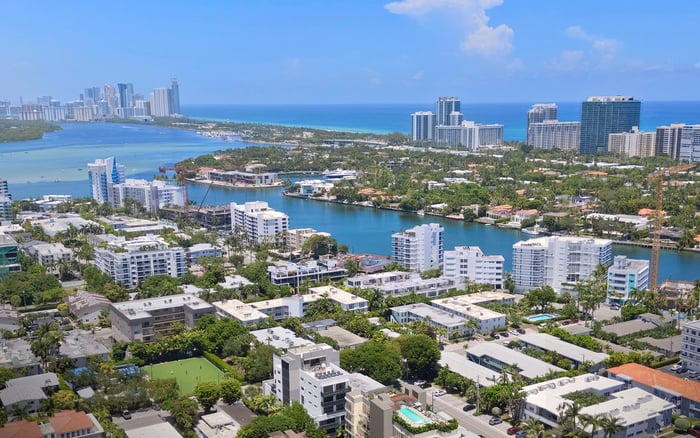
A buyer-focused comparison of Glass House Boca Raton and Mila Bay Harbor Islands, centered on lifestyle fit rather than branding. The decision comes down to whether a Boca Raton routine or a Bay Harbor Islands routine better supports calm, daily convenience and access to surrounding energy.

The meaningful comparison between Glass House Boca Raton and Mila Bay Harbor Islands is not a contest of names. It is a question of how a buyer wants life to feel from Monday morning through Sunday evening. One option is anchored in Boca Raton, where the appeal is a calmer residential rhythm and a more self-contained sense of daily order. The other is anchored in Bay Harbor Islands, where the value proposition leans toward island-village convenience and proximity to the broader Miami-area lifestyle.
That distinction matters because luxury buyers can be distracted by presentation. Renderings, lobbies and amenity language may shape first impressions, but the lasting test is more practical. How often will you leave the building? Where will you dine casually? How will friends reach you? Does the location make life easier, or simply look persuasive in a brochure?
For this comparison, the right lens is fit. Glass House should be evaluated as the Boca Raton choice. Mila should be evaluated as the Bay Harbor Islands choice. Once that is clear, the decision becomes less emotional and more useful.
Glass House Boca Raton belongs in the conversation for buyers who want the polish of new development without surrendering to a constant public-facing pace. Boca Raton is often attractive to residents who prefer a more measured residential environment, with routines shaped around comfort, privacy and familiar local patterns rather than constant movement across a dense urban grid.
That does not mean a buyer should assume quiet, privacy or convenience without checking the actual building and location details. It means the Boca Raton setting gives Glass House a different starting point. The buyer considering this side of the comparison is likely asking whether the residence supports a lower-key everyday life while still delivering a refined condominium experience.
For some, that Boca-oriented logic may also bring Alina Residences Boca Raton into the broader search, especially when the goal is to understand how different Boca Raton projects interpret walkability, service, privacy and access. Others may look at The Residences at Mandarin Oriental Boca Raton as a reference point for how branded hospitality and a Boca address can intersect. Those comparisons are useful, but they should not replace the central question: does Glass House make the buyer’s actual routine simpler and calmer?
Mila Bay Harbor Islands starts from a different premise. Bay Harbor Islands is not trying to be Boca Raton. It offers a more proximity-driven lifestyle, with island-village convenience and access to surrounding Miami-area energy. The buyer drawn to Mila may want a home base that feels residential while remaining close to a more public-facing set of restaurants, shops, services and social patterns.
The appeal is not simply that Bay Harbor Islands is connected. It is that the connection can be woven into daily life. A resident may value being able to structure errands, dining and social plans around a compact local environment while still remaining near the wider Miami ecosystem. That is a different form of convenience than the Boca Raton version. It is less about retreating into a quieter routine and more about reducing friction between home, leisure and the surrounding city.
Within Bay Harbor Islands, buyers may also compare Mila with projects such as The Well Bay Harbor Islands and Onda Bay Harbor to understand how each building positions daily convenience, privacy and waterfront or neighborhood character. The key is to compare actual floor plans, amenity programs, parking, services and location feel rather than relying on a general Bay Harbor impression.
The buyer choosing between these two addresses should avoid framing the decision as quiet versus exciting. That is too simple. The better framework is controlled calm versus nearby energy.
Glass House may appeal if the buyer wants the home environment to feel like the center of gravity. In that scenario, the building, the residence and the Boca Raton setting are expected to create a dependable daily base. The owner may still want dining, culture, beach access and travel routes, but those needs are filtered through a preference for residential ease.
Mila may appeal if the buyer wants a home environment that remains composed while keeping the surrounding world closer at hand. The Bay Harbor Islands side of the equation is more about access. The owner may be comfortable with a slightly more active surrounding lifestyle if it translates into shorter, simpler daily patterns.
This is where language such as Bay-harbor, Boutique, New-construction, Beach-access and Second-home can be useful shorthand in a buyer’s notes, but it should never become the decision itself. The true test is how the setting behaves when the novelty fades.
Before making a commitment, buyers should verify the current unit mix, pricing, floor plans, amenity package, delivery timing and sales status directly for each property. These details can change, and they often determine whether a lifestyle thesis is actually supported by the specific residence available.
For Glass House Boca Raton, the buyer should focus on the Boca-based convenience checks: approach, parking experience, elevator rhythm, views, exposure, outdoor space, service expectations and the ease of moving through a typical week. If the goal is residential calm, the selected residence must reinforce that goal.
For Mila Bay Harbor Islands, the buyer should test the convenience thesis in practice. That means looking carefully at access points, daily errands, nearby dining habits, traffic patterns, visitor logistics and the relationship between the building and the neighborhood around it. If the goal is proximity and ease, the building must make those advantages tangible.
Resale logic should also be practical. A future buyer will not purchase branding alone. They will evaluate whether the building’s location, plan quality and daily usability still make sense relative to competing options in the same submarket.
Glass House Boca Raton is likely the more intuitive fit for a buyer who wants a composed South Florida residence, a Boca Raton lifestyle profile and a setting that can support quieter daily habits. It may be especially relevant for someone prioritizing a primary residence or second home where privacy, routine and local comfort matter more than being near the busiest social corridors.
Mila Bay Harbor Islands is likely the better fit for a buyer who wants residential scale with more immediate access to Miami-area energy. It may suit someone who values convenience, enjoys a more connected lifestyle and wants the surrounding neighborhood to participate actively in daily life.
Neither path is inherently more luxurious. Luxury, at this level, is the absence of friction. For one buyer, that means a calmer Boca Raton base. For another, it means a Bay Harbor Islands address that keeps the day efficient, social and close to the action.
Is Glass House Boca Raton the calmer choice? It should be evaluated as the Boca Raton option, where the lifestyle thesis centers on a calmer residential routine. Buyers should confirm the actual building and location details before relying on that assumption.
Is Mila Bay Harbor Islands more convenient? Mila should be evaluated through the Bay Harbor Islands lens, where island-village convenience and nearby Miami-area access are central. The convenience case should be tested through daily routes and habits.
Should branding decide between the two? No. The stronger decision is based on location, residence quality, building scale, privacy, access and how the property supports daily life.
Which building is better for a second home? Either can work, depending on how the owner plans to use the residence. Boca Raton may suit quieter stays, while Bay Harbor Islands may suit convenience-led visits.
Can buyers compare pricing directly? Only after verifying current pricing, availability and residence details for each property. Without current data, lifestyle fit is the safer comparison.
Is beach access part of the decision? It can be, but buyers should verify actual routes, preferences and expectations. Beach access means different things depending on frequency and ease.
Which option has stronger resale logic? Resale logic depends on the specific residence, building execution and submarket demand at the time of sale. A practical floor plan and durable location usually matter more than presentation.
Should I compare other Boca Raton projects too? Yes, if Boca Raton is the preferred lifestyle setting. Comparing nearby options can clarify whether Glass House best matches the desired balance of calm and convenience.
Should I compare other Bay Harbor Islands projects too? Yes. Bay Harbor Islands has several distinct residential interpretations, and comparing them can sharpen the difference between convenience, privacy and neighborhood feel.
What is the simplest way to decide? Spend less time asking which building sounds more prestigious and more time asking which address improves an ordinary week. The best choice is the one that makes daily life feel effortless.
For a tailored shortlist and next-step guidance, connect with MILLION.
If branded residences are on your mind — as a home or as an allocation — we would be glad to share what we are seeing, privately.
Begin a quiet conversation