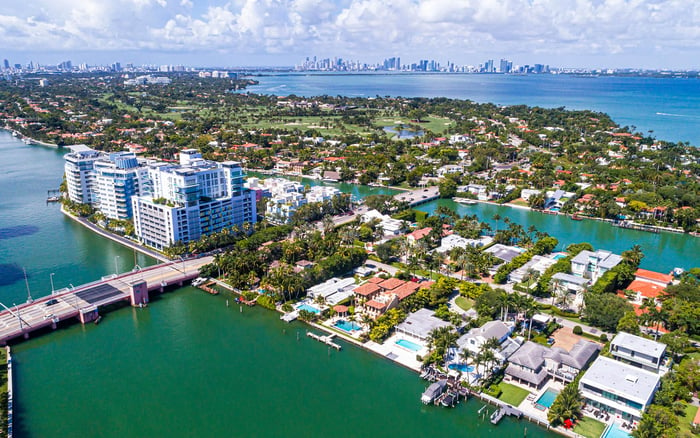
For Toronto buyers, the most consequential Miami Beach tax decision may be made before the deed is signed. Coordinating ownership, records, FIRPTA planning, and closing mechanics from the outset can protect liquidity when the property is eventually sold.

For a Toronto purchaser, acquiring a Miami Beach residence is both a lifestyle decision and a cross-border planning exercise. Views, architecture, privacy, and service culture may shape the search, but ownership structure and eventual disposition deserve equal attention before the deed is signed.
That is especially true at the luxury end of the market. A buyer considering 57 Ocean Miami Beach or The Perigon Miami Beach should model the eventual sale before completing the purchase. The essential question is not simply who will own the residence today, but how that owner will be treated when the property is sold, how much cash may be withheld at closing, and which filings will be required to reconcile that withholding with the final U.S. tax liability.
Within MILLION’s Buyer's Guides, this is best understood as an Investment, Second-home, Resale, and Waterfront planning issue at once. Each lens informs the practical exit strategy, though none replaces coordinated Canadian and U.S. legal and tax advice.
The most effective exit strategy is designed before the acquisition closes.
FIRPTA is a federal withholding mechanism that collects funds toward a foreign seller’s eventual U.S. tax liability on the sale of a U.S. real property interest. A Toronto-based individual who remains a U.S. nonresident is generally considered a foreign person for this purpose. Foreign corporations, partnerships, trusts, and estates may also fall within the regime.
The critical distinction is between withholding and final tax. Standard withholding is generally 15% of the amount realized-typically the gross sale price, not the seller’s profit. On an $8 million transfer, for example, the default calculation would be $1.2 million, regardless of the seller’s purchase price, capital improvements, or projected taxable gain. This illustrates cash withheld, not final tax.
Limited residence exceptions exist at lower price points. No withholding is generally required for a qualifying buyer residence purchase of $300,000 or less. A qualifying residence purchase above $300,000 and no more than $1 million may receive a 10% rate. Once the amount realized exceeds $1 million, the general 15% rate applies even if the buyer intends to use the property as a residence. For most ultra-premium Miami Beach exits, 15% of gross proceeds is therefore the prudent baseline for liquidity modeling.
Personal ownership can appear straightforward, but simplicity at acquisition does not resolve questions of U.S. estate-tax exposure, Canadian reporting, residency, succession, or the eventual transfer of wealth. Corporate and trust structures introduce their own trade-offs. No structure should be selected solely because it is familiar in one jurisdiction.
A Canadian corporation does not remove FIRPTA. It remains a foreign owner for U.S. withholding purposes when it sells Florida real estate. If full withholding occurs, an individual generally claims the credit through the applicable U.S. return. A Canadian corporate seller generally calculates its U.S. liability through Form 1120-F and seeks any available refund.
The analysis should extend beyond the property sale. If a corporation was created solely to hold the residence, the plan should address its eventual liquidation and the related consequences in both countries. Changing title after acquisition can itself produce separate U.S. and Canadian consequences, making it preferable to settle the structure before closing whenever possible.
This discipline applies whether the intended residence is The Ritz-Carlton Residences® Miami Beach, a private home, or another high-value condominium. Property selection and ownership architecture should advance together, not on parallel tracks that meet only at closing.
A sophisticated resale model should distinguish among gross sale proceeds, projected taxable gain, and expected net cash at closing. FIRPTA affects the third figure immediately, while the final U.S. tax calculation ultimately determines whether additional tax is due or a refund may be available.
Maintain a permanent acquisition file from day one. It should preserve the purchase closing statement, evidence of tax basis, invoices and proof of payment for qualifying improvements, ownership documents, and taxpayer identification information. Before listing, update the projected gain and review whether ownership, residency, or succession circumstances have changed.
This recordkeeping matters because withholding based on gross proceeds can materially exceed final tax based on gain. A beautiful acquisition at Shore Club Private Collections Miami Beach still requires an orderly documentary history if the seller later seeks a reduced withholding certificate or claims a credit and refund.
A foreign seller may request reduced or eliminated withholding through Form 8288-B when the projected U.S. tax supports that result. This is not a closing-day improvisation. To coordinate the application with the sale, it should generally be submitted on or before the transfer date.
When a timely application is pending, the buyer must still withhold the required amount, but remittance can be delayed until a determination is issued. A Miami title company may hold the tailored amount in escrow during that period. A complete application is normally acted upon within approximately 90 days, so the seller should prepare well before contract execution or closing and should not assume immediate access to the escrowed funds.
The working file should include reliable basis records, improvement costs, proposed contract economics, projected gain, taxpayer identification numbers, and the requested withholding calculation. The purchase and sale agreement should also address the application, escrow arrangement, and parties’ duties after a determination.
The buyer, as transferee, is generally responsible for withholding. Failure to collect and remit the required amount can expose the buyer to tax, interest, and penalties. Foreign status therefore cannot be treated as a private matter for the seller’s accountant alone.
The contract and closing instructions should allocate responsibility for foreign-status certifications, preparation of Form 8288-B, escrow, withholding, and post-closing filings. The buyer generally reports and remits withholding using Form 8288 and prepares Form 8288-A for each foreign seller. The forms and funds are generally due by the 20th day after the transfer date, subject to the procedures governing a timely certificate request.
Form 8288-A records the amount withheld. The foreign seller uses the IRS-stamped copy to claim the corresponding credit on a U.S. return. Names, ownership percentages, taxpayer identification numbers, and mailing details should therefore be verified carefully before closing.
Before acquisition, compare personal, corporate, and trust ownership through coordinated Canadian and U.S. advice. At acquisition, establish a complete basis file and document the intended succession path. During ownership, retain improvement records and revisit the structure when residency or family circumstances change.
Before listing, estimate both final tax and default FIRPTA withholding, then decide whether Form 8288-B is appropriate. During contract negotiations, settle certification, escrow, withholding, filing, and cooperation provisions. After closing, track Form 8288-A, file the appropriate U.S. return, claim the withholding credit, and complete any required Canadian reporting or entity wind-up planning.
Florida’s individual income-tax environment does not displace this federal regime. The practical advantage belongs to the owner who treats tax, title, documentation, liquidity, and succession as elements of one residential strategy.
For discreet guidance on South Florida’s finest residences, connect with MILLION.
If branded residences are on your mind — as a home or as an allocation — we would be glad to share what we are seeing, privately.
Begin a quiet conversationFIRPTA is a federal mechanism that withholds funds toward a foreign seller’s eventual U.S. tax liability when a U.S. real property interest is sold.
Yes. A Toronto-based individual who remains a U.S. nonresident is generally treated as a foreign person when selling Miami Beach real estate.
Generally, no. The standard withholding is 15% of the amount realized, typically the gross sale price rather than taxable profit.
The general 15% rate applies when the amount realized exceeds $1 million, even if the buyer intends to use the property as a residence.
No. A Canadian corporation remains a foreign owner for U.S. withholding purposes when it sells Florida real estate.
Yes. A seller may apply for an IRS withholding certificate using Form 8288-B when projected U.S. tax supports reduced or eliminated withholding.
It should generally be submitted on or before the transfer date, with advance preparation preferable for closing and liquidity planning.
The buyer, as transferee, is generally responsible and may face tax, interest, and penalties if required withholding is not collected and remitted.
Form 8288-A documents the amount withheld. The foreign seller uses the IRS-stamped copy to claim the corresponding credit on a U.S. tax return.
It should assign responsibility for foreign-status certifications, Form 8288-B, escrow, withholding, post-closing filings, and cooperation between the parties.