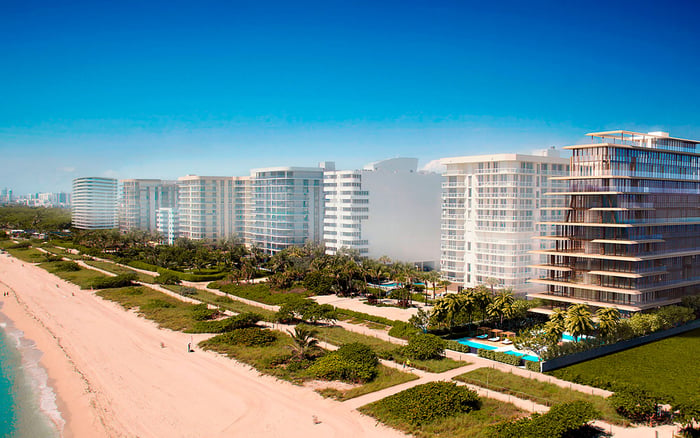
At an oceanfront condominium, pending exterior work can affect far more than the visible condition of the building. The disciplined offer accounts for engineering scope, reserves, assessment timing, disruption, and contractual responsibility without assuming that any current project at Ocean House Surfside has been confirmed.

At Ocean House Surfside, an offer should distinguish among ordinary coastal upkeep, an identified repair program, and unresolved structural uncertainty. This oceanfront condominium in Surfside faces salt air, wind-driven rain, and regulatory scrutiny, making its concrete, waterproofing, and façade records especially consequential. Yet the available facts do not establish that Ocean House currently has a specific project, assessment, engineering finding, or construction schedule. A buyer should verify every point rather than price rumor as fact.
The starting file should include the latest milestone or recertification report, engineer follow-up letters, reserve information, current budgets, recent board minutes, owner notices, and every proposed or adopted assessment. Missing engineering or association records do not prove that no work exists. They present a due-diligence concern that should shape both timing and contractual protection.
The offer should price documented exposure, while protecting against what remains unresolved.
This is the central principle for a sophisticated resale acquisition. A pristine residence does not neutralize building-level obligations, and a planned repair does not automatically make a building undesirable. The decisive issues are scope, funding, management, schedule, and the residence's direct exposure.
Florida requires milestone structural inspections for condominium and cooperative buildings of three or more stories, generally at 30 years, or at 25 years where applicable coastal rules require an earlier review. Follow-up inspections generally recur every 10 years. Miami-Dade's framework likewise identifies a 25-year first recertification for coastal buildings and 30 years for inland buildings.
Surfside's program calls for recurring inspections every 10 years after the initial age-based recertification. Its process provides 90 days after notice to submit an engineer's report and 150 days to complete required repairs or modifications when deficiencies are identified. Exact deadlines should still be confirmed against the building's certificate-of-occupancy date and current requirements at the state, county, and town levels.
A licensed engineer or architect conducts the examination, addressing structural deterioration and electrical-system functionality. Post-Surfside reforms have also strengthened inspection and reserve-funding obligations, limiting an association's ability to postpone major structural maintenance indefinitely. For buyers, reserve strength and the quality of board execution are central valuation questions, not administrative details.
Concrete restoration, waterproofing replacement, and façade work are related, but they do not carry identical implications. Waterproofing failures can allow moisture to reach concrete and reinforcing steel. Visible rust penetrating concrete warrants prompt engineering assessment because it may signal moisture intrusion and deterioration around reinforcement. The observation is not a diagnosis, but it is reason to seek professional analysis.
Scope also determines lifestyle impact. Work in a garage or at a remote common element may create inconvenience without directly affecting daily life inside the residence. Balcony, terrace, window, or ocean-facing façade work can be more intrusive, potentially limiting access, privacy, views, quiet, and the use of outdoor areas. Buyers should ask whether staging, scaffolding, swing stages, protective coverings, or access through the unit may be contemplated-and accept only documented answers.
The same discipline applies when comparing nearby luxury choices such as Arte Surfside or Fendi Château Residences Surfside. Each condominium must be evaluated on its own engineering history, reserves, governance, and disclosed obligations.
An approved assessment for concrete, waterproofing, or façade work belongs in the acquisition calculation. The relevant figure is not merely the contract price. It is the contract price plus the buyer's allocated assessment liability, likely carrying costs, and the value of foreseeable disruption.
If an assessment has been adopted and quantified, negotiations can be precise. The parties might address it through a price reduction, seller credit, seller payment, or another written allocation at closing. The contract should state who is responsible for assessments approved before closing and what happens if a project is disclosed, proposed, or adopted during the contract period. A Florida real-estate attorney should prepare or review that language, including any escrow mechanics and cancellation rights.
If engineering records identify deterioration but the final scope, contractor pricing, or assessment remains unsettled, the offer warrants a larger uncertainty discount. It should also include a document-review contingency permitting renegotiation or cancellation. An undefined obligation cannot be valued with the same confidence as a fully adopted, funded, and scheduled program.
A reserve balance has meaning only in relation to the work it may need to fund. Weak reserves relative to identified structural needs increase the prospect of special assessments or higher recurring contributions. Adequately funded reserves reduce that exposure, although they do not eliminate construction risk or disruption.
Determine how much of the expected cost is covered, whether bids or contracts exist, whether contingencies are included, and whether owner payments have begun. Then examine collection status, project governance, engineer oversight, and the reliability of the anticipated completion schedule. Fully funded, competently managed repairs justify a smaller risk adjustment than deferred work with uncertain scope, inadequate reserves, or no dependable timetable.
For a buyer considering The Surf Club Four Seasons Surfside alongside Ocean House, the evaluation should remain residence-specific and association-specific. Brand, design, and amenities may shape desire, but they do not replace scrutiny of structural records and financial obligations.
The strongest offer terms anticipate changes between execution and closing. Require timely delivery of new engineering correspondence, notices, board actions, contracts, and assessment decisions. Preserve the right to review material developments. Define whether seller responsibility turns on the approval date, due date, commencement of work, or another negotiated trigger. Ambiguous timing can shift a substantial obligation after the price has been agreed.
A balcony or terrace deserves particular attention because direct access restrictions can diminish the very attributes supporting an oceanfront premium. Buyers should determine whether windows, railings, sliding doors, exterior finishes, or private outdoor areas fall within the contemplated scope-and whether responsibility belongs to the association or unit owner under the governing documents.
The most durable advice is also the most discreet: do not overreact to responsible maintenance, but do not underprice uncertainty. A transparent, funded, professionally managed project can demonstrate stewardship. Incomplete records, deferred decisions, and unclear contractual responsibility call for a more defensive offer.
For discreet guidance on South Florida luxury condominium opportunities, connect with MILLION.
If branded residences are on your mind — as a home or as an allocation — we would be glad to share what we are seeing, privately.
Begin a quiet conversationThe supplied facts do not confirm a current scope, assessment, engineering finding, or schedule. Buyers should verify the association's latest records before assigning a cost.
Request the latest milestone or recertification report, engineer letters, reserve information, budgets, board minutes, owner notices, and details of proposed or adopted assessments.
Treat it as part of the effective acquisition cost. Address it through price, credit, seller payment, or another clearly written allocation.
Apply a larger uncertainty discount and include a document-review contingency that allows renegotiation or cancellation.
Weak reserves relative to identified needs increase the likelihood of special assessments or higher recurring contributions. Stronger funding reduces, but does not erase, exposure.
No. A fully funded, competently managed project with a reliable schedule generally warrants a smaller adjustment than deferred or undefined work.
Failed waterproofing can allow moisture to reach concrete and reinforcing steel. Visible rust penetrating concrete should prompt professional engineering assessment.
Yes. Work involving balconies, terraces, windows, or ocean-facing elevations can affect access, noise, privacy, views, and outdoor use.
The purchase contract should expressly allocate responsibility. A Florida real-estate attorney should review the language, timing triggers, and any escrow terms.
Surfside's program requires inspections every 10 years after the initial age-based recertification. Exact deadlines should be verified for the particular building.