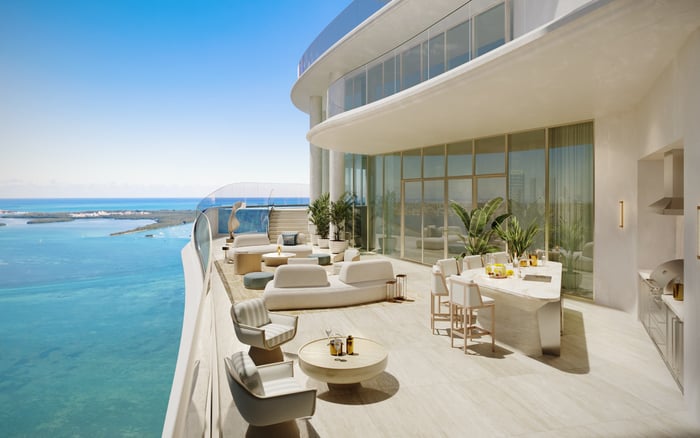
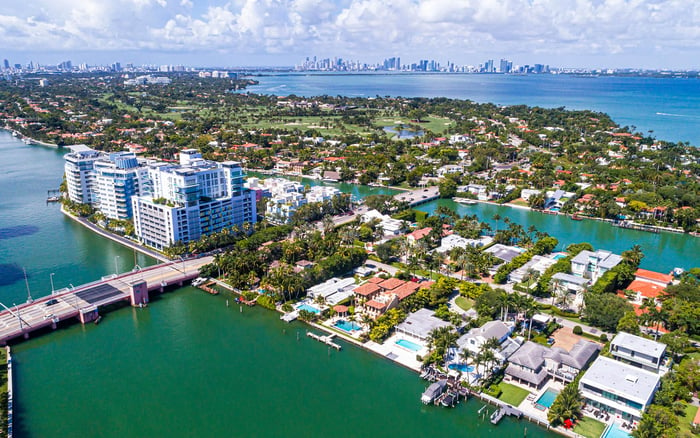
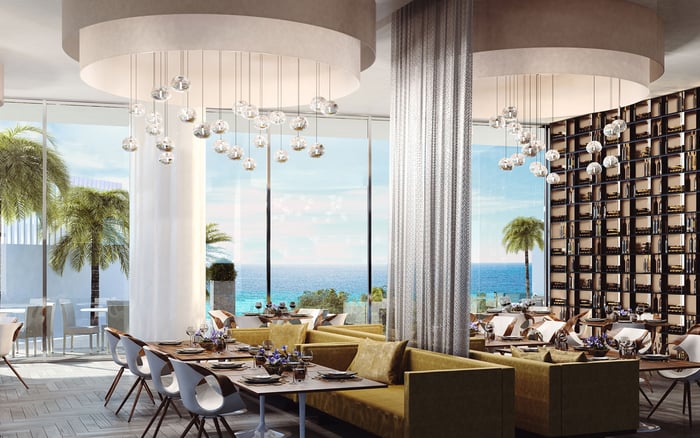
The meaningful distinction between oceanfront and bayfront living is not simply the view. For a well-run household, private arrival, guest circulation, staff access and clearly defined services deserve equal weight in the purchase decision.
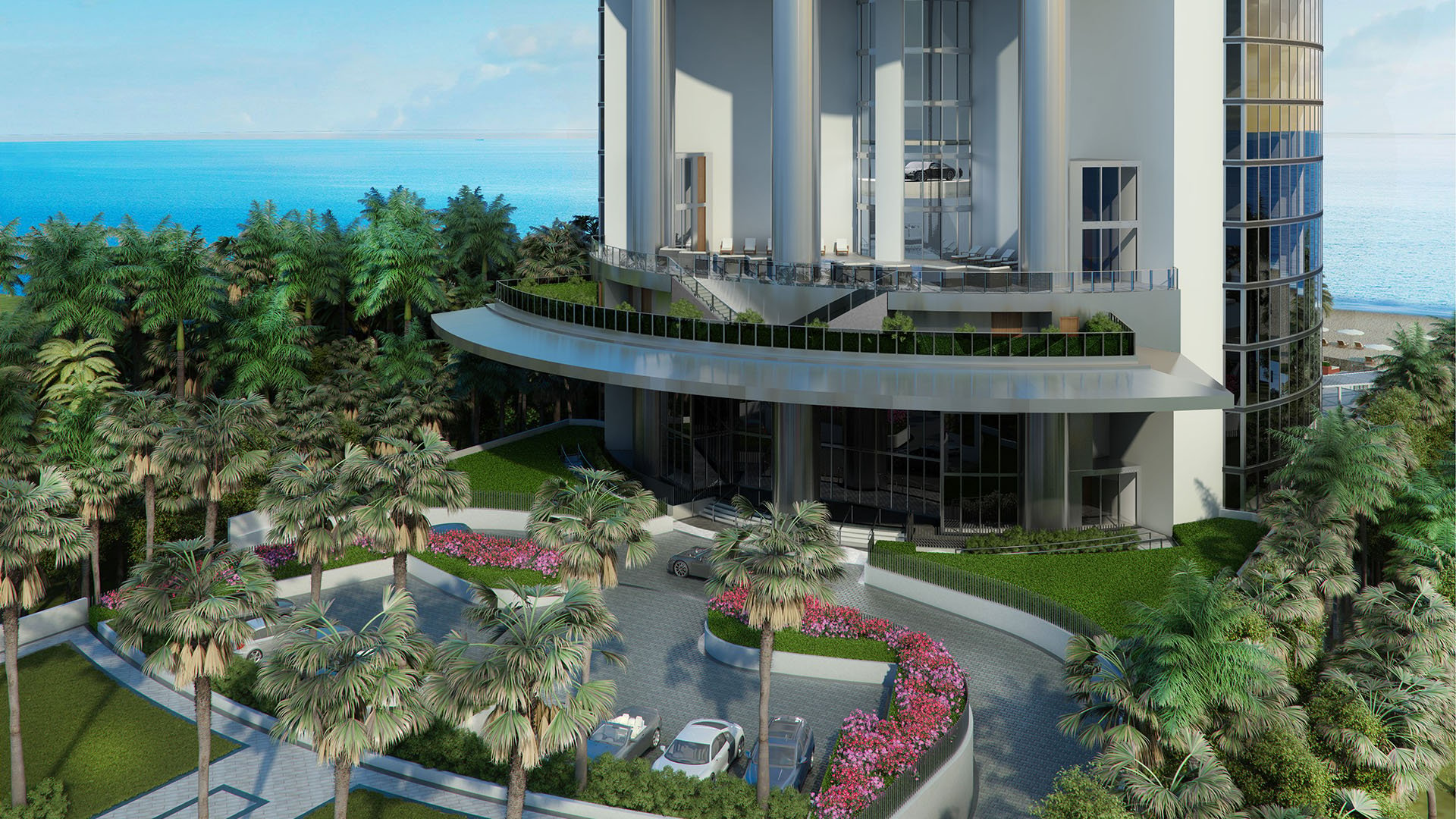
The first waterfront decision is emotional: an open ocean horizon or the changing light across Biscayne Bay. The more consequential decision is operational. Who can reach the residence, where guests wait, how household employees arrive and what happens to deliveries while the owner is away will shape daily life long after the view becomes familiar.
Neither oceanfront nor bayfront living is inherently more private. Privacy depends on the specific residence, its circulation plan and its operating rules. A private elevator may create an elegant arrival without resolving staff access. A concierge may coordinate requests without providing the household support an owner expects.
Here, liability is a prompt for due diligence, not a legal conclusion. Advertised features do not establish security performance, service quality or legal responsibility. The buyer's task is to distinguish the pleasure of the setting from the obligations of running a home within it.
Start at the vehicle, not the apartment door. Ask how residents move from valet or parking to the elevator, where visitors are cleared and whether anyone shares the final landing. Then inspect the plan for the particular residence: private and semi-private are not interchangeable descriptions.
At Continuum on South Beach, advertised features in the South Tower in Miami Beach include private and semi-private elevator foyers, as well as an oversized service elevator accessed through a separate service corridor. These are distinct features. Buyers should examine both rather than treating the foyer as shorthand for complete separation.
In Surfside, the advertised arrival arrangement at Ocean House Surfside provides access to each home through private keyed elevators and vestibules. That describes an arrival feature, not the complete route for employees, deliveries or contractors. Request those routes separately.
For every option, ask who can authorize access, whether credentials are limited by destination or time, and how permissions are withdrawn. The question is not simply whether entry is private, but how that privacy is administered.
A dinner party is a useful test of a building's guest-arrival arrangements. Trace the experience from arrival through check-in, elevator authorization and entry to the home. Ask what changes when several guests arrive together, when an owner is delayed or when an overnight visitor returns independently.
Keep these scenarios separate from delivery access. A dinner guest, a grocery courier and a household employee have different reasons to enter and need not receive equivalent permissions. Ask management to explain each route, including where someone waits if entry is not immediately authorized.
During a peak-time visit, look for intersecting routes, not just attractive finishes. Does the route to a residential elevator cross a busy amenity entrance? Where would a caterer wait while guests arrive? Do not assume these conflicts exist, but do not let a quiet showing substitute for understanding how the building handles simultaneous arrivals.
For a household with recurring employees, the service route deserves the same attention as the principal entrance. Begin at loading or parking and follow the entire sequence: credentials, waiting area, elevator, corridor and residence door. A dedicated elevator is only one component.
At Faena House in Miami Beach, advertised features include private or semi-private elevator vestibules and service entrances, along with a dedicated service elevator. Those features provide a concrete basis for asking how guest arrival and household work are separated. They do not, by themselves, establish permitted hours or uninterrupted access.
Request written clarification of employee access hours, contractor procedures, storage and refuse handling. Ask what happens when the service elevator is reserved or unavailable, and whether routine deliveries can still reach the home without disrupting guests. Establish who is responsible for authorizing temporary workers.
The objective is discreet, workable access rather than invisibility at any cost. A route that appears separate on a floor plan must also function for the people maintaining the residence every day.
On the bayfront side of the comparison, advertised features at Una Residences Brickell include private elevator entry, a 24-hour concierge and front desk, valet parking, package facilities and available housekeeping services. That combination warrants a conversation about routine household needs-not an assumption that every task is included.
Ask what housekeeping covers, who performs it, how it is booked and what it costs. For packages, establish the process for acceptance, notification, storage and transfer to the residence. For any service described as available, distinguish availability from a commitment to respond.
Butler service deserves equally precise questions. Define the tasks your household would actually request, then confirm scope, staffing arrangements, booking requirements and fees. A service title is not a substitute for an agreed operating brief.
Beach and marina amenities require a second circulation review beyond the residential lobby. Verify the rights attached to ownership, the rules for guests, any public access and any hotel or club overlap. An appealing waterfront setting does not answer those questions.
St. Regis® Residences Sunny Isles is planned across approximately 435 linear feet of beachfront in Sunny Isles Beach. Advertised services include dedicated butler service and 24-hour concierge support, while the proposed offering includes a full-floor oceanfront spa designed solely for residents. A resident-only designation is meaningful, but buyers should still clarify access procedures and distinguish proposed features from operating services.
As a bayfront counterpart, St. Regis® Residences Brickell has an advertised offering that includes private marina access on Biscayne Bay and signature butler service. Marina access should prompt specific questions about privileges, guest boarding and boat-crew provisioning routes. It should not be read as confirmation of an assigned slip or unrestricted use.
Choose the waterfront routine you intend to enjoy, then establish how it connects to the residential circulation plan.
Compare shortlisted homes using the same household scenarios: returning with groceries, receiving dinner guests, admitting a housekeeper, accepting a delivery while away and reaching the beach or marina. For each, record the route, authorization, timing, cost and person responsible.
Prioritize what your household cannot comfortably compromise. Frequent entertaining may place guest arrival first. Regular household staffing may make the service entrance decisive. Owners seeking daily assistance should focus on defined commitments rather than the longest amenity list.
Before committing, ask management to confirm operational representations and have appropriate advisers review access rights, service terms and questions of responsibility. The stronger choice is the residence whose privacy and support arrangements fit your life, whether its windows face surf or sheltered water.
Explore South Florida waterfront residences with MILLION to refine a shortlist around the way your household lives.
If branded residences are on your mind — as a home or as an allocation — we would be glad to share what we are seeing, privately.
Begin a quiet conversationNeither setting is inherently more private. Compare the specific residence's arrival layout, access rules and service routes.
No. Private residential entry does not establish a separate service elevator, corridor or residence entrance; verify each independently.
It advertises private and semi-private elevator foyers, plus an oversized service elevator accessed through a separate service corridor.
Each home is described as accessed through private keyed elevators and vestibules. Staff and delivery routes should be reviewed separately.
Faena House advertises private or semi-private elevator vestibules, service entrances and a dedicated service elevator. Access hours and operating procedures still require confirmation.
Trace dinner guests and overnight visitors from arrival to the residence during a peak-time visit. Review authorization, waiting arrangements and independent return access.
Follow the full route from loading or parking to the residence. Confirm credentials, permitted hours, storage, refuse handling and arrangements when the service elevator is unavailable.
UNA advertises a 24-hour concierge and front desk, valet parking, package facilities and available housekeeping services. Confirm scope, booking requirements and fees.
Sunny Isles promotes a beachfront setting, butler service and concierge support, with a proposed resident-only oceanfront spa. The Brickell residences are marketed with private marina access on Biscayne Bay and signature butler service.
No. Confirm operational commitments with management and have appropriate advisers review access rights, service terms and responsibility questions.