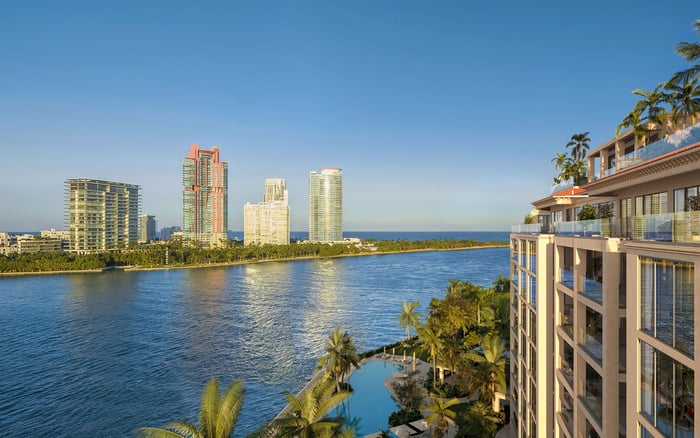
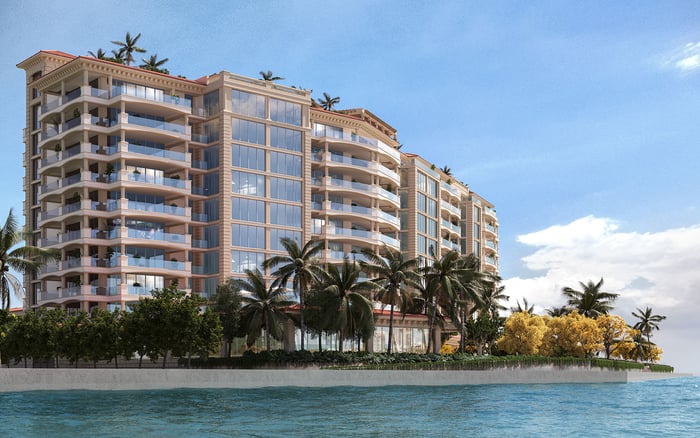
A disciplined framework for evaluating domicile, door-to-door travel, recurring ownership costs, and effective occupied-day economics for an Austin-based buyer considering Palazzo della Luna.
For an Austin household considering Palazzo della Luna, the decisive question is not simply whether the residence appeals to the eye. It is whether the property works within a multi-home life. The analysis should connect three subjects often considered separately: domicile, the true rhythm of travel, and the full cost of maintaining a highly serviced home on a private island.
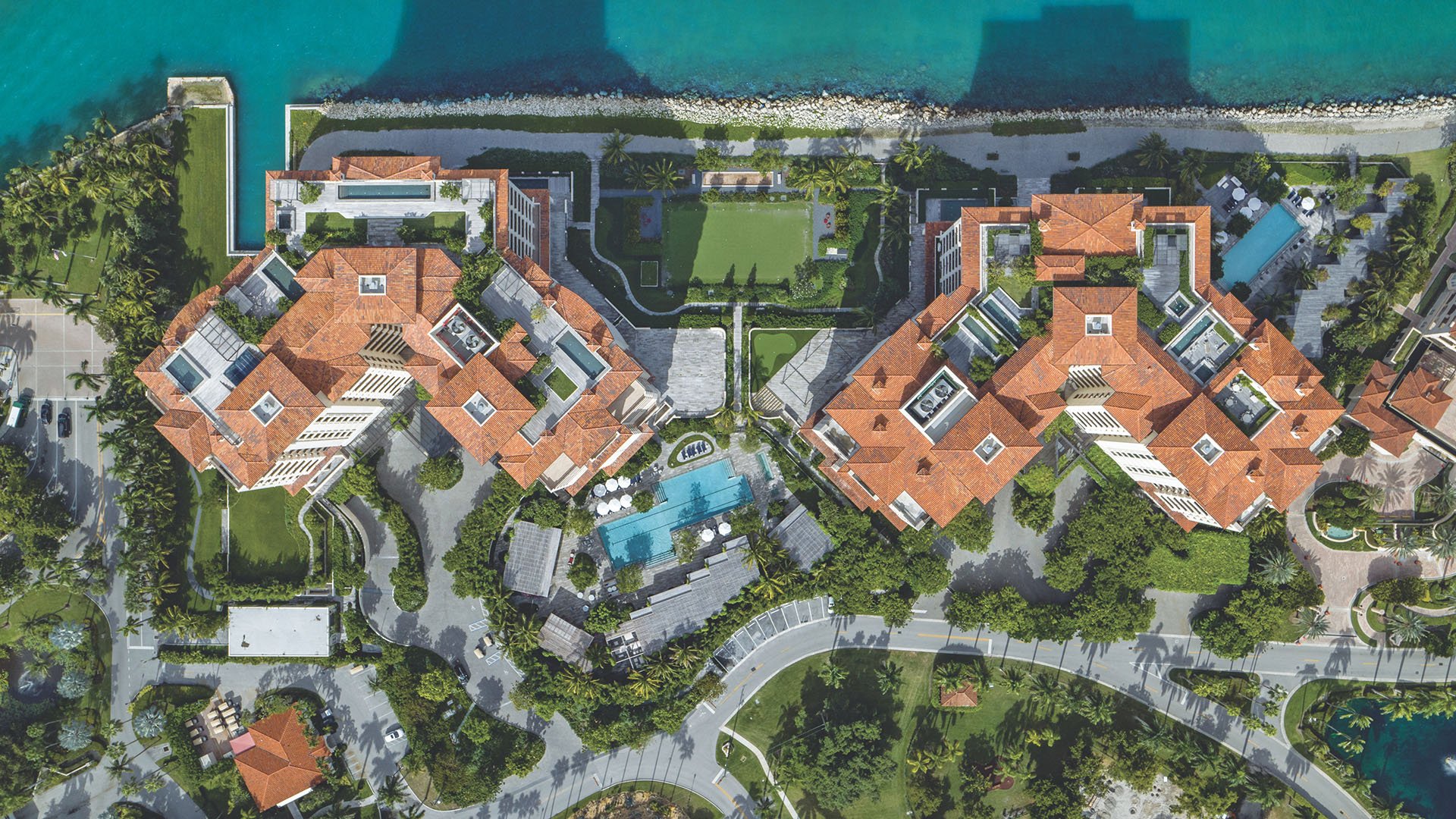
Palazzo della Luna is an ultra-luxury residential development in Fisher Island’s waterfront enclave. Its separation from mainland Miami creates both privacy and an additional operational step. That distinction should inform the buyer’s calendar, staffing plan, annual budget, and definition of convenience.
The waterfront setting is central to the appeal, but water access is also part of the logistics. A useful decision model therefore begins at the Austin residence and ends inside the Fisher Island home, rather than stopping when a flight reaches Miami.
Domicile should never be inferred from the location of a favored residence or the number of enjoyable weeks spent there. An Austin owner contemplating more time in South Florida should ask qualified legal and tax advisers to review the household’s facts, intentions, documentation, and patterns of use.
Keep this review distinct from the real-estate purchase. The relevant questions may extend beyond tax planning to estate arrangements, ownership structure, family considerations, and the administration of multiple homes. These issues require current, individualized advice in Texas and Florida before any change is made or assumed.
A practical file should record where the family expects to spend time, which home anchors personal and business life, and how travel may evolve. The objective is consistency among intention, documentation, and conduct. The residence can then be evaluated on its merits without asking the property itself to answer a domicile question.
The most revealing travel model is door to door. Build each trip from departure at the Austin home through airport time, the flight, mainland ground transportation, the ferry or boat transfer, and arrival at the residence. Fisher Island’s physical separation makes Miami arrival an intermediate point, not the finish line.
Test several trip types. A longer seasonal stay absorbs transfer time differently from a short weekend. Frequent brief visits may place greater value on ferry timing, marina access, provisioning, and residence services. Irregular arrivals may require a different support plan from a predictable monthly pattern.
The model should also reflect who is traveling. A principal arriving alone has different requirements from a family, guests, household staff, or a party carrying substantial luggage. Rather than relying on one ideal itinerary, create expected, compressed, and disrupted versions. This reveals whether the lifestyle remains graceful when timing changes.
Private-island alternatives can provide context without being treated as interchangeable. Palazzo del Sol offers another Fisher Island residential reference, while The Links Estates at Fisher Island can help a buyer consider how different property formats may shape the lived routine.
The acquisition price is only the opening line. A disciplined investment model separates recurring obligations from expenses generated by actual occupancy. Begin with building association charges and shared services, then identify costs related to Fisher Island’s common infrastructure and transportation system as a separate category.
Club or membership costs should be evaluated separately from condominium expenses. The distinction matters because access, terms, and obligations may not be identical to ownership in the building. Association rules and island operating arrangements also warrant review because they can influence annual spending and daily use.
Request current association budgets, fee schedules, reserve information, insurance details, assessments, membership terms, and ferry policies from the appropriate parties. Avoid combining unlike items into a single annual estimate. A clear ledger should distinguish:
Fixed property and association costs that continue regardless of use
Island infrastructure and transportation expenses
Any applicable club or membership obligations
Residence services and household staffing
Occupancy-driven housekeeping, provisioning, and hospitality
Ground, marine, and any private aviation costs tied to each visit
This structure makes comparisons more meaningful. A buyer examining The Residences at Six Fisher Island should apply the same categories while obtaining property-specific figures and rules, rather than transferring assumptions from one residence to another.
A second-home model becomes more useful when annual cost is divided by realistic occupied days. Start with planned trips, expected duration, seasonal preferences, and the probability that business or family commitments will alter the calendar. Then calculate fixed carrying cost per occupied day separately from variable spending per visit.
This is not a judgment of value. A highly serviced residence may justify substantial fixed costs by reducing friction, preserving privacy, and keeping the home ready for arrival. The purpose is to understand what the owner is buying operationally, not merely architecturally.
Run at least three occupancy cases: conservative use, expected use, and extended use. If the residence still feels coherent under the conservative case, the decision is less dependent on an optimistic calendar. If the economics improve only with frequent short visits, the complete transfer schedule deserves greater scrutiny.
The strongest file combines a domicile memorandum from the household’s advisers, door-to-door travel scenarios, current property documents, and a layered annual budget. Add a calendar of intended trips and a responsibility map covering transportation, provisioning, housekeeping, and arrival preparation.
For clarity, label the asset “Palazzo della Luna Fisher Island” in the model and keep every assumption visible. The final decision should explain not only whether the family can own the residence, but also how naturally it fits the family’s time, privacy expectations, and service preferences.
Does owning at Palazzo della Luna establish Florida domicile? Property ownership alone should not be treated as a domicile determination. Obtain individualized advice addressing current Texas and Florida requirements.
Where should an Austin to Fisher Island trip model end? It should end at the residence after mainland ground transportation and the ferry or boat transfer-not at the Miami arrival point.
Why model short and long stays separately? Transfer time and arrival logistics weigh more heavily on brief visits, while longer stays distribute that friction across more occupied days.
Which costs belong outside the purchase price? Include association charges, shared services, island infrastructure, transportation, and occupancy-driven household expenses as distinct budget lines.
Should club costs be combined with condominium expenses? No. Evaluate any applicable club or membership terms and costs separately from building ownership expenses.
What property documents should a buyer request? Seek current budgets, fee schedules, reserve information, insurance details, assessments, governing rules, and relevant transportation policies.
How do association rules affect the model? They can shape both annual obligations and the practical use of the residence, so they belong in the financial and operational reviews.
What is an effective cost per occupied day? It is the annual carrying cost measured against realistic days of use, with variable trip expenses shown separately for clarity.
Why create multiple occupancy scenarios? Conservative, expected, and extended-use cases show whether the ownership plan remains persuasive as the family calendar changes.
What makes private-island ownership operationally distinct? Ground transportation, water-transfer timing, marina access, and residence services become integral to every arrival and departure.
If you'd like a private walkthrough and a curated shortlist, connect with MILLION.
If branded residences are on your mind — as a home or as an allocation — we would be glad to share what we are seeing, privately.
Begin a quiet conversation