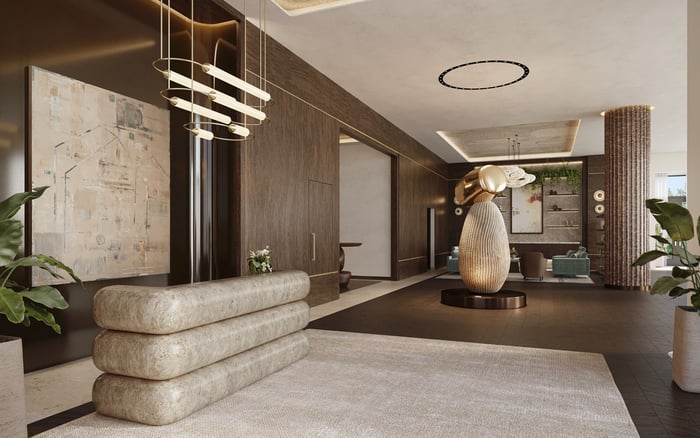
An ownership-focused look at private elevator openings at Four Seasons Residences Coconut Grove, with emphasis on legal boundaries, exclusive use, association control, and buyer diligence.

At the top end of South Florida condominium design, arrival has become part of the residence itself. The most valuable front door is not always a front door at all. It may be an elevator that opens directly into a foyer, a short private vestibule, or a landing that feels removed from the shared rhythm of a conventional corridor.
That is the ownership question surrounding Four Seasons Residences Coconut Grove. The project sits in Coconut Grove, one of Miami’s established waterfront residential neighborhoods, and belongs to the broader ultra-luxury branded-residence movement reshaping buyer expectations across South Florida. For many purchasers, private elevator access is not a minor convenience. It is a marker of discretion, status, and domestic control.
Yet the essential question is more technical than emotional: when the elevator opens into a space that feels private, is that space legally part of the unit, or does it remain under condominium or common-element control?
Luxury buyers often read a private elevator opening the way they would read a gated driveway at a single-family estate. The doors part, the residence receives you, and the public world appears to fall away. In experiential terms, that can be entirely true.
In legal terms, the answer may be more layered. A buyer may have exclusive use of a vestibule or landing without owning every surface, fixture, threshold, door, control panel, or elevator-related component in the same way they own the interior of a residence. The elevator cab, shaft, landing, doors, call buttons, access controls, foyer boundaries, and related mechanical systems can each be treated differently in the governing documents.
This distinction matters because condominium living divides a building into categories of ownership and control. Some portions are owned by the unit owner. Some are common elements. Some may be limited common elements assigned to a particular residence. Some may fall within association control, and in a branded environment, certain operational standards may also be influenced by management or branding agreements.
The safest approach is to look past marketing language and into the recorded project documents. For any specific residence, the answer depends on the condominium declaration, the condominium survey or plot plan, the bylaws, and any management or branding agreements that influence use, operations, alterations, or access.
The declaration typically defines unit boundaries and common elements. The survey or plot plan can clarify where those boundaries sit physically. The bylaws may address maintenance, association authority, access rights, and operational procedures. Management or branding agreements can introduce additional standards that shape the experience of ownership, even when they do not change legal title.
For a high-net-worth buyer, this is not simply a legal exercise. It is a lifestyle audit. If a space feels like the private entry hall to the residence, the purchaser should understand whether future lighting, wall finishes, cameras, smart locks, art placement, millwork, or staff circulation can be controlled unilaterally, approved conditionally, or restricted by the association or operator.
The cleanest way to analyze a private elevator opening is to separate three ideas: what the owner exclusively uses, what the owner legally owns, and what another party controls.
Exclusive use can be highly valuable. A foyer that serves only one residence can deliver the privacy buyers expect from a trophy condominium. It can reduce corridor exposure, limit casual encounters, and create a residential sequence that feels closer to a private home than a shared building.
Legal ownership is a different issue. If the foyer or landing is drawn inside the unit boundaries, the owner may have broader rights than if it is classified as a limited common element. If elevator doors, landings, access controls, or adjacent areas remain common elements, the association may retain responsibilities and approval authority even when no other resident regularly uses the space.
Operational control adds a third layer. In an ultra-luxury branded residence, service standards, security procedures, maintenance protocols, and aesthetic consistency can be central to the building’s value proposition. That may be attractive to many buyers, but it also means the experience of privacy is balanced against building-wide governance.
Coconut Grove attracts buyers who often understand privacy through the lens of estate living, waterfront homes, mature landscaping, and established residential streets. In that context, a private elevator opening can feel especially persuasive. It translates the single-family idea of a controlled arrival into a vertical residence.
The Coconut Grove buyer may also bring expectations shaped by new-construction quality, pre-construction customization, top-project positioning, and an exclusive-area mindset. Four Seasons Residences Coconut Grove sits directly within that conversation, where the perceived boundary between public and private space can influence how a residence is valued.
The strongest luxury buildings increasingly reduce traditional corridor exposure. Direct elevator access, private vestibules, and very short semi-private halls all support a quieter arrival experience. But the more a condominium imitates the privacy of a house, the more carefully the buyer should examine where the house-like experience ends and the condominium regime begins.
The boundary question can affect more than abstract ownership. It can shape security-system configuration. If a buyer wants cameras, motion sensors, biometric access, or specialized entry controls near the elevator opening, the approval path may depend on who controls the landing and related systems.
It can affect alterations. A foyer that appears visually connected to the residence may tempt an owner to treat it as an interior design opportunity. Stone floors, paneled walls, art lighting, specialty doors, and concealed technology all require a clear understanding of what may be changed and who must consent.
It can affect staffing. Private chefs, estate managers, drivers, security personnel, assistants, and household staff may all use the elevator sequence differently from guests. Buyers should understand whether building protocols align with the level of domestic independence they expect.
It can affect reconstruction and future maintenance. If an event requires repair to elevator doors, access panels, landings, or foyer finishes, responsibility may not track the way the space feels. The party that enjoys the space may not always be the party that controls repair standards or cost allocation.
The refined buyer should ask precise questions early. Where exactly do the unit boundaries begin? Is the elevator foyer part of the unit, a common element, or a limited common element? Who maintains the doors, landing, call buttons, cameras, flooring, lighting, and wall finishes? Who approves changes? Who controls access credentials? What happens during an emergency, repair, or renovation?
The answers should come from documents, not assumptions. In the luxury market, presentation can be intentionally seamless. That is part of the appeal. But seamless design should not obscure the division of rights.
For Four Seasons Residences Coconut Grove, the right framing is not to diminish the value of private elevator access. It is to understand it with precision. Privacy is a luxury. Control is a legal structure. The best purchase decisions treat both as essential.
Does private elevator access mean the foyer is owned by the unit owner? Not necessarily. The ownership answer depends on the recorded condominium documents and the unit boundary descriptions.
What is the central buyer question at Four Seasons Residences Coconut Grove? The key question is whether the elevator opening or foyer-like space is legally part of the unit or remains under condominium control.
Which documents should a buyer review? Buyers should review the condominium declaration, condominium survey or plot plan, bylaws, and any management or branding agreements.
Can a space be private without being fully owned? Yes. A space may be for exclusive use while still being classified as a common element or limited common element.
Why does this matter for security systems? Cameras, access controls, sensors, and elevator credentials may require approval if they affect common or controlled areas.
Can an owner redesign a private elevator foyer freely? That depends on the legal classification of the space and the alteration rules in the governing documents.
Does branding change the ownership boundary? Branding itself does not define unit boundaries, but branding and management agreements may influence operational standards and approvals.
Why is this issue important to high-net-worth buyers? Many expect single-family-home levels of privacy and control, while condominium ownership involves shared governance.
Is private elevator access still valuable if the foyer is not fully owned? Yes. Exclusive use and reduced corridor exposure can remain highly valuable even when ownership and control are shared.
What is the safest way to evaluate the feature? Treat the private elevator experience as a luxury benefit, then verify the legal boundary and control rights in the recorded documents.
When you're ready to tour or underwrite the options, connect with MILLION.
If branded residences are on your mind — as a home or as an allocation — we would be glad to share what we are seeing, privately.
Begin a quiet conversation