Fort Lauderdale and Palm Beach both command the yachting conversation, but they do it in fundamentally different ways. Fort Lauderdale operates like a year-round global marketplace with deep service infrastructure, high-volume brokerage activity, and signature scale at the Fort Lauderdale International Boat Show. Palm Beach, by contrast, leans into heritage, club culture, and a curated approach to ownership that feels as much social as it is nautical. For buyers and second-home owners, the most practical question is not which city is “better,” but which ecosystem matches the way you intend to use your yacht and your waterfront real estate.
South Florida offers no shortage of waterfront addresses, but experienced yacht owners tend to filter the decision quickly. When they compare Fort Lauderdale and Palm Beach, the conversation often comes down to one practical question: which city makes time on the water feel truly effortless.
Both deliver the fundamentals that draw owners here in the first place: salt-air mornings, quick access to open ocean, and a social calendar that assumes you can call a captain with little notice. The difference is structural. Fort Lauderdale operates like a working yachting metropolis, built around movement, transactions, and service speed. Palm Beach presents yachting as a heritage lifestyle, where access, discretion, and tradition shape the tone as much as horsepower.
For luxury real estate buyers, this is not abstract. Marina proximity, dockage availability, and the culture of the waterfront can decide whether your yacht becomes a tool you use often or a centerpiece you admire from the terrace. In these markets, “waterfront” is not only about the view line. It is about logistics, readiness, and whether the ecosystem around your home supports the way you actually boat.
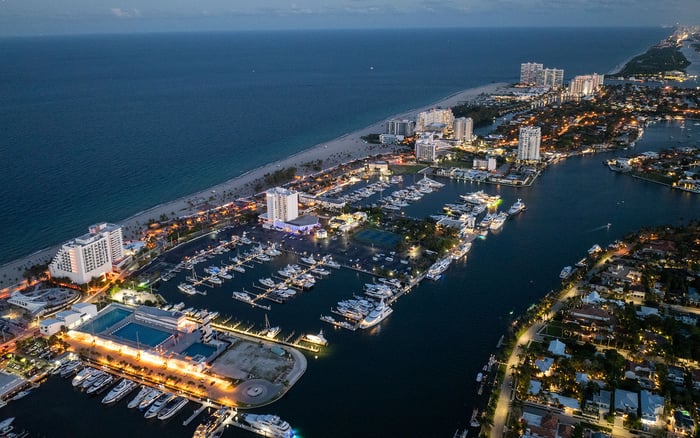
Fort Lauderdale’s “Venice of America” reputation is not just a slogan. Greater Fort Lauderdale is publicly described as having about 300 miles of inland waterways, with roughly 165 miles within the city limits. That network is not merely scenic. It functions as infrastructure, supporting a dense marine economy of service yards, marinas, crews, and brokerage activity that stays active year-round.
That daily operating rhythm is why Fort Lauderdale often reads as the default choice for owners who prioritize operational convenience. If your boating life includes frequent runs, scheduled upgrades between seasons, or a preference for being surrounded by active brokerage visibility, this is a city where yachting is not an occasional event. It is a primary language.
Marina capability illustrates the point. Bahia Mar Yachting Center, a core venue for major events, publishes slips up to 300 feet. In a market where large-vessel dockage is a real constraint, that clarity matters. Add downtown options such as New River Downtown Marina, listed at around 100 slips with a significant transient component and accommodation for large vessels, and you begin to see what depth looks like in practical terms.
That density can smooth ownership in ways that rarely show up on a brochure: more options when plans change, more redundancy when weather compresses schedules, and more service availability when a small issue risks becoming an expensive delay.
Palm Beach frames yachting with a different emphasis. The area’s identity leans heavily on institutional heritage and member culture, anchored by organizations such as the Palm Beach Yacht Club, which documents a history reaching back to the early 20th century.
That lineage shapes the lifestyle. The signal is not volume. It is curation: who is on the dock, which events anchor the season, and how ownership intersects with social life. In this environment, yachting can feel less like an open marketplace and more like a long-established scene, with relationships and continuity carrying real weight.
You can see that tone in the way inventory is often presented by Palm Beach based firms. The framing tends to feel more edited, with an emphasis on standout listings rather than the breadth you might associate with a high-throughput hub. The result is a market that can feel intentionally quieter, where fewer options may be visible at once, but the options that do surface are positioned with purpose.
Marina choices in the wider Palm Beach area often match that resort-minded posture. Facilities like Safe Harbor Old Port Cove in North Palm Beach promote a full-service environment where the experience is designed to feel like an extension of a private club. For buyers who want boating to integrate seamlessly into a discreet social sphere, that experience can matter as much as any technical specification.
To understand how each city behaves at peak intensity, look at its signature boat show. These events are not simply entertainment. In South Florida, they function as compressed market reports where you can observe inventory, service capacity, and buyer intent in real time.
Fort Lauderdale’s calling card is scale. The Fort Lauderdale International Boat Show is widely described as the world’s largest in-water boat show, spanning multiple locations, including the Superyacht Village at Pier Sixty-Six. Recent coverage has reported 100,000-plus attendance and a dense concentration of high-value assets in a single week. Market intelligence reporting has cited 162 superyachts on display with combined asking values around $1.9 billion. That snapshot is less about spectacle than liquidity. It signals how much product can surface quickly in one place, and how much brokerage activity orbits Fort Lauderdale.
Palm Beach’s signature event, the Palm Beach International Boat Show, is officially presented as taking place in downtown West Palm Beach along the waterfront. That setting is telling. The show is woven into a walkable urban edge, where hotels, restaurants, and the shoreline become part of the experience. The mood is seasonal and social, and the show reads as a polished storefront for a curated market rather than a vast global bazaar.
For buyers, the takeaway is straightforward. A market that consistently hosts enormous in-water inventory and draws global attention tends to optimize for access, service, and transaction flow. A market that frames yachting as part of a heritage calendar tends to optimize for culture, continuity, and discretion.
Events are the headline, but day-to-day visibility is often the clearest indicator of how a market behaves. Fort Lauderdale appears on major marketplaces with thousands of boats listed, serving as a proxy for breadth and churn compared with smaller, more boutique environments. The region also supports long-running brokerage firms that maintain visible positioning around superyacht sales and marketing.
This does not automatically mean better deals, and it does not imply a lack of prestige. It simply means the marketplace is built to absorb constant movement. If you treat a yacht as a dynamic asset, upgrading, repositioning, or selling into a global buyer pool, Fort Lauderdale’s velocity can become a practical advantage.
That same liquidity affects the real estate conversation. In a high-activity yachting hub, homes and condos near service corridors can function as true operational bases. Buyers often prioritize the ease of provisioning, refit access, crew logistics, and the ability to pivot when schedules change. The home is part of a system, not only a view.
Palm Beach can feel closer to a showroom with carefully chosen pieces. For certain buyers, less noise is the feature. They prefer a smaller set of highly aligned options, even if that means waiting longer for the right opportunity. When the ownership goal is consistency and a defined season, a market that moves at a more deliberate pace can feel like the better match.
In yacht ownership, the most expensive inconvenience is often the simplest one: not having a place to go. It is easy to underestimate how quickly a perfect weekend becomes a logistics problem when dockage is tight, weather shifts, or service schedules collide.
Fort Lauderdale’s marina story is fundamentally a story of redundancy. You see it in the presence of major hubs like Bahia Mar, and in downtown options that emphasize transient capacity. You also see it in integrated waterfront redevelopment, where projects like Pier Sixty-Six are promoted as part of a broader marina-and-lifestyle ecosystem. In a dense operating environment, having multiple workable alternatives is not a luxury detail. It is a core value proposition.
Palm Beach’s dockage reality is less about constant movement and more about lifestyle fit. Many owners are not trying to maximize rotations. They want a dependable, high-touch home base, and they want the dock environment to mirror the tone of their broader social world. The right marina choice is often paired with the right neighborhood and the right circuit, because the experience is intended to feel cohesive.
This is where waterfront real estate becomes more than frontage. What matters is the distance, complexity, and friction between your front door and your dock. In both cities, the most satisfying ownership experience is the one where intention and execution stay aligned.
West Palm Beach has increasingly become the hinge point for buyers who want Palm Beach polish with a more contemporary residential and urban waterfront environment. It sits close enough to participate in the Palm Beach social sphere, while offering a downtown shoreline that can feel more dynamic day to day.
For second-home owners who do not want a sprawling estate but still expect a turnkey experience, new luxury towers have become part of the equation. A residence in Forté on Flagler West Palm Beach, for example, places you along the Flagler waterfront, where the city’s shoreline lifestyle can feel immediate rather than occasional.
Similarly, Mr. C Residences West Palm Beach speaks to buyers who value hospitality-minded service and a refined, European-leaning sensibility, the same sensibility that naturally pairs with a curated boating calendar.
For those who prioritize brand standards and long-term confidence in operations, The Ritz-Carlton Residences® West Palm Beach adds another layer to the decision: the idea that your home should run with the same predictability as your yacht management.
And for buyers who prefer a more intimate, design-forward waterfront posture, Alba West Palm Beach reflects a modern approach to waterfront living that complements the city’s boat show energy and its evolving shoreline.
These residences are not a substitute for choosing between Fort Lauderdale and Palm Beach. They are recognition that many owners want proximity to both modes, the global marketplace and the heritage calendar, without committing fully to either extreme.
Industry commentary has pointed to a superyacht brokerage rebound in 2025, with improving transaction activity. That optimism matters, but it does not change the fundamentals of ownership. Crew, maintenance, insurance, dockage, and fuel shape the annual reality far more than any single purchase decision.
As buyers re-enter the market, many are also refining how they think about utilization. Some owners want the flexibility of stepping up or stepping out of a vessel class without friction. Others want predictable use with predictable management. This is one reason newer participation models have attracted attention. Fractional yacht ownership and shared-use concepts have been covered as a growing trend in South Florida.
These models tend to favor infrastructure-dense hubs, where scheduling, service, and repositioning can be handled with minimal disruption. In practical terms, that means Fort Lauderdale’s structure can align naturally with high-utilization styles. Palm Beach’s heritage-forward positioning can align more comfortably with owners who prize privacy, consistency, and a social ecosystem that does not depend on constant turnover.
From a real estate perspective, this backdrop reinforces the same conclusion: the best waterfront home is the one that supports your operating rhythm. The more you intend to use a yacht, the more you should weigh service access and dockage flexibility as lifestyle necessities, not optional amenities.
Luxury buyers often shop yachts the way they shop residences: by aspiration. The smarter approach is to shop by patterns. Your ideal city is less about which one looks better on paper and more about how it performs against the way you live.
If your boating life is frequent, operational, and flexible, Fort Lauderdale is usually the easier platform. You are buying into a place where marine professionals are abundant, inventory is highly visible, and the waterways support constant movement. You can run a busier schedule and still keep the experience composed because the ecosystem is designed to absorb activity.
If your boating life is seasonal, social, and deliberately curated, Palm Beach tends to feel more natural. The emphasis shifts from transactions to continuity. Ownership can feel like an extension of a long-standing calendar, where discretion, tradition, and a defined community set the tone.
And if your lifestyle includes both, plus a preference for a contemporary condo footprint rather than a legacy estate, West Palm Beach can be the pragmatic middle ground. In the right building, you can keep the routine simple, maintain access to the Palm Beach season, and still stay close enough to Fort Lauderdale’s larger service and marketplace ecosystem when you need it.
Ultimately, Fort Lauderdale and Palm Beach are not competing for the same buyer. They are serving two distinct definitions of luxury: one built around capability and velocity, the other built around heritage and restraint. The best choice is the one that makes ownership feel easy, not just impressive.
Is Fort Lauderdale truly the “Venice of America”? It is widely promoted that way, and the area is described as having about 300 miles of inland waterways, including roughly 165 miles within the city limits.
What does FLIBS tell a buyer that listings cannot? It concentrates inventory, brokers, and buyers into one week. Recent coverage reported 100,000-plus attendance and 162 superyachts on display, offering a real-time read on market depth.
Is Palm Beach better for privacy? Many buyers perceive Palm Beach as more heritage-driven and club-oriented, which can translate into a quieter, more curated social environment.
Why does marina infrastructure matter so much for real estate decisions? Because convenience determines use. Dockage options, transient capacity, and service access can be the difference between frequent weekends on the water and a yacht that stays idle.
Where does West Palm Beach fit into the yachting lifestyle map? West Palm Beach hosts the Palm Beach International Boat Show along its downtown waterfront and offers a growing set of luxury residences that let owners stay close to Palm Beach culture with a more modern urban shoreline.
For tailored guidance on South Florida waterfront living and luxury ownership, explore MILLION Luxury.
If branded residences are on your mind — as a home or as an allocation — we would be glad to share what we are seeing, privately.
Begin a quiet conversation