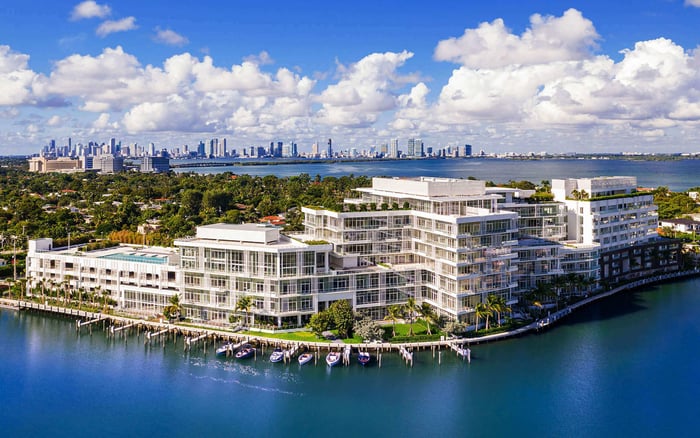
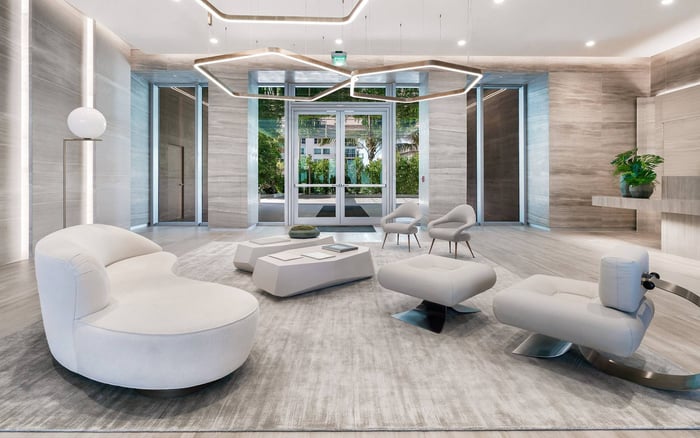
At The Perigon Miami Beach, valet service will sit at the center of daily household movement. Buyers should examine guest privileges, driver staging, staff access and retrieval protocols as carefully as residence layouts and amenities.

At The Perigon Miami Beach, the most consequential luxury may prove operational rather than ornamental. Planned for 5333 Collins Avenue on approximately 200 linear feet of oceanfront between the Atlantic Ocean and Indian Creek, the property is designed with 24-hour valet parking and security. That places the arrival court at the center of household life.
A valet-forward building can operate seamlessly when demand, staffing and rules align. Yet a family residence generates more than resident arrivals. Visiting relatives, nannies, caregivers, tutors, chefs, private drivers, rideshares and service vendors may all reach the property within the same morning. The planned house car introduces another stream of pickups and drop-offs.
In a fully serviced residence, parking policy becomes household infrastructure.
This is why guest parking and driver waiting areas warrant review before purchase. The planned amenities include valet, security and a guard house, but they do not establish unrestricted guest use, a dedicated driver lounge or permission for prolonged on-site staging.
For families, valet performance is measured in minutes that matter. A slow retrieval can complicate a school run, medical appointment or airport departure. The loading sequence matters when a parent is securing a child seat, a caregiver is assisting an elderly relative, or staff are handling a stroller, luggage or mobility equipment.
The beachfront adjoins the Miami Beach Boardwalk and includes beach-service access, creating regular movement among residences, amenities and the shore. After a beach outing, a family may return with children and equipment just as another vehicle arrives for a restaurant reservation. Buyers should ask how the porte cochere accommodates overlapping uses and whether there is a protected place for an unhurried handoff.
The project also includes resident-only guest suites of roughly 560 square feet. Their inclusion suggests overnight visitors are contemplated, but a guest suite does not automatically confer overnight vehicle rights. Confirm how visitors are registered, where their cars are held, whether fees apply and how long a guest vehicle may remain.
A staffed home generates recurring traffic, not occasional visits. Planned home-management support includes cleaning, maintenance, floral service and pantry stocking. In-residence dining and catering can add chefs, servers and deliveries. The residential butler and lifestyle concierge may coordinate these movements, but management rules will determine where vehicles may stop, wait and park.
The key distinction is between access to the building and permission to leave a vehicle on site. A nanny may need to remain for a full day. A caregiver may work overnight. A tutor could overlap with a floral delivery while catering staff arrive ahead of dinner. Buyers should seek written answers on staff registration, parking charges, credentialing, approved entrances and vendor time windows.
This level of inquiry is appropriate for a Pre-Construction purchase because operating documents, contracts and policies can shape the residence long after finishes are selected. It is also central to Lifestyle planning: a home-management program functions best when the service personnel supporting it can arrive predictably.
Owners who employ drivers should not treat 24-hour valet as a substitute for a waiting area. Valet service stores and retrieves vehicles. A private driver may need to remain nearby between a morning drop-off and an afternoon pickup, respond quickly to a changing schedule, or stage a larger vehicle for a family transfer.
Buyers should ask whether a driver may wait inside a parked vehicle, use an interior staff area, leave the property and return, or stage only for a limited interval. The guard house signals controlled entry, so repeat access may involve separate procedures. It is equally important to establish whether idling, curbside waiting or standing in the arrival lane is prohibited.
If no dedicated holding area is provided, determine the expected alternative. The practical question is not simply whether a driver can enter, but whether the building's rules support the response time and discretion the household expects.
Residences in the 01 and 06 lines are planned to include two-car, air-conditioned private garages. Other residences are planned with one assigned space plus additional valet service. Buyers should confirm the current allocation in the controlling offering documents, since parking rights determine how heavily a household will depend on valet.
A two-car garage may provide greater control for a multi-vehicle family, but it does not resolve parking for relatives, caregivers or staff. One assigned space may suit a second-home owner who relies on the house car, yet prove less practical for a full-time household with several daily drivers. Vehicle-size restrictions also matter for larger sport utility vehicles and cars carrying mobility equipment.
The relevant comparison is operational, not merely numerical. Buyers considering other Oceanfront choices, such as 57 Ocean Miami Beach or Faena House Miami Beach, should request the same categories of information, even where the physical arrival design or service model differs.
Across Miami Beach, luxury residences may offer assigned parking, covered spaces, valet or some combination of the three. Those labels do not, by themselves, define guest and staff rights. Even complimentary resident valet would not necessarily mean that a visiting family member, chef or driver can park without charge or remain overnight.
For a useful comparison, buyers might examine how The Ritz-Carlton Residences® Miami Beach handles advance registration, vehicle retrieval and household personnel. The objective is not to assume equivalence, but to identify which written policies best fit the family's operating pattern.
Before committing, request the condominium declaration, current budget, parking exhibit, valet agreement and written management policies. Residence and guest-suite counts vary, so buyers should also confirm the current schedule in the offering documents.
The parking review should address assigned-space ownership or use rights, guest fees, overnight privileges, vehicle dimensions, retrieval procedures and expected service during peak periods. Ask whether reservations or advance notice are required for gatherings, catering teams or multiple arriving vehicles.
For staff, verify daily and overnight access, credentialing, parking location and time limits. For drivers, request a diagram or written explanation of permitted staging. For the house car, clarify how residents schedule pickups and where boarding occurs when the arrival court is busy. Buyers with young children, elderly relatives or mobility requirements should walk through a realistic transfer with the sales team rather than rely on an amenity summary.
The Perigon's planned restaurant, speakeasy, spa, screening room, children's playroom and breakfast or conservatory lounge create a substantial residential program. Its service offering is similarly ambitious. The question for a buyer is whether vehicle operations can support that program with equal precision.
Guest parking affects hospitality. Staff parking affects continuity of care and home management. Driver staging affects response time. Valet retrieval affects nearly every departure. In a residence designed around service, these are not secondary details. They are part of the architecture of daily life.
For a discreet review of The Perigon and comparable South Florida residences, consult MILLION.
If branded residences are on your mind — as a home or as an allocation — we would be glad to share what we are seeing, privately.
Begin a quiet conversationYes. The project advertises 24-hour valet parking and security, making valet central to resident, guest and staff arrivals.
No. Buyers should confirm guest fees, time limits and overnight privileges in the governing documents and written management policies.
No dedicated driver lounge or holding area is identified in the publicly disclosed amenity program. Buyers who employ drivers should request written staging rules.
Resident-only guest suites of roughly 560 square feet indicate that overnight visitors are contemplated, but they do not automatically establish overnight vehicle rights.
Residences in the 01 and 06 lines are reported to include two-car, air-conditioned private garages. The current allocation should be verified in the offering documents.
Other residences are reported to receive one assigned space plus additional valet service. Buyers should confirm the legal nature and operating terms of each space.
Families should ask about retrieval procedures, peak-period performance and loading protocols for children, elderly relatives, luggage and mobility equipment.
Public marketing does not establish unrestricted staff parking. Buyers should verify registration, fees, approved access points, time limits and overnight rules.
Request the condominium declaration, current budget, parking exhibit, valet agreement, offering documents and written management policies.
The house car adds scheduled pickups and drop-offs to an area also used by residents, guests, rideshares, private drivers and valet attendants.