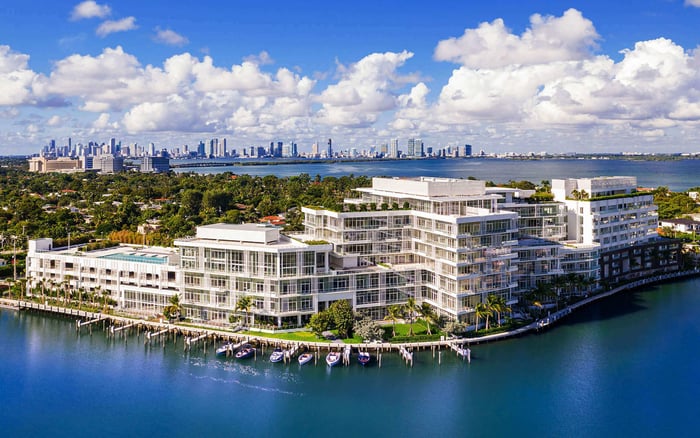
A buyer’s framework for separating hospitality promises from documented evacuation arrangements at Shore Club, with focused questions on pets, household staff, specialist movers, and residence-level continuity.

At Shore Club Private Collections Miami Beach, the acquisition decision extends beyond architecture and service. For a household with pets, private staff, and valuable collections, it should include a written account of how departure, property protection, and eventual return would work. The relevant luxury is clarity: knowing who acts, what remains available, and when assistance ends.
The development at 1901 Collins Avenue occupies approximately three oceanfront acres in South Beach, with 49 private homes planned across The Tower, Cromwell House, and Beach House. Witkoff Group and Monroe Capital are the developers, and Robert A.M. Stern Architects is the design architect. Those credentials establish project context, not emergency capabilities.
A decision-grade review should distinguish documented building provisions from household arrangements yet to be made. Hospitality affiliation is not confirmation of pet transport, continuing staff availability, or collection relocation. Each requires a separate answer.
Auberge Resorts Collection is the hospitality operator, with residential services planned alongside the resort. That relationship alone does not establish what support will be available during an evacuation.
Request a written emergency-service schedule identifying the responsible entity, services offered, eligibility, charges, and the point at which each service stops. Clarify whether requests go through residential management, the resort, or an outside provider. A named contact is useful; a named alternate and an escalation procedure make the arrangement more actionable.
Apply the same distinction when considering Setai Residences Miami Beach: evaluate emergency arrangements independently of everyday service expectations. This is a due-diligence standard, not a claim that either property provides particular assistance.
For Shore Club, ask whether the three residential components share procedures. Do not assume an answer about one entrance, lift, or service route applies to every home.
Begin with written pet restrictions and the proposed departure procedure for the specific residence. Ask how carriers are handled, which routes are designated, and what happens if elevators are unavailable. If an animal cannot manage stairs or requires assistance, seek a residence-specific answer rather than a general reassurance.
The household plan should assign a primary handler and a backup. Prepare carriers, identification, veterinary information, medication, and destination arrangements in advance. Confirm that the intended transport and accommodation will accept the animals involved. Permission to keep a pet in the building does not mean a vehicle, hotel, or shelter will accept it.
If departure support is offered, request the reservation process and cutoff conditions in writing. Establish what happens if the owner is away, whether an authorized caretaker can collect the animal, and how that person obtains access.
Do not base the plan on last-minute staff assistance. Have an independent alternative, and verify current evacuation instructions and destination requirements with the relevant authorities before relying on them.
Distinguish residential management, hospitality personnel, and privately employed household staff. Ask management for the emergency chain of command and resident-notification procedure. Identify who is responsible for confirming that communications reached an absent owner or designated representative.
For household employees, develop a written departure plan covering responsibilities, transport, release timing, and backup contacts. Discuss the arrangements with the employees themselves. Direct questions about employment obligations to qualified counsel; do not infer the answers from building policy.
Keep the task sequence explicit: who gathers the pets, who secures documents, who contacts transport, and who confirms departure. Avoid assigning one person simultaneous responsibilities in different places.
Re-entry deserves its own allocation of duties. Request procedures for access authorization, notifications, and admitting household representatives after restrictions are lifted. Do not assume a concierge, housekeeper, or estate manager will be available to inspect the residence immediately. Arrange an alternative and define what inspection can safely proceed.
For art, wine, jewelry, and other sensitive possessions, start with a private inventory and a discussion with the relevant insurer and collection specialists. Decide what should leave early, what may remain under an agreed protection strategy, and who can authorize action if the owner is unreachable.
Request documented generator coverage. Ask which systems and residential circuits it serves, whether it includes any in-residence climate control, and what operational limitations apply. Do not equate backup power with uninterrupted temperature or humidity control.
Seek equally specific answers about storage and garage flood protection. Identify the spaces intended for use and ask what protections, access restrictions, and shutdown procedures apply. A general statement about the development cannot substitute for information about the room holding a collection or the garage housing a vehicle.
For specialist movers, confirm advance registration, loading access, lift reservations, insurance documentation, and the deadline for entry. Ask your specialist to establish a safe mobilization window before emergency restrictions take effect. Property retrieval should never delay compliance with evacuation instructions or put people at risk.
Delivery is expected in 2027, not guaranteed. At this stage, distinguish proposed procedures from approved provisions and operational arrangements that still require confirmation. Request final approved plans and condominium documents before making assumptions about access, layouts, or building systems.
Organize the review into a simple decision register: the question, written answer, responsible party, supporting document, and next review point. Have counsel identify whether a representation is contractual, discretionary, or subject to later policy changes. Revisit unresolved items before closing and again before occupancy.
For buyers also weighing The Perigon Miami Beach, use the same register without assuming equivalent systems or services. Consistent questions produce a more useful comparison than broad assurances about preparedness.
Before relying on any arrangement, ask the household team to walk through a departure scenario with the owner away. Test the contact sequence, pet collection, transport confirmation, specialist authorization, and access permissions. Record unresolved dependencies and assign responsibility for each.
Keep official evacuation instructions separate from private service cutoffs. Verify the property’s current evacuation designation and applicable directions with the relevant authorities; neither an oceanfront address nor a building’s design establishes those instructions. Private arrangements should support timely departure, not justify waiting.
The purchase decision becomes clearer when each essential function is documented, independently arranged, or identified as unresolved. A service promise is most useful when its limits are as clear as its benefits.
For a discreet conversation about evaluating South Florida residences, connect with MILLION.
If branded residences are on your mind — as a home or as an allocation — we would be glad to share what we are seeing, privately.
Begin a quiet conversationThe development is at 1901 Collins Avenue, Miami Beach, FL 33139, in South Beach. It occupies approximately three oceanfront acres.
The planned program comprises 49 private homes across The Tower, Cromwell House, and Beach House. Buyers should request procedures specific to their residence and component.
No such guarantee should be inferred from the affiliation. Ask for written confirmation of any assistance, its provider, and its cutoff conditions.
Request written pet restrictions, carrier and stair-egress procedures, assistance arrangements, and departure-support deadlines. Confirm transport and destination acceptance independently.
Designate an authorized representative and backup, then confirm access permissions and notification procedures. Establish who can collect pets and authorize specialist movers.
It should address task assignments, transport, release timing, and backup contacts. Keep private employee arrangements distinct from building and hospitality duties.
Request documentation identifying supported systems and residential circuits, including whether in-residence climate control is covered. Ask about operational limitations rather than assuming continuous protection.
Develop an inventory and a protection strategy with the relevant insurer and collection specialists. Confirm mover access, authorization, and an early mobilization window without delaying safe departure.
Delivery is expected in 2027, not guaranteed. Buyers should distinguish proposed procedures from approved provisions and confirmed operating arrangements.
Verify current evacuation designations and directions with the relevant authorities. Separately request management’s access, notification, and representative-admission procedures for re-entry.