A discreet, buyer-oriented comparison of two ultra-luxury Brickell towers, centered on privacy, circulation, and the lived experience of service.
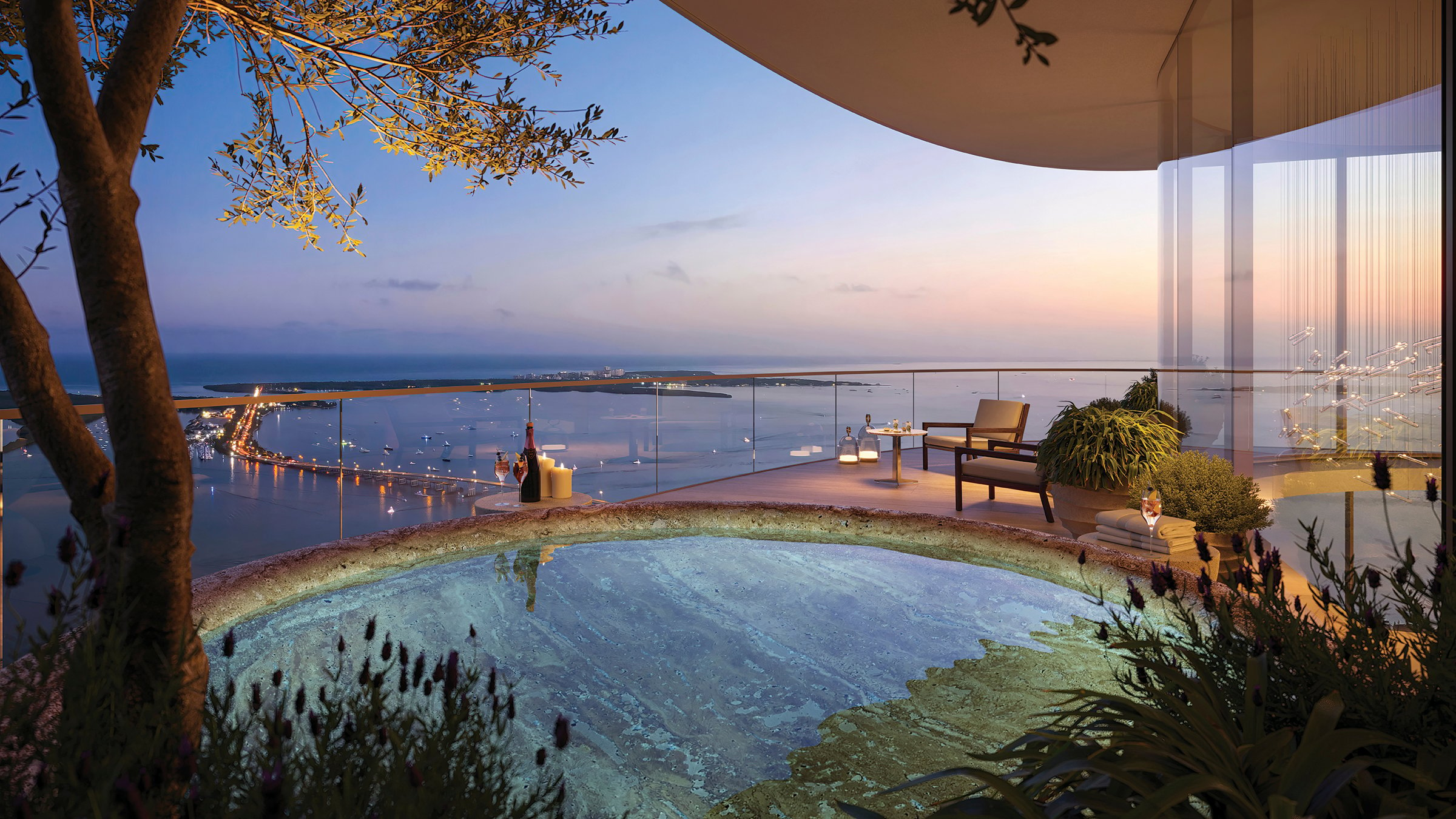
In Brickell, the conversation has shifted. Finishes still matter, views still matter, and a great terrace can still reset an entire day. But at the ultra-premium end, many buyers are now choosing between two quieter luxuries: privacy engineered into the building, and service orchestrated around daily life.
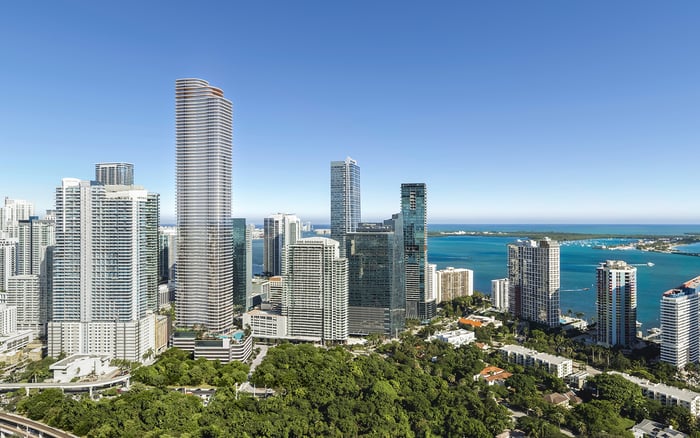
That split comes into focus when you compare two headline projects: The Residences at 1428 Brickell, a 70-story tower with 189 residences, and Cipriani Residences Brickell, an 80-story tower with 397 residences. Both sit squarely in Brickell’s narrative of height, glass, and global buyers. Yet the lived experience can diverge sharply depending on how each building manages arrivals, circulation, staffing, and density.
This is not about which is “better.” It is about which one fits the way you actually live when the front door closes.
When privacy is done well, you feel it before you can describe it. It’s reduced friction on arrival. It’s the ease of moving from car to living room without ceremony. It’s the ability to host without your home functioning like a hallway.
At 1428 Brickell, privacy is embedded in the framework: every residence is served by private elevators, and published floorplans emphasize a double-door entry and private foyer. That buffer matters. It creates a true decompression zone between “public building” and “private home,” while protecting sightlines into primary living spaces.
Density reinforces that experience. With 189 residences across 70 stories, 1428 Brickell reads as intentionally low-count for its height. In day-to-day life, that often means fewer shared-space encounters and less elevator demand. This is the kind of luxury that rarely photographs like a lobby, yet it changes mornings, returns from travel, and the cadence of hosting.
Cipriani Residences Brickell approaches privacy differently. The project highlights terrace access in every residence, and it notes private elevator entry in select residences - meaning direct entry is not universal throughout the building. For many buyers, that nuance is decisive. A universal private-elevator model typically feels closer to owning a home in the sky. A selective model can still be highly private, but it requires more precision around stack, floor, and entry sequence.
Luxury buyers often ask about square footage. The sharper question is how the home moves. Flow is the invisible architecture of daily life: where you pause, where you turn, what you see first, and how quickly the home becomes quiet.
At 1428 Brickell, the private-foyer concept and double-door entry function as choreography. They introduce separation: arrival doesn’t immediately reveal the great room; service can operate more discreetly; and private quarters can remain genuinely private when guests arrive.
Cipriani’s appeal is different. The project’s language around residences emphasizes indoor-outdoor living through terraces as a baseline condition. In practice, that can translate into a more extroverted plan - living areas that open readily to outdoor space, with entertainment flow taking priority. If your day-to-day includes frequent hosting, or you prefer a bright, open great room that feels connected to the skyline, that emphasis may align.
Ceiling height isn’t just a number; it’s a behavioral cue. It changes acoustics, light distribution, and whether a home reads as gallery-like or cocooned.
At 1428 Brickell, residences are described with approximately 11-foot ceilings, and select homes feature double-height volumes up to approximately 30 feet. That kind of verticality can materially change how a great room lives at scale, especially where art, large-format furniture, and long sightlines benefit from volume.
Cipriani Residences Brickell describes 10-foot ceilings in residences and 20-foot ceilings in penthouse great rooms. That remains a luxury standard, with a slightly more intimate baseline in typical residences and a clear pivot to drama at the top. Buyers weighing a penthouse lifestyle - or who want the uppermost product to feel meaningfully distinct - will recognize that as a deliberate hierarchy.
In high-rise living, sound is often the deciding factor you only discover after move-in. The strongest towers treat acoustic performance as a core feature, not an afterthought.
1428 Brickell specifies enhanced solid concrete walls between residences to reduce sound transmission. It’s a practical, confidence-inspiring detail because it addresses one of the most common friction points in vertical living: neighbor noise and vibration.
Cipriani’s story leans more toward branded lifestyle and hospitality. That is not an automatic negative for privacy, but it can suggest a more social building rhythm. If you’re sensitive to ambient activity, the most effective approach is to prioritize stack selection, distance from amenity zones, and the specific entry condition of the residence you’re buying.
Service can feel like a privilege - or like a presence. The difference is how much is “always on” versus available precisely when you want it.
1428 Brickell frames many resident services as a la carte and emphasizes back-of-house planning so operations remain out of view. For buyers who value autonomy, that matters. It reduces the feeling of being observed and allows you to opt into assistance rather than living inside it.
Cipriani Residences Brickell is positioned around a hospitality-driven residential model with brand-operated dining among its offerings. That’s a distinct lifestyle. It can read like living adjacent to a private club, with a consistent energy in the building. Some owners want that because it delivers convenience and a social backdrop. Others prefer a quieter, more owner-centric environment.
Even without touring a residence, the published unit range can hint at how a building lives.
Cipriani indicates a typical residence size range of roughly 1,387 to 4,533 square feet. That spread suggests a broader mix of end users, pied-a-terre buyers, and larger primary residences, which can create a more varied pattern of occupancy.
At 1428 Brickell, published floorplans show the smallest 2-bedroom layouts starting around 1,796 interior square feet plus terrace area. Larger starting footprints often support cleaner circulation: more hallway depth, more separation between entertaining and sleeping zones, and more flexibility for home office or staff accommodations, depending on the plan.
Some features read like ethics. Others read like performance. In the best cases, they deliver both.
1428 Brickell highlights a “Solar Backbone” using photovoltaic-integrated glazing. It is described as 500-plus PV-integrated glass panels spanning more than 20,000 square feet, producing approximately 170,000 kWh annually. Beyond the environmental narrative, façade systems like this can influence heat-load management and day-to-day comfort - experienced through temperature stability and light control.
Many buyers in South Florida aren’t choosing a single neighborhood. They’re curating a portfolio of experiences: a city residence for proximity and pace, and a beachfront address for decompression.
If you’re building that two-home rhythm, Brickell’s privacy-versus-service question becomes even more consequential. A Brickell home often functions as the operational base, where efficiency and predictability matter. Miami Beach, by contrast, often becomes the reset, where ambiance leads.
That’s why some buyers pair a Brickell tower with a Miami Beach property like Shore Club Private Collections Miami Beach or Setai Residences Miami Beach, depending on whether they want a more residential calm or a more hotel-adjacent cadence. Others who want a strong branded membership layer consider Casa Cipriani Miami Beach as a complement, particularly when privacy and service are both expected to be highly choreographed.
If you’re deciding between Cipriani Residences Brickell and The Residences at 1428 Brickell, the fastest path to clarity is defining the moments you refuse to compromise.
If your non-negotiable is a quiet arrival, minimal encounters, and the ability to move through the building without feeling “in the building,” 1428 Brickell’s private elevators, low residence count, and foyer-forward entry sequence align naturally.
If your non-negotiable is an elevated daily lifestyle with hospitality energy and a more service-forward rhythm, Cipriani’s model will likely feel more intuitive - especially if you select a residence with the most private entry condition available in your preferred stack.
In both cases, review the entry sequence first. Then evaluate the living-to-terrace adjacency and whether the home lets you entertain without exposing private quarters. Finally, decide whether you want service to remain in the background, or to be part of the scene.
Which tower is lower density, Cipriani Residences Brickell or The Residences at 1428 Brickell? The Residences at 1428 Brickell is lower density, with 189 residences versus 397 at Cipriani.
Do all residences at The Residences at 1428 Brickell have private elevators? Yes, the project states every residence is served by private elevators.
Does Cipriani Residences Brickell offer private elevator entry? It is offered in select residences, so it is not universal across the building.
How do ceiling heights compare between the two buildings? 1428 Brickell describes approximately 11-foot ceilings, while Cipriani describes 10-foot ceilings in residences.
What is the “Solar Backbone” at 1428 Brickell? It is a photovoltaic-integrated glazing system described as generating about 170,000 kWh annually.
If I value acoustic privacy, what detail should I look for? 1428 Brickell specifies enhanced solid concrete walls between residences to reduce sound transmission.
Are terraces a consistent feature at Cipriani Residences Brickell? Yes, the project markets terrace access in every residence.
What is the main difference in service style between these projects? 1428 Brickell emphasizes a la carte services and back-of-house discretion, while Cipriani leans hospitality-forward.
Do larger starting floorplans change daily livability? Often, yes; larger footprints can allow better separation between entertaining areas and private rooms.
Is it common to pair a Brickell home with a Miami Beach residence? Yes, many buyers use Brickell for access and efficiency and Miami Beach for a distinct lifestyle setting.
For a confidential assessment and a building-by-building shortlist, connect with MILLION Luxury.
If branded residences are on your mind — as a home or as an allocation — we would be glad to share what we are seeing, privately.
Begin a quiet conversation