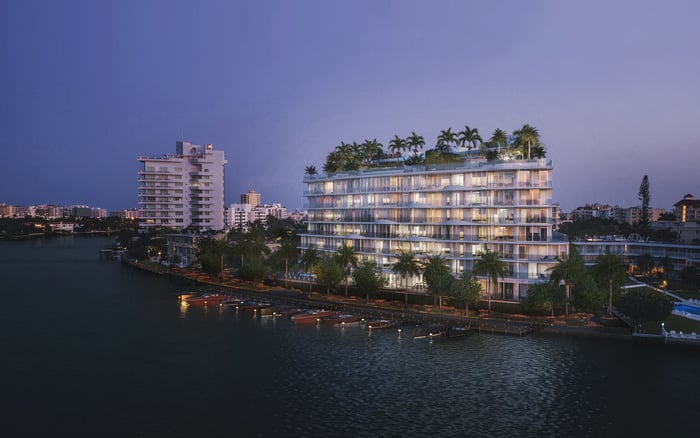
Rivage Bal Harbour’s oceanfront appeal deserves a separate assessment from its ownership economics. A disciplined buyer should examine deposit exposure, budget assumptions, reserve planning and association control before treating luxury positioning as long-term financial assurance.

At the trophy end of South Florida real estate, the most persuasive details are often the easiest to appreciate: an oceanfront address, a carefully considered interior and the promise of privacy. Yet the purchase also includes something less visible: participation in a shared financial and governance structure. Finishes describe the residence; budgets, reserves and decision-making rules help define the ownership experience.
Rivage Bal Harbour deserves evaluation on both levels. The oceanfront condominium development at 10245 Collins Avenue, Bal Harbour, FL 33154, is planned with 56 residences. Its luxury positioning sets the context for the purchase; it does not establish the adequacy of future association funding. Transparent governance and reserves are diligence questions, not presumed strengths or weaknesses.
This distinction is not an allegation of deficient management, inadequate reserves or anticipated special assessments. It is a standard of scrutiny appropriate to a substantial capital commitment.
The development partners are Related Group, Rockpoint and Two Roads Development. A $424 million construction loan from Tyko Capital was secured in November 2024, following the September 2024 construction start. The developers targeted completion in 2027; that remains a projected delivery date, not confirmation of completion.
These milestones concern development execution and financing. They do not establish an adopted association budget, a particular reserve balance or the assessments owners will ultimately pay. Construction financing funds the development; association reserves provide for the association’s future needs. They answer different questions.
Buyers should therefore conduct two distinct reviews. The first addresses delivery, specifications and contractual protections. The second addresses recurring ownership costs, capital planning and control of shared decisions. Confidence in the first should not replace documentation for the second.
Advertised pricing has started at $8 million, subject to current availability and contract pricing. The published payment schedule is 20% at contract, 10% at groundbreaking, 10% at top-off and 60% at closing. Together, those installments put 40% of the purchase price due before closing.
On an illustrative $10 million purchase, that means $4 million in pre-closing deposits. At $15 million, it means $6 million. These are arithmetic examples, not quoted residences or confirmation of terms available today.
The executed contract must establish the actual obligations. Because the published schedule references construction milestones, a buyer entering at a later stage should have counsel confirm which installments are immediately due, what triggers subsequent payments and how delays affect contractual rights. Deposit handling, release provisions and remedies also warrant direct review, not assumptions drawn from a payment summary.
For an affluent buyer, the issue is not simply whether those deposits are affordable. It is whether the contractual exposure is understood before liquidity is committed.
An assessment figure without its underlying assumptions offers an incomplete picture of ownership costs. Request the latest proposed or adopted budget, with its status and effective period clearly identified. Ask which expenses reflect contracted amounts and which remain estimates, particularly for staffing, insurance, utilities, maintenance and management.
The review should distinguish recurring operations from reserve contributions. It should also clarify whether developer support, temporary arrangements or occupancy assumptions affect the initial presentation. These are questions to resolve, not assertions that Rivage uses any particular arrangement.
Ask how costs are allocated to the residence under consideration. A project’s 56-residence count alone does not establish an equal division of expenses. The governing documents should establish the relevant allocation.
If the shortlist also includes Oceana Bal Harbour, compare the supporting financial documents rather than headline monthly charges alone. The aim is a consistent review, not an unsupported conclusion that either property offers better financial governance.
A reserve review should go beyond whether a contribution appears in a budget. Ask which components the plan addresses, what replacement-cost and useful-life assumptions support it, when those assumptions were prepared and how they will be updated. Request the funding schedule and distinguish projected contributions from money actually held.
For Rivage, reserve balances, a completed Structural Integrity Reserve Study, stabilized assessments and an adopted association budget should not be assumed. Ask what is available now, what remains preliminary and when further documentation is expected. Have qualified advisers assess the applicable requirements rather than relying on generalized descriptions of Florida condominium law.
Apply the same scrutiny when considering The Delmore Surfside as part of a Surfside comparison. Ask the same questions without presuming identical obligations, development stages or funding positions.
A useful reserve discussion provides more than reassurance. It identifies assumptions, responsible parties and a timetable for updating the financial picture. Where figures remain provisional, the buyer should understand precisely what is unresolved.
Governance diligence begins with the declaration, bylaws and applicable purchase documents. Ask counsel to explain voting rights, the transition from developer to owner control and the authority to approve budgets, contracts and material expenditures. Identify which commitments could continue after that transition.
Request available management agreements and service contracts, including their duration, termination provisions and any disclosed relationships among the parties. Ask how financial statements, meeting materials and budget changes will be communicated to owners. If records are not yet available, seek a clear explanation of when they are expected and how buyers will receive them.
The same discipline applies to a Miami Beach search that includes The Perigon Miami Beach. Architectural preference can remain personal; the standard for understanding ownership obligations should remain consistent.
Before proceeding, assemble a written diligence record that separates confirmed contractual terms, preliminary financial assumptions and unresolved questions. Each unresolved item should have an identified respondent and an expected answer date. This turns broad assurances into a practical basis for judgment.
Have legal counsel review contractual and governance provisions, and engage appropriate financial or technical advisers for budget and reserve questions. Neither a polished presentation nor a substantial construction loan resolves every issue that matters after closing.
Rivage’s oceanfront proposition can be evaluated on its merits without allowing luxury positioning to substitute for financial transparency. The objective is not to eliminate every uncertainty in a developing condominium. It is to understand which uncertainties remain, how they affect the commitment and whether the documentation supports the buyer’s expectations.
For a considered perspective on South Florida’s exceptional residences, explore MILLION.
If branded residences are on your mind — as a home or as an allocation — we would be glad to share what we are seeing, privately.
Begin a quiet conversationRivage Bal Harbour is an oceanfront condominium development at 10245 Collins Avenue, Bal Harbour, FL 33154.
The development is planned with 56 residences. That count alone does not establish how association expenses will be allocated.
The development partners are Related Group, Rockpoint and Two Roads Development.
The developers targeted completion in 2027. That is a projected delivery date, not confirmation of completion or a substitute for the contract’s delivery provisions.
Advertised pricing has started at $8 million, subject to current availability and contract pricing. Buyers should confirm the terms for the specific residence under consideration.
The published schedule is 20% at contract, 10% at groundbreaking, 10% at top-off and 60% at closing. The executed contract must establish the buyer’s actual obligations.
Applying the published schedule, pre-closing deposits would total $4 million. This is an arithmetic illustration, not a quoted unit offering.
No. The $424 million construction loan concerns development financing and does not establish an association reserve balance or the adequacy of future funding.
No. Reserve adequacy and governance transparency are unresolved diligence questions, not findings of deficient funding, poor management or anticipated special assessments.
Request the applicable budget, reserve documentation, governing documents and available management agreements. Counsel should also review deposit provisions, delivery terms and the transition to owner control.