Ocean House Surfside pairs genuine boutique scarcity with a financing profile that remains to be established at the condominium-association level. Its construction loan signals institutional confidence in the development, but future mortgage access and resale liquidity will turn on reserves, insurance, assessments, litigation, building condition and the quality of the association's disclosures.

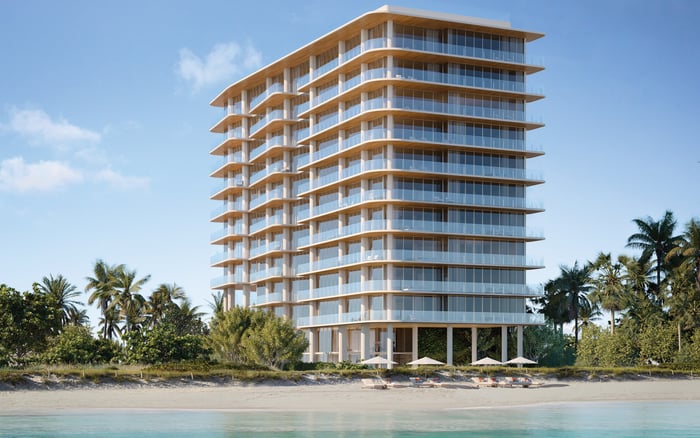
At first glance, Ocean House Surfside presents a compelling ultra-luxury proposition: a planned 12-story building with just 25 residences at 9317 Collins Avenue. Multiplan Real Estate Asset Management is the developer, Arquitectonica is identified as the architect, and pricing begins at approximately $5.1 million for two-bedroom residences.
Yet for a future financed buyer, the most consequential document may be neither the floor plan nor the offering presentation. It will be the condominium questionnaire completed on behalf of the association when a borrower seeks to purchase or refinance. That document shifts underwriting from the individual residence to the project as a whole.
No completed Ocean House association questionnaire, final reserve budget or operating history is yet available. It is therefore too early to declare the condominium warrantable for conventional resale financing. Instead, the questionnaire defines the standards against which lender appetite will ultimately be measured.
A full condominium questionnaire asks whether the project is complete, whether the developer still controls the association, how units are owned and occupied, and whether one entity holds a meaningful concentration of residences. In a 25-unit building, each residence represents a visible share of the whole, making transparent ownership data especially important.
Financial governance receives equal scrutiny. Lenders examine the operating budget, reserve funding, current or proposed special assessments, and delinquent assessments. They also review insurance coverage, litigation, deferred maintenance, structural or mechanical concerns, and unsafe conditions. These are not peripheral administrative matters. They help determine whether the association can preserve the asset without exposing owners to unpredictable obligations.
That scrutiny has intensified since the Champlain Towers South collapse. Enhanced standards addressing deferred maintenance and unsafe conditions began taking effect in 2022, placing greater weight on physical condition and association disclosure. For an oceanfront property in Surfside, documentation is now inseparable from financeability.
Multiplan secured a $30 million construction loan from Bradesco Bank for the development. This demonstrates institutional lender appetite at the development level and represents a meaningful point in the project’s capital story.
It does not, however, establish whether an individual residence will qualify for a conventional mortgage after completion. A construction lender evaluates the developer, land, budget, execution plan and collateral. A unit lender evaluates the borrower and the operating condominium. The two decisions overlap only indirectly.
This distinction is particularly important for pre-construction buyers planning to refinance, preserve liquidity or sell to a financed purchaser. Even an all-cash acquisition can later face a narrower buyer pool if the association cannot satisfy project-review requirements.
Ocean House is planned with two- to five-bedroom configurations and residence sizes of approximately 2,093 to 6,279 square feet. That range, paired with only 25 residences, supports a boutique identity rather than the transaction cadence of a large tower.
Scarcity can be an advantage. A limited collection may appeal to buyers who value privacy, lower density and a more tightly held address. The same characteristic can complicate appraisals and resale price discovery because fewer same-building closings may be available as comparable sales.
Prospective owners can examine the broader Surfside luxury context through completed and planned alternatives such as Arte Surfside and The Delmore Surfside. Those comparisons may help frame the location and buyer preferences, but they cannot replace recent, genuinely comparable transactions within Ocean House itself.
The result is not necessarily weak liquidity. It is more selective liquidity, in which documentation, pricing discipline and the availability of suitable comparables can exert an outsized influence on execution.
Before relying on future mortgage availability, a buyer should request the completed lender questionnaire alongside the association budget, reserve information, insurance evidence, assessment history, litigation disclosures and structural-maintenance records. These documents should be read together, because a favorable answer in one category may not offset a material concern in another.
Timing also requires precision. Current estimates span 2027 and 2028, so contract milestones and delivery expectations should be reviewed directly rather than inferred from a single date. Until the building is complete and association operations are established, future warrantability remains an underwriting question rather than a project attribute.
Buyers comparing the area may also consider how established properties, including The Surf Club Four Seasons Surfside, demonstrate the importance of building-specific transaction history. Ocean House will need time to establish its own record of closings, governance and maintenance.
The prudent conclusion is balanced. Ocean House offers a scarce oceanfront format, substantial residences and development financing. Its eventual lending depth and resale liquidity will depend on what the operating condominium can prove after delivery.
What does a condominium questionnaire evaluate? It evaluates project-level matters such as completion, control, ownership, finances, insurance, litigation and physical condition.
Is Ocean House currently confirmed as warrantable? No completed association questionnaire, final reserve budget or operating history is yet available, so future warrantability cannot be confirmed.
Does the $30 million construction loan guarantee buyer mortgages? No. Development financing and an individual purchaser’s mortgage are separate underwriting decisions.
Why does developer control matter? The questionnaire asks who controls the association because governance and project completion can affect condominium-level risk.
How could 25 residences affect resale liquidity? The limited inventory creates scarcity but may yield fewer same-building comparable sales for appraisers and buyers.
Which financial records will lenders review? Key records include the association budget, reserve funding, special assessments and delinquent assessments.
Which physical issues can affect approval? Structural or mechanical problems, deferred maintenance and unsafe conditions can be material to project review.
Does paying cash eliminate condominium risk? No. An all-cash owner may still face a smaller pool of financed buyers upon resale if project documentation is deficient.
When is Ocean House expected to be completed? Current estimates span 2027 and 2028, so buyers should verify the applicable contractual timeline.
What should buyers request before relying on future financing? Request the completed questionnaire, budget, reserves, insurance, assessment history, litigation disclosures and maintenance records.
For a confidential assessment and a building-by-building shortlist, connect with MILLION.
If branded residences are on your mind — as a home or as an allocation — we would be glad to share what we are seeing, privately.
Begin a quiet conversation