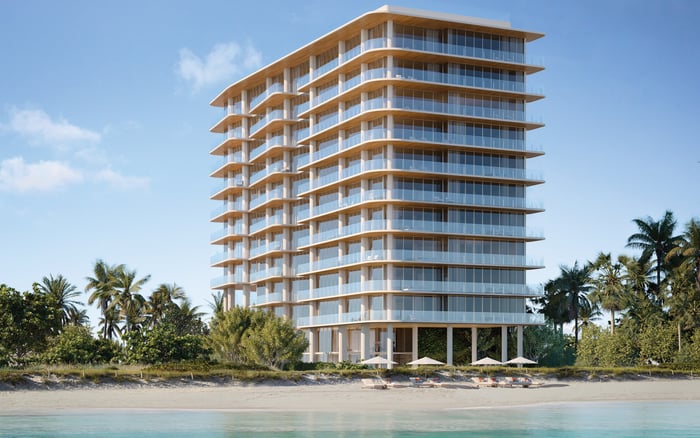
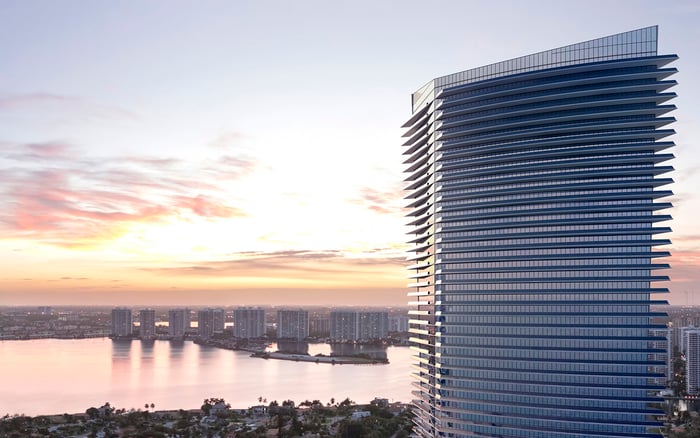
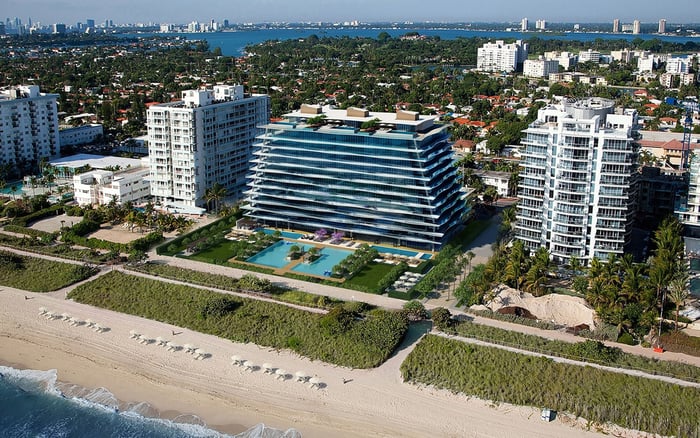
At Ocean House Surfside, the legal definition of the residence matters as much as its design. Buyers should reconcile plans, surveys, easements, title exceptions and beach-access rights before closing.
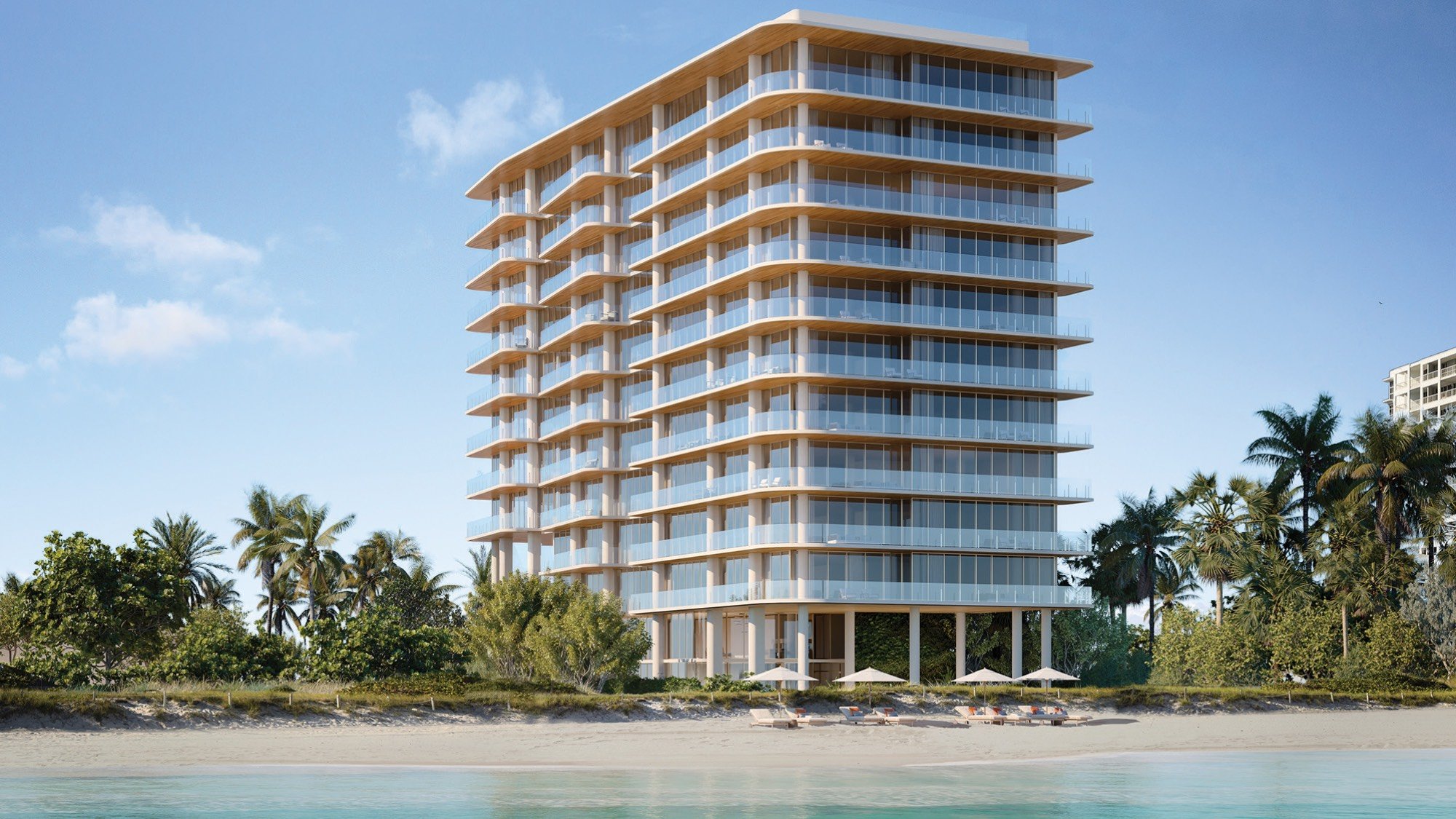
At the rarefied end of the Surfside market, architecture and service are only part of the acquisition. The more consequential question is what, precisely, the buyer will own, use exclusively and share with others. At Ocean House Surfside, those distinctions warrant particular attention because the oceanfront condominium at 9317 Collins Avenue remains under construction.
Developed by Multiplan Real Estate Asset Management, the project is planned for 25 residences, with two- to five-bedroom configurations, prices starting at around $5.1 million and targeted delivery in 2028. Residence sizes span approximately 2,093 to 6,279 square feet. That breadth makes it essential to match the contracted home to its eventual legal description rather than treat a presentation plan as the final measure of ownership.
This is fundamentally a pre-construction issue. A purchaser commits before the completed building can be compared with an as-built survey and final condominium documents. The review must therefore look beyond finishes and views to the legal framework beneath them.
In a condominium purchase, exclusivity is established by documents, not atmosphere.
Florida condominium documents must include or attach a survey, plot plan or graphic description sufficient to identify the units, their relative locations and the common elements. These statutory documents-not a brochure or sales floor plan-establish the legally recognized boundaries of a residence.
For an Ocean House buyer, the final survey and declaration should be compared line by line with the plan attached to the purchase agreement. Counsel should confirm dimensions, horizontal and vertical boundaries, and the treatment of spaces adjoining the residence. Small discrepancies can affect usable area, design flexibility and value, particularly in a market where asking prices range from roughly $10 million to $17.6 million and average nearly $4,051 per square foot.
The comparison is not merely mathematical. A ceiling cavity, exterior wall, structural element or threshold can sit outside the unit even when it appears integral to the home. The legal boundary can determine who may enter for repairs, who bears maintenance responsibility and whether an owner may alter a feature without association approval.
Ocean House features private elevators and deep terraces. Buyers should establish whether an elevator vestibule, landing or terrace is part of the unit, a limited common element or a general common element. Each classification carries a different bundle of rights.
A limited common element is reserved for one or more units rather than all owners. Exclusive use may therefore exist without direct ownership. The declaration should define responsibility for maintenance, repair, replacement and alteration, including who pays when waterproofing, railings, doors or circulation components require work. It should also clarify association access and any developer-reserved rights affecting these spaces.
This distinction is relevant across the neighborhood's boutique oceanfront segment. Buyers comparing Arte Surfside or The Delmore Surfside should apply the same discipline: compare the lifestyle promise with the declaration's precise allocation of space, expense and control.
Easements allow specified use of property without transferring ownership. In a condominium, they can support utilities, drainage, emergency access, maintenance, deliveries, service vehicles and movement through common property. They are operationally necessary, but their placement and scope may affect the privacy a luxury buyer expects.
A title review should identify recorded easements benefiting utilities, public authorities, neighboring parcels or service providers. The purchaser should assess whether any route crosses an arrival court, valet area, entrance, amenity zone, beach path or private circulation corridor. The inquiry is not simply whether an easement exists, but who may use it, for what purpose, under which conditions and with what ability to relocate it.
Unless a declaration prohibits it, a Florida condominium association may grant, modify or relocate an easement across common elements without every owner joining the transaction. Buyers should therefore examine limits on future board authority, voting thresholds and developer amendment rights. Privacy should be tested against what the recorded documents permit, especially when controlled entrances and private elevator access are integral to the building's positioning.
Oceanfront living does not eliminate the need to document ingress and egress. Florida law generally prevents local governments from prohibiting condominium owners and their guests, licensees or invitees from pedestrian access to a contiguous public beach, subject to health, safety and natural-resource exceptions. That protection concerns access to a public beach. It does not make the shoreline privately owned or exclusive to residents.
A beach-access review should identify the building's actual route to the sand. Is it a deeded common element, a limited common element or an easement? May neighboring owners, service personnel or another third party use the same path? Who controls gates, hours, maintenance and restoration after work? These questions translate an evocative phrase into enforceable rights and operating responsibilities.
The same distinction matters when evaluating established Surfside properties such as The Surf Club Four Seasons Surfside. A beautiful route to the ocean and a legally protected route to the ocean are not interchangeable concepts.
Rentals at Ocean House are described as long-term only. The governing declaration should still be reviewed for its definitions of tenant, guest, licensee and invitee, as well as their rights to amenities, elevators, parking and beach access. These provisions help determine whether day-to-day traffic aligns with the low-density character suggested by a 25-residence building.
Service circulation warrants equal scrutiny. Housekeepers, contractors, deliveries, emergency responders and association personnel may hold legitimate access rights that intersect with ostensibly private areas. Buyers should seek clarity on notice, security protocols and the circumstances under which the association can enter a residence or limited common element.
The most useful approach is reconciliation, not collection. Florida counsel should compare the executed purchase agreement, amendments, final declaration, condominium plat, title commitment and exceptions, and as-built survey. Material representations about dimensions, terraces, vestibules, elevator access, parking, storage, valet circulation and the beach route should be traced to the controlling document.
This is the central lesson for buyer's guides focused on new oceanfront condominiums: the documents should agree with one another and with the asset the buyer believes is being acquired. Project details can change, and disclosed information may differ across materials. The executed agreement and filed offering documents should control the analysis.
Counsel should also address survey exceptions, encroachments, legal ingress and egress, reciprocal-access arrangements and the developer's reserved power to amend documents before turnover. Any unresolved discrepancy should be evaluated for its practical effect, not merely its drafting significance.
Ocean House offers the appeal of a highly limited oceanfront address, generous configurations and an emphasis on privacy. Yet the most durable form of luxury is certainty about boundaries, access and responsibility. A meticulous legal and title review can reveal whether the residence, terraces, circulation routes and beach connection operate as the buyer expects.
For discreet guidance on Ocean House Surfside and South Florida's luxury condominium market, connect with MILLION.
If branded residences are on your mind — as a home or as an allocation — we would be glad to share what we are seeing, privately.
Begin a quiet conversationIt helps identify the residence, its location and its relationship to common elements. Buyers should compare it with the contracted floor plan and final declaration.
No. The declaration and its attached survey, plot plan or graphic description establish the legally recognized boundaries.
They should confirm whether it is part of the unit, a limited common element or a general common element, and identify the related maintenance and access rules.
It is a condominium element reserved for the use of one or more units rather than all owners. Its classification can affect control, alteration rights and maintenance costs.
Easements may authorize utilities, drainage, emergency access, service circulation or passage through common property. Their scope and location can affect privacy and operations.
Unless the declaration prohibits it, an association may grant, modify or relocate an easement across common elements without every owner joining the transaction.
No. Statutory protection for pedestrian access to a contiguous public beach does not convert the shoreline into privately owned or exclusive beach property.
It should identify recorded rights involving utilities, drainage, emergency access, service vehicles and neighboring parcels that may affect the property.
Counsel should compare the purchase agreement, final declaration, condominium plat, title exceptions and as-built survey.
They can determine access to amenities, elevators, parking and the beach. Those rules also influence whether building traffic aligns with a low-density ownership experience.