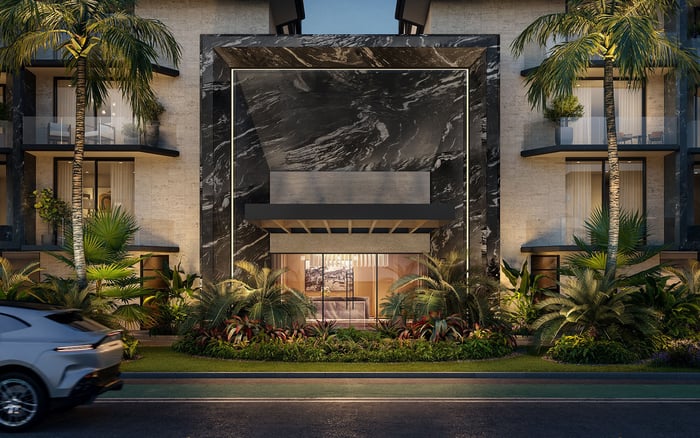
A buyer-focused examination of LILLI’s disclosed privacy framework, the unresolved questions around resident directories and intercom naming, and the documents needed to make discretion a clear purchase requirement.

For a luxury buyer, privacy is more than an arrival experience. It is control over how a name, residence and household become visible to visitors, service providers and the public. At Lilli Miami Edgewater, that distinction warrants attention before a purchase commitment, particularly when discretion is essential to the brief.
LILLI is located at 717 NE 27th Street, Miami, FL 33137, and is marketed as a boutique collection of 117 waterfront residences on Biscayne Bay. It is a proposed 53-story condominium tower, not a completed, operating building. Private elevator arrivals are described for each residence, but that physical arrangement does not establish resident-directory confidentiality or intercom anonymity.
The central conclusion is straightforward: the available privacy framework addresses website data, not future resident naming rules. The absence of a published resident directory proves neither anonymity nor mandatory name display. Buyers must translate a preference for discretion into specific, documented requirements.
A private elevator arrival and a confidential directory solve different problems. One concerns physical access to a residence; the other concerns the information someone can see before access is granted. Neither is a substitute for the other in a purchase decision.
It remains unresolved whether a future LILLI intercom will display full names, initials, unit numbers or a concierge contact. An intercom-name opt-out, a preferred-name procedure and directory visibility controls are also unconfirmed. These are unresolved operating questions, not evidence of either a privacy benefit or a privacy defect.
Buyers also considering Aria Reserve Miami should apply the same distinction: evaluate arrival arrangements separately from identity visibility. That is a diligence framework, not a claim that either project offers a particular directory configuration.
The useful question is not whether the building feels private. It is which identifiers each system will reveal, to whom and under whose authority.
The published privacy policy concerns personal information processed when people use LILLI’s website. Covered categories can include names, addresses, telephone numbers, employment information and financial information. Permitted sharing includes affiliates, service providers, financial institutions and other business-purpose recipients under contractual confidentiality restrictions.
The policy’s no-sale provision applies to personal information being “sold” as the policy defines that term. That qualification matters: a no-sale statement is not a promise that information is never shared or that a resident’s name will never appear on an entry panel.
Privacy-rights requests may be directed to [email protected] or to 720 NE Street PropCo LLC, 4100 NE 2nd Ave, Suite 307, Miami, FL 33137. This is a channel for requests within the policy’s scope. It does not establish a future association procedure for changing an intercom label.
A website-data policy is not a condominium declaration, association rule or technology specification. Buyers should keep those documents distinct, even when all concern personal information.
Before signing or closing, request the declaration, bylaws, rules, disclosure documents and technology/security specifications. Ask which documents govern resident names and which provisions could later change. Where a system or policy remains undecided, seek written confirmation of its status rather than an assurance that privacy will be accommodated.
The display questions should be precise: Will any name be mandatory? Can residents use initials, a preferred name, a unit identifier or concierge routing? Is an opt-out available? Can a visitor browse all entries, search by surname or access information remotely? These are questions to resolve, not descriptions of LILLI’s planned equipment.
Request separate answers for visitor panels, package systems and concierge software. A setting in one interface should not be assumed to control another. Ask who can approve a change, how residents request it and whether visibility choices extend to household members and authorized occupants.
For a buyer comparing LILLI with EDITION Edgewater, consistent written questions make the comparison more useful than broad language about exclusivity.
A name hidden from visitors may still be available to personnel or service providers. Diligence should therefore extend beyond the entry screen to the eventual manager’s and intercom vendor’s data-sharing, retention, correction and deletion policies.
Ask which parties receive resident information, what purposes justify access and how long records remain after a household leaves. Request clear procedures for correcting inaccurate entries and removing information from systems when appropriate. Do not assume that an opt-out from visitor display also deletes an internal account or service record.
A demonstration, once available, can help distinguish a policy promise from an actual configuration. Request confirmation of the intended setup and ask how it will be checked before occupancy. This is a recommended verification step, not an indication that LILLI’s systems have already been selected or installed.
Privacy requirements are most useful when operationally specific: a defined audience, a defined identifier and a defined procedure for changes.
Building records are a different information layer from resident-facing directories. The City of Miami maintains property permits and plans for investigating building history, with access routes for building records, property histories, city documents and permitting materials.
In Miami-Dade County, condominium, cooperative and homeowners’ associations must register annually and provide a centralized registry of documents. Association records offer another research avenue. The existence of these resources does not establish that LILLI-specific association filings or operating policies are already available.
Site ownership also requires careful interpretation. The site owner is 720 NE Street PropCo LLC, an OKO Group-affiliated entity. That fact is not a resident roster and does not establish which future individual unit owners or beneficial owners will appear publicly.
When evaluating Villa Miami alongside LILLI, maintain the same separation between property records and building-system visibility. A concierge-controlled arrival cannot, by itself, answer questions about public-facing ownership information.
A decision-ready privacy file should distinguish confirmed terms, unresolved specifications and preferences that have not been accepted. Have counsel review whether any privacy representation appears in the relevant purchase or governing documents, and whether the party providing it has authority to make that commitment.
If name visibility is non-negotiable, resolve it before treating discretion as part of the residence’s value. Ask what happens if the vendor, manager or association rules change. A future-facing promise is more useful when its scope and limits are explicit.
LILLI’s private elevator arrivals and boutique residential scale are meaningful project characteristics. Neither settles intercom naming, directory searchability or public-record exposure. A disciplined purchase decision keeps those questions separate and secures written answers where they matter most.
For a discreet perspective on South Florida residences and buyer priorities, explore MILLION.
If branded residences are on your mind — as a home or as an allocation — we would be glad to share what we are seeing, privately.
Begin a quiet conversationLILLI is located at 717 NE 27th Street, Miami, FL 33137, in Edgewater.
The project is described as a proposed 53-story waterfront condominium tower, not a completed, operating building.
LILLI is marketed as a boutique collection of 117 waterfront residences on Biscayne Bay.
No. Private elevator arrivals concern physical access and do not establish resident-directory privacy or intercom anonymity.
The available materials do not establish whether future panels will display full names, initials, unit numbers or a concierge contact.
The published website-data policy does not establish an intercom-name opt-out, preferred-name procedure or directory visibility controls.
No. It permits specified business-purpose sharing under contractual confidentiality restrictions and states that information is not sold as defined in the policy.
Requests may be directed to [email protected] or 720 NE Street PropCo LLC, 4100 NE 2nd Ave, Suite 307, Miami, FL 33137.
Request the declaration, bylaws, rules, disclosure documents and technology/security specifications. Obtain written answers about display requirements, opt-outs and vendor data practices.
No. The site-owning entity is not a resident roster and does not establish which future individual unit owners or beneficial owners will appear publicly.