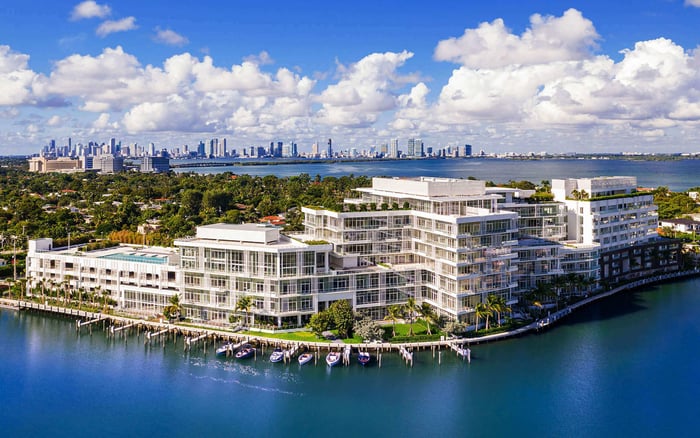
Eighty Seven Park offers a completed, design-led reference point for buyers evaluating future South Florida preconstruction timelines. The essential discipline is to distinguish a sales schedule from contractual rights, model personal timing under several scenarios, and have Florida counsel review the provisions governing deposits, extensions, closing, assignment and remedies.

Now complete, Eighty Seven Park Surfside offers a useful lens through which to consider a question facing every sophisticated preconstruction buyer: how can one plan around a completion schedule without allowing it to dictate every personal and financial decision?
The boutique condominium stands at 8701 Collins Avenue, on the northern edge of Miami Beach and immediately south of Surfside. Associated with Renzo Piano and the Renzo Piano Building Workshop, it was conceived as a low-density alternative to larger Miami-area towers. Its horizontal architecture, expansive interiors and deep terraces frame the Atlantic on one side and parkland on the other.
These qualities help explain why buyers commit early to singular projects. Yet design conviction and calendar certainty are distinct. Because Eighty Seven Park is complete, the prudent lesson is not a project-specific warning, but a framework for assessing future purchases in which delivery timing, lifestyle plans and capital commitments must remain aligned.
A projected construction schedule can inform planning, but buyers should distinguish presentation materials and conversations from the obligations set out in the purchase agreement. Before signing, a Florida real-estate attorney should review how the contract defines completion, closing notice, permitted extensions, buyer default and available remedies.
The review should focus on language, not assumptions. Ask which event triggers the obligation to close, how much notice may be given, whether dates can move and what happens to deposits in each outcome. Force-majeure provisions, rescission rights and outside completion concepts warrant particular attention because their meaning depends on the agreement itself and applicable law.
This discipline applies across the market, whether evaluating an intimate Surfside proposition such as The Delmore Surfside or a Miami Beach address such as The Perigon Miami Beach. Architecture may inspire the acquisition; the contract governs the buyer’s flexibility.
A refined purchase plan should encompass more than one anticipated closing month. Create at least three working scenarios: delivery near the projected period, delivery later than expected and a closing notice arriving at an inconvenient moment. For each, map housing, liquidity, financing, travel and furnishing decisions.
If the residence will replace another home, avoid making an irreversible sale or lease decision solely around an estimated date. If it will serve as a second home, consider how a shifting closing could intersect with seasonal use. International buyers should also account for the practical time required to move funds, execute documents and coordinate advisers, without assuming the contract will accommodate personal logistics.
Liquidity deserves equal attention. Buyers should know when each deposit is due and keep those funds separate from capital reserved for closing, design work and ongoing ownership. Counsel and financial advisers can help determine whether a schedule change would create unnecessary pressure elsewhere in the portfolio.
Assignment rights may matter when circumstances change before closing, but they should never be presumed. Ask a Florida attorney whether assignment is allowed, restricted, conditioned on approval or prohibited-and whether the original buyer retains any continuing obligation.
Financing language also demands precise review. A buyer who intends to borrow should not assume that the agreement includes a financing contingency or that a lender’s timetable will govern the closing. Confirm the contractual position first, then structure lending discussions around it.
Deposit provisions are equally consequential. Counsel should explain the schedule, the holding arrangements described in the contract, the consequences of default and any conditions for return. The objective is not to predict a delay, but to understand in advance which options remain if timing diverges from expectations.
For buyers comparing oceanfront choices, these questions belong alongside considerations of design and views. The privacy and architectural identity associated with Arte Surfside may appeal for different reasons than the broad coastal profile of 57 Ocean Miami Beach, but contractual flexibility deserves the same rigor.
Preconstruction buyers should establish how updates will be delivered and who is authorized to communicate on the seller’s behalf. Keep signed documents, amendments, notices and payment confirmations in a single secure file. After substantive conversations, request written clarification rather than relying on memory.
Questions should be specific and neutral: What milestone has been reached? Has the projected closing period changed? Which selections remain open, and when do they become final? Which contractual notice provisions should the buyer monitor? Clear questions create a more useful record without conflating an update with a contractual amendment.
Buyer’s guides often emphasize what to purchase. The more valuable discipline is deciding which commitments can wait. Furniture orders, temporary accommodations, movers and the sale of another property may each require distinct cancellation terms or timing cushions.
Eighty Seven Park’s appeal rests on attributes that are difficult to replicate: intimate scale, park adjacency, ocean exposure, generous terraces, light and an understated relationship with nature. A buyer drawn to these qualities should protect the original investment thesis while preserving room for life to change.
That means documenting the features central to the decision, reviewing the plans and specifications supplied with the agreement, and asking counsel how the contract addresses permitted changes. Flexibility is not simply an exit strategy. It is the ability to reach closing without compromising liquidity, housing plans or the reasons the residence was selected.
For MILLION clients considering Miami Beach or Surfside, the strongest posture is established before signature. Legal review, scenario planning and disciplined documentation are measured safeguards relative to the scale of an ultra-premium acquisition.
Is Eighty Seven Park still a preconstruction condominium? No. The condominium is complete and serves here as context for future preconstruction decisions.
Where is Eighty Seven Park located? It is at 8701 Collins Avenue in Miami Beach, immediately south of Surfside.
What makes the setting distinctive? The property occupies an oceanfront site, with the Atlantic on one side and parkland on the other.
Who is associated with its architecture? The project is associated with Renzo Piano and the Renzo Piano Building Workshop.
Should a buyer rely on a projected completion date? It should serve as a planning input, while contractual obligations are reviewed separately with counsel.
Which timeline terms deserve legal review? Ask a Florida real-estate attorney to review completion definitions, extensions, notices, defaults, deposits and remedies.
Can a preconstruction contract be assigned? Assignment rights vary by agreement, so counsel should confirm whether assignment is permitted and under which conditions.
Should financing be arranged around an estimated closing? Financing plans should accommodate timing variability and reflect the actual contract rather than an assumed contingency.
How can a buyer prepare for a later closing? Maintain liquidity, avoid inflexible housing commitments and model alternative dates before signing.
What records should a buyer retain? Keep the executed agreement, amendments, notices, payment confirmations and material written communications together.
To compare the best-fit options with clarity, connect with MILLION.
If branded residences are on your mind — as a home or as an allocation — we would be glad to share what we are seeing, privately.
Begin a quiet conversation