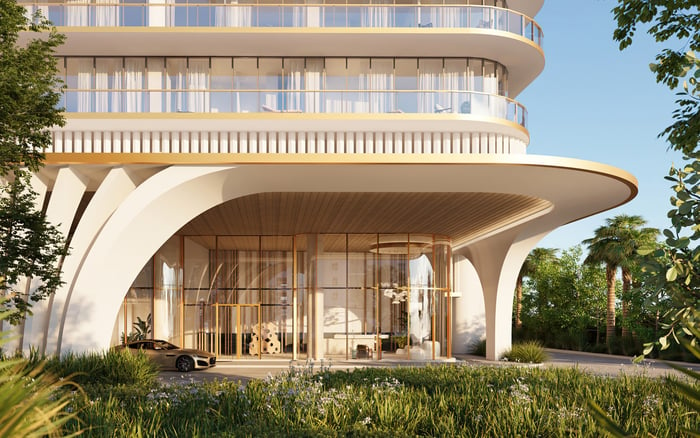
For Downtown Miami buyers who move at aviation speed, the difference is rarely about prestige and almost always about logistics. One Thousand Museum is synonymous with the idea of arriving by helicopter; Aston Martin Residences is synonymous with arriving to the waterfront and then moving quickly to regional airports, private terminals, and the broader travel network. This MILLION Luxury comparison focuses on how each address tends to work in real life: decision paths, building operations, curb-to-elevator flow, and the practical tradeoffs between rooftop capability and ground-based aviation access.
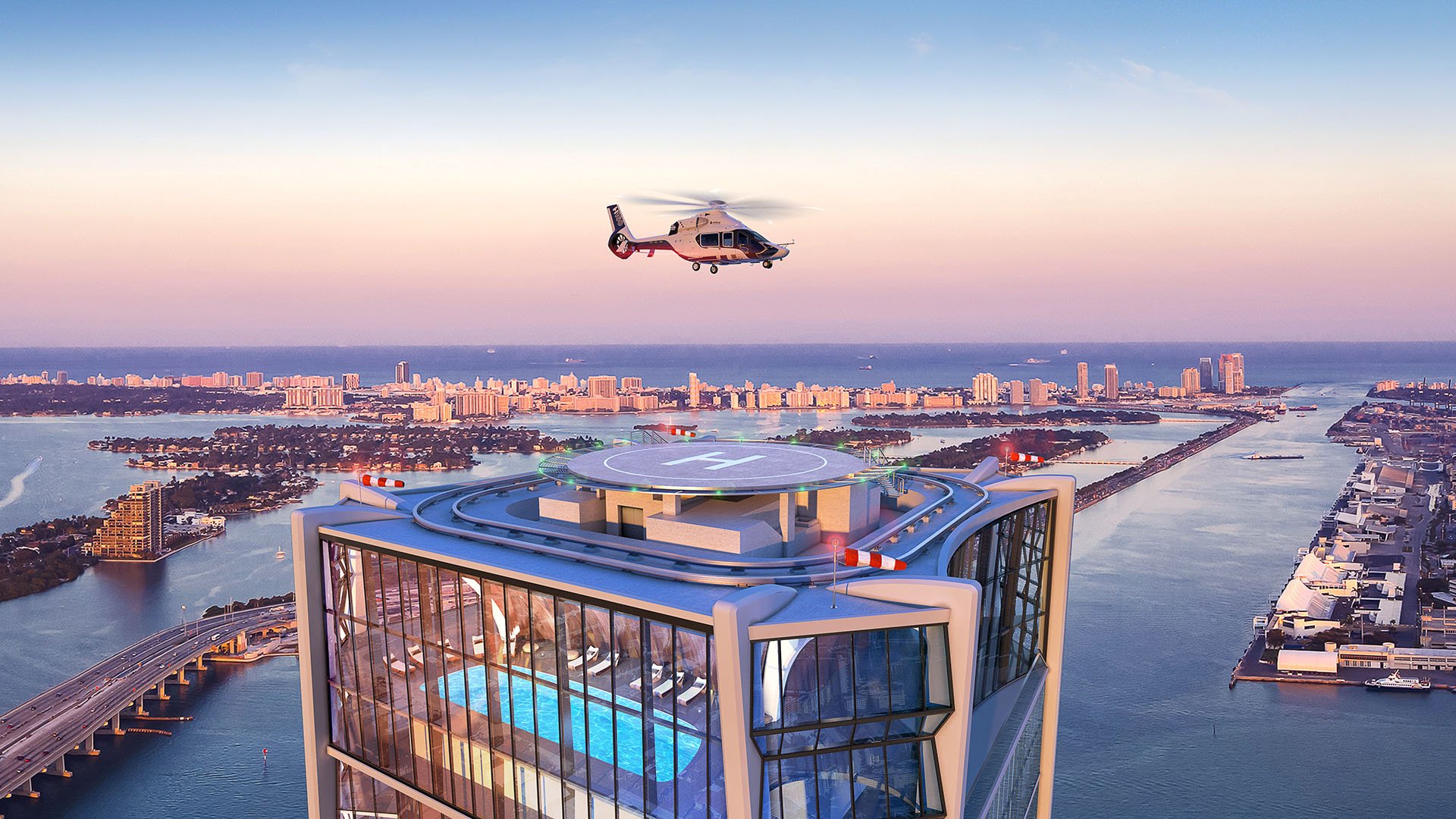
In Downtown, “aviation access” can describe two distinct lifestyles. One is heli-centric: a resident expects to lift off or land as close to home as possible, then transition directly into private life. The other is airport-centric: a resident prioritizes smooth, repeatable movement to and from private aviation facilities, with predictable ground logistics.
That’s why the discussion around One Thousand Museum Downtown Miami and Aston Martin Residences Downtown Miami is inherently nuanced. Both are marquee addresses in Downtown, yet they often serve very different travel patterns. The right choice hinges on how you actually fly, how often you fly, and what level of operational complexity you consider acceptable.
At MILLION Luxury, we anchor the decision in “door-to-air” performance: how cleanly you move from residence to aircraft (and back), including the unglamorous variables-protocols, approvals, staffing, and contingency routing.
The appeal is straightforward: One Thousand Museum has become a symbol of helicopter-adjacent living in Miami. For certain principals, it’s not about novelty-it’s about control. A rooftop arrival can compress the travel sequence into a single private flow: secure approach, rapid vertical circulation, and immediate separation from street-level unpredictability.
The real evaluation, however, isn’t the idea of a helipad. It’s the logistics that surround it.
Because policies and operating parameters can vary by building-and can evolve over time-a prudent buyer treats the helipad as an operational ecosystem, not a simple amenity. Key considerations typically include:
Operating permissions and protocol:
whether use is limited, scheduled, member-based, or reserved for certain scenarios.
Coordination and lead time:
how far in advance arrivals and departures must be arranged, and what happens when timing shifts.
Security choreography:
what the building requires before and after movement, and where handoffs occur.
Noise and neighborhood constraints:
how flight paths and hours can affect feasibility.
If your calendar is fixed and you value tightly managed arrivals, rooftop capability can be compelling. If your schedule changes hourly, “on paper” convenience can turn into a planning exercise-often less spontaneous than simply driving to a private terminal.
Helicopter logistics are sensitive to factors that don’t impact a car ride in the same way. Weather, air-traffic constraints, and operational limits can push a flight to another landing option. The practical question is: what is your Plan B when the helipad isn’t the fastest choice today? A helipad-forward lifestyle works best when the resident is equally comfortable pivoting to ground-based aviation access.
Aston Martin Residences reflects a different kind of travel intelligence. Rather than centering the aircraft at the building, it positions the residence within the region’s broader mobility network. In practical terms, this model tends to be more predictable: a chauffeured vehicle, a controlled route, a private terminal-then your aircraft.
For many buyers, that predictability is the luxury. Aviation access becomes a matter of minimizing transfer points: exiting your residence cleanly, entering your vehicle discreetly, and arriving at your chosen aviation facility with minimal friction.
In Downtown, mileage to an airport is only part of the story. The deciding factor is often reliability-how consistently you can execute the trip. Aston Martin Residences tends to suit residents who prefer repeatable routines: a consistent lobby-to-curb experience, a controlled pick-up, and a route that can be adjusted in real time.
If your travel includes early departures, tight connections, or frequent day trips, this ground-based model can outperform rooftop romance simply because it’s easier to run, easier to staff, and easier to standardize.
Rather than asking “which is better,” a sophisticated buyer asks, “which is better for my travel profile?” Use this framework.
If you regularly rely on helicopter transfers as a primary mode, One Thousand Museum’s association with rooftop aviation is naturally relevant. If your flights are more often fixed-wing via private terminals, the building that optimizes ground routing, storage, and staging can be the more useful asset.
Heli-centric living can be exceptional for planned movements. Airport-centric living is often stronger for high-frequency travel where the fastest option can change day to day.
Some principals prioritize a fully separated sequence from arrival to residence. Others accept a brief public interface-so long as it’s tightly managed and fast.
Consider the real-world practicalities: staff arrivals, family movements, guest coordination, and luggage. The fastest trip for one person may not be the smoothest trip for four people and a security detail.
Luxury aviation is an operations business. The building that reads as most “exclusive” in marketing is not always the building that feels most frictionless at 6:10 a.m.
When evaluating either One Thousand Museum or Aston Martin Residences, ask questions that reveal how the building performs under pressure:
Scheduling and permissions:
Who approves movement, and on what timeline?
Hours and constraints:
Are there restrictions that affect early or late travel?
Security and access points:
Where are the handoffs, and how controlled are they?
Elevator strategy:
How quickly can you transition from arrival point to residence?
Contingency routing:
If your first-choice arrival plan fails, what is the next best option?
Even if you never intend to use a helipad personally, understanding the operational environment can matter for resale perception, guest expectations, and the building’s overall tone.
Many Downtown owners pair a primary tower residence with a second location that changes the entire day-to-day. The logic is simple: Downtown offers proximity to culture and business, while other neighborhoods can deliver different operational advantages-quieter arrivals, lower-density curb experiences, or a more residential rhythm.
For example, if you prefer Brickell’s business adjacency and want a newer residential narrative, 2200 Brickell can complement a two-address strategy: Downtown for events and waterfront energy, Brickell for a different tempo. If your lifestyle trends toward a wellness-forward, boutique coastal cadence that feels simpler to manage between trips, 57 Ocean Miami Beach offers a Miami Beach counterpoint that some buyers use as a decompression base between flights.
And for principals who want a true lock-and-leave oceanfront posture north of the core, 2000 Ocean Hallandale Beach can serve as the “quiet runway”-not literally, but operationally: fewer moving pieces, more predictable arrivals, and a calmer return.
None of these alternatives replaces the Downtown experience. They simply reflect a truth of high-mobility life: sometimes the strongest aviation plan isn’t a single address, but a portfolio that makes every leg easier.
This is the discreet, buyer-oriented way to think about it.
You value the idea of helicopter-adjacent arrivals as part of the residence identity.
You prefer a highly curated, high-control arrival sequence.
You are comfortable planning and coordinating aviation as a managed operation.
Most trips are fixed-wing, and you prioritize predictable access to private aviation by car.
You want a waterfront signature address but measure luxury in repeatable efficiency.
You prefer a travel routine that scales easily for family, guests, and staff.
In both cases, the best outcomes come from operational fit-not the most dramatic narrative.
Is One Thousand Museum guaranteed to provide helicopter access at any time? No building amenity functions as “any time.” Confirm current policies, hours, and approvals.
Does Aston Martin Residences have a helipad? Evaluate Aston Martin primarily for ground-based aviation access and waterfront logistics.
Which address is better for frequent private-jet travel? Often Aston Martin, because the workflow is typically car-to-terminal-though your routine matters.
What should I verify first when helipad use is important? Confirm permissions, the scheduling process, security procedures, and contingency options.
How do weather and restrictions affect helicopter convenience? They can change the fastest option quickly, which makes a strong Plan B essential.
Is “door-to-air time” mainly about distance to the airport? Not always. Predictable curb access, lobby flow, and routing often matter more than miles.
Will aviation-oriented features affect resale value? They can-especially when they signal a buyer profile-but usability is the real driver.
Do I need two residences to optimize travel in Miami? Not necessarily, but a second address can simplify logistics for certain schedules.
What operational details are easy to overlook in high-end towers? Elevator programming, loading flow, guest handling, and after-hours staffing are common misses.
Should my decision be based on brand identity or logistics? Logistics first. Brand identity is meaningful, but it should follow operational fit.
When you're ready to tour or underwrite the options, connect with MILLION Luxury.
If branded residences are on your mind — as a home or as an allocation — we would be glad to share what we are seeing, privately.
Begin a quiet conversation