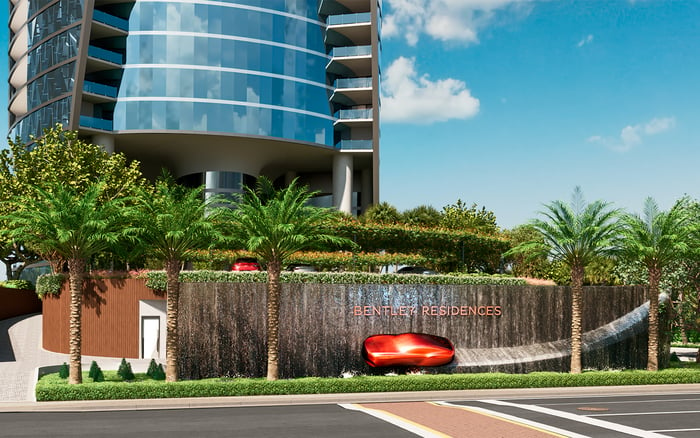
For luxury buyers in Sunny Isles, arrival is part of the residence. This editorial compares robotic parking systems and traditional valet through the lens of daily efficiency, privacy, staffing exposure, and the lived experience of coming home, with Bentley Residences Sunny Isles as the anchor.
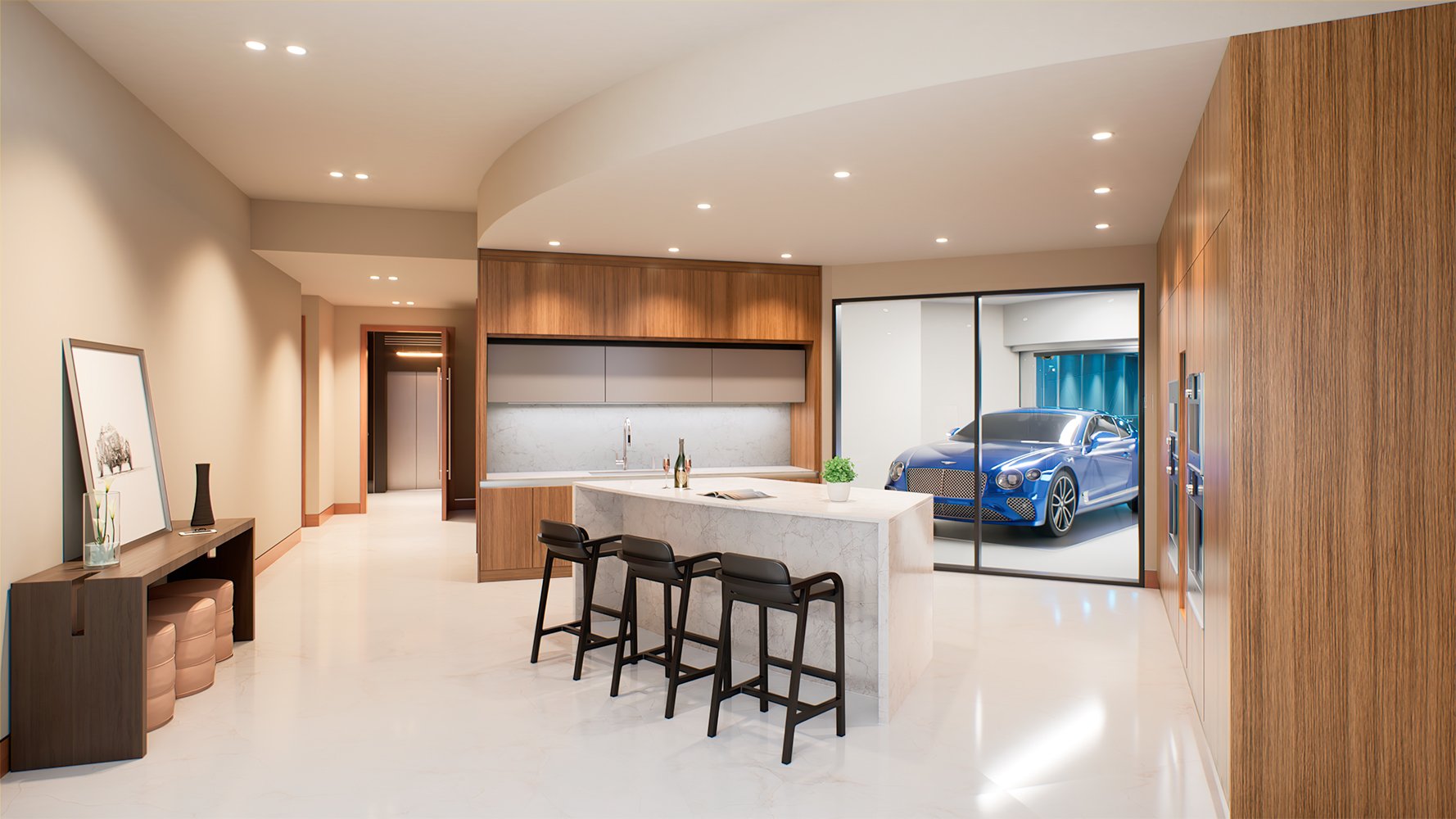
In a market where oceanfront glass, private elevators, and amenity decks are increasingly baseline expectations, a quieter battleground has emerged: the ground-level experience. In Sunny Isles-where many owners split time between cities and keep multiple vehicles-the real test of a building often comes down to two moments: how quickly you can leave, and how effortlessly you can return.
That’s why parking has shifted from a utilitarian afterthought to a design and operations decision that shapes the lived feel of a residence. At Bentley Residences Sunny Isles, the conversation frequently centers on whether a robotic parking system can outperform the traditional valet model that has defined South Florida high-rise living for decades.
Efficiency, in this context, is not just a stopwatch metric. It’s the consistency of the experience at peak times, the number of handoffs, the discretion of your routine, and the way the building absorbs traffic without telegraphing residents’ comings and goings.
A meaningful comparison requires the right scorecard. For most luxury owners, efficiency is a blend of five practical outcomes:
Predictability: Whether the system performs the same way on a quiet Tuesday and a busy holiday weekend.
Time-to-keys: Not just the time to park, but the full cycle from curb to elevator-and back again.
Privacy and discretion: How visible your arrival is and how many people interact with your vehicle.
Operational resilience: How the building performs when demand spikes, staff schedules shift, or weather disrupts routines.
Vehicle stewardship: The confidence that the process reduces unnecessary seat time, idling, and incidental wear.
With those criteria in place, robotic parking and valet aren’t simply competing service styles; they represent fundamentally different operational philosophies.
A robotic parking system is designed to make parking a repeatable process. The resident (or driver) typically positions the vehicle in a defined bay, exits, and the system handles storage. The core promise is consistency: automation can reduce the variability created by staffing levels, shift changes, and the friction of navigating tight ramps.
From an efficiency standpoint, robotic parking often excels in three ways:
Consistency at the margins.
Peak demand is where valet often feels slowest. Automation, when properly engineered and maintained, is built around known cycle times. Even if you occasionally wait, the waiting tends to feel more predictable-less dependent on who is on duty and less exposed to the chaos of a crowded porte-cochère.
Fewer handoffs.
Many buyers value the idea that fewer people are in the driver’s seat. That’s an efficiency measure in its own right: fewer steps and fewer interpersonal touchpoints, which can translate into a calmer, more controlled arrival.
Space efficiency.
Robotic systems can be deployed to maximize the usable volume of a garage. While owners experience this indirectly, it can matter-more efficient layouts can support better resident allocation, more guest capacity, or cleaner back-of-house circulation.
The trade-off is that robotics is typically less improvisational. It’s optimized for repeatability-which is a strength until an exception shows up.
Valet remains the classic South Florida luxury standard because it handles real life. It’s not merely parking; it’s service choreography. A strong valet team solves problems before they become friction: a guest arrives early, a trunk needs to be loaded, a driver is unfamiliar with the property, a resident wants a car staged at a specific time.
Valet efficiency comes from judgment and adaptability:
Edge cases and exceptions.
Oversized vehicles, unusual wheel-and-tire setups, delicate luggage, and quick turnarounds are typically handled more fluidly by an experienced team.
Guest management.
For residents who entertain frequently, valet can feel more seamless because the building can absorb guest arrivals without requiring everyone to learn a new workflow.
Concierge-style staging.
A well-run valet operation can coordinate vehicles with dinners, airport runs, and security preferences. The “efficiency” is that you don’t have to think about it.
But valet also introduces variability. Your experience can hinge on staffing levels, turnover, training discipline, and the unpredictability of peak demand. The human element is both the magic and the risk.
For an ultra-premium buyer considering Bentley Residences Sunny Isles, the right question isn’t “which is faster?” but “which is more reliable for my lifestyle?”
Robotic parking tends to appeal to owners who:
Prioritize privacy and minimal interaction.
Keep a predictable routine and value repeatable outcomes.
Treat the car as an asset they want handled with minimal seat time.
Traditional valet tends to appeal to owners who:
Host often and want guest flow managed.
Change plans frequently and want a team that can improvise.
Prefer a service-forward arrival, especially for multi-generational households.
In practice, the most satisfying luxury experience is rarely purely automated or purely human. The most livable buildings often blend a controlled, automated core with a polished front-of-house team that manages curbside flow, guest arrivals, and the soft details that make a tower feel effortless.
To evaluate efficiency the way an operator does, focus on the conditions that stress the system.
Peak stacking.
In Sunny Isles, peak moments tend to concentrate around weekend arrivals, holiday turnovers, and event nights. Under stacking pressure, robotic parking is typically judged on cycle time and queue management. Valet is judged on staffing depth and the quality of curbside choreography.
Weather friction.
Heavy rain and high winds aren’t theoretical. A system that reduces the need for drivers to navigate ramps or hunt for space can feel more “efficient” simply because it reduces exposure and confusion. Conversely, when weather disrupts routines, the presence of capable staff can be the difference between a calm experience and a bottleneck.
Staffing exposure and privacy.
Some buyers define efficiency as fewer people involved. If discretion is central to your routine, a process that limits keys, handoffs, and idle conversation can be a meaningful advantage.
Parking expectations vary by neighborhood and building profile. Buyers cross-shopping Sunny Isles with other waterfront submarkets often notice that arrival philosophy shifts with a property’s identity.
In Sunny Isles, towers such as St. Regis® Residences Sunny Isles often position arrival as a hospitality moment: curated, staffed, and designed to feel like a private hotel. In that environment, a traditional valet model can feel natural-even when it isn’t the fastest at peak.
On the other hand, buildings that emphasize contemporary engineering and a more controlled resident journey can make automation feel like part of the luxury narrative. Consider how a design-forward, ocean-facing residence such as Jade Signature Sunny Isles Beach frames privacy and clean circulation as part of the overall experience. Even when a building isn’t defined by robotic parking, the expectation for frictionless flow sets the bar.
Outside Sunny Isles, the same buyer may look to Brickell, where density and traffic patterns change the calculus. For example, 2200 Brickell sits in a context where arrival timing can be more variable due to street congestion, making predictability and curb management feel as important as garage mechanics.
The takeaway isn’t that one neighborhood “needs” robotics and another “needs” valet. It’s that the building’s operational model must match the lifestyle it is selling.
If you’re assessing robotic parking versus valet at a luxury tower, ask questions that reveal operational truth without getting lost in marketing.
1) What happens at the curb?
Even with robotic parking, the curb is where friction appears first. Look for a plan that prevents spillover into traffic and keeps arrivals discreet.
2) How is queueing handled?
Efficiency breaks down when a system can’t communicate. Whether it’s a valet podium or a digital interface, you want clarity: what’s the wait, and what’s the next step?
3) What is the backup plan?
Ask how exceptions are handled: guest vehicles, service providers, last-minute schedule changes, or a vehicle that can’t be processed normally.
4) How is the resident experience protected during maintenance?
All systems require upkeep. The question is whether the building can preserve a luxury-grade experience while doing it.
5) Which model aligns with resale expectations?
Because parking is tied to daily life, it can influence long-term satisfaction and, by extension, resale appeal. In the high-end segment, buyers don’t just tour a unit; they picture their routine.
Robotic parking systems tend to win on repeatability, discretion, and reduced human variability. Traditional valet tends to win on flexibility, hospitality, and the ability to solve unusual situations in real time.
For Bentley Residences Sunny Isles, the most compelling interpretation is that efficiency isn’t a single metric. It’s the feeling that your home responds to you. Whether that response is engineered through automation or delivered through a seasoned team, the standard in Sunny Isles remains the same: minimal friction, maximum discretion, and an arrival that feels inevitable.
Is robotic parking always faster than valet? Not always. It can be more predictable, but speed depends on demand, queueing, and operational tuning.
Does robotic parking improve privacy? Typically yes, because it can reduce the number of people who handle your vehicle and keys.
Can valet feel more “luxury” than automation? Yes. A refined valet program can deliver a hospitality-style arrival that some owners prefer.
What is the main drawback of robotic parking for daily use? It can be less flexible with exceptions, and wait times can occur during peak retrieval periods.
What is the main drawback of traditional valet? Service quality can vary with staffing, training, and peak-time pressure.
How should second-home owners think about the choice? If you prioritize consistency when you arrive after time away, automation can be appealing; if you host, valet can help.
Do guests typically find robotic parking confusing? It can be unfamiliar at first, which is why a strong front-of-house team matters either way.
Is “efficiency” only about time? No. It also includes predictability, discretion, security, and how calm the process feels.
Does a strong curbside design matter as much as the garage? Yes. Most friction is experienced at the porte-cochère before the vehicle is even parked.
What should I look for in a building tour related to parking? Watch peak flow, ask how exceptions are handled, and judge whether the process feels controlled.
If you'd like a private walkthrough and a curated shortlist, connect with MILLION Luxury.
If branded residences are on your mind — as a home or as an allocation — we would be glad to share what we are seeing, privately.
Begin a quiet conversation