A buyer-focused editorial on how Coconut Grove and Coral Gables approach entertaining, from chef-ready kitchens and service flow to private dining rooms and discreet hosting.
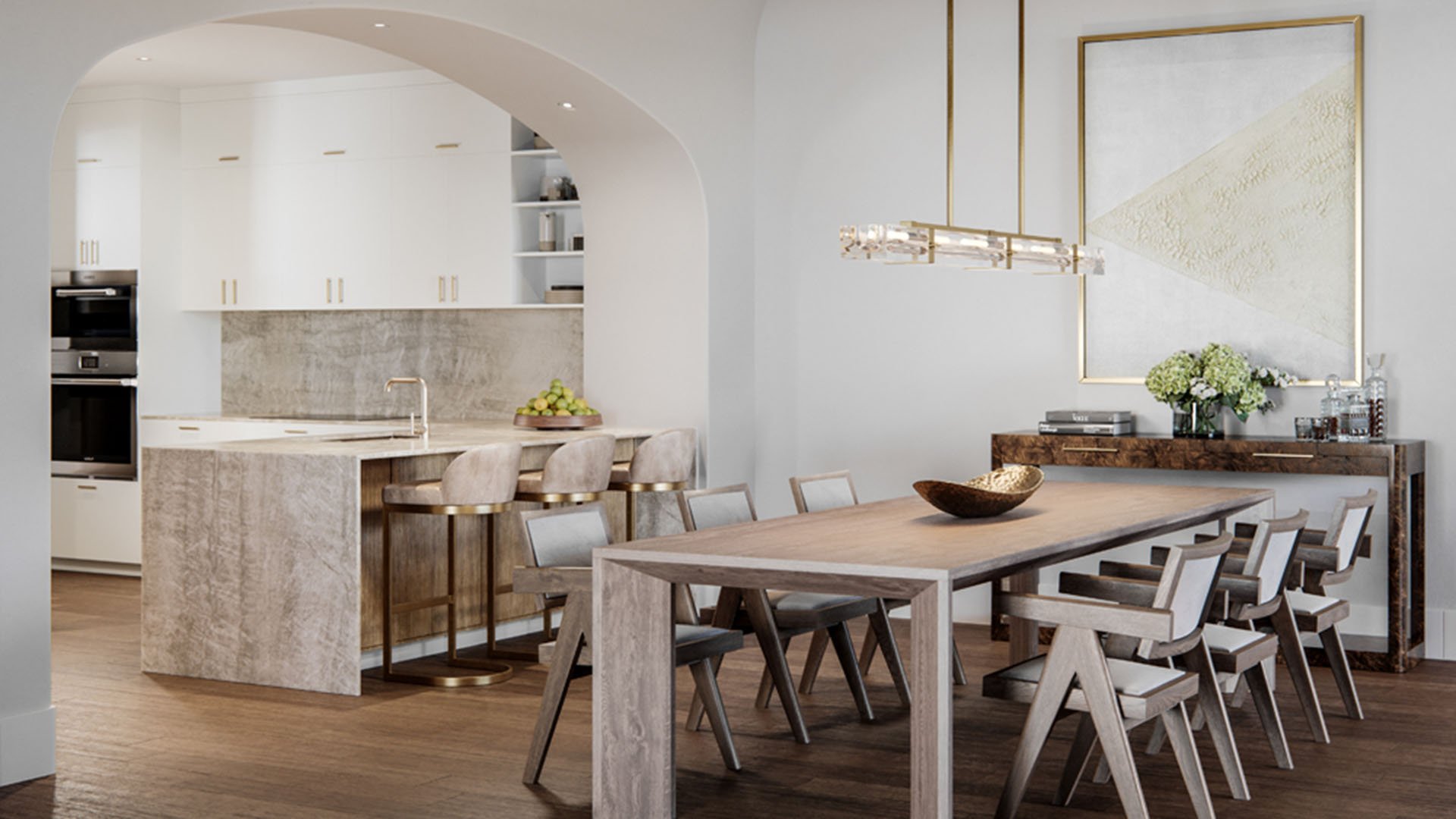
In Coconut Grove and Coral Gables, the most serious residential kitchens are no longer judged by finishes alone. Marble, millwork, professional appliances, and sculptural lighting still matter, but the higher test is choreography. Can a chef prep without overtaking the family room? Can staff arrive, stage, plate, and clear without crossing the host’s conversation? Can dinner for six feel intimate, while a catered evening for thirty remains composed?
That is where these two markets begin to separate. Coconut Grove often appeals to buyers who want the kitchen to breathe into terraces, gardens, and informal gathering spaces. Coral Gables often attracts buyers who value a more composed sequence: arrival, salon, dining room, kitchen, service zone, and retreat. Neither approach is inherently better. The right answer depends on how a household actually entertains.
For search shorthand, Coconut Grove and Coral Gables signal two distinct hosting temperaments. One is often softer, more tropical, and more fluid. The other is frequently more formal, architectural, and room-driven. The strongest acquisitions translate that temperament into a kitchen and dining plan that performs beautifully under pressure.
Coconut Grove is at its best when entertaining feels effortless rather than staged. Buyers considering residences such as Arbor Coconut Grove and Four Seasons Residences Coconut Grove should study more than the headline kitchen. The essential question is whether the plan allows daily living, family breakfast, cocktail service, and private chef work to coexist without visual clutter.
A chef-ready Grove residence should have a persuasive relationship between kitchen, dining, and outdoor space. The most useful layouts do not force every event into one grand room. Instead, they allow small zones to flex: a prep island that can become a breakfast counter, a dining area that can open toward greenery, a discreet service path that keeps the evening smooth, and storage that supports more than everyday groceries.
In this market, buyers should be especially sensitive to sightlines. An open kitchen may photograph beautifully, but if every prep surface is visible from the principal entertaining area, the host may lose privacy during a catered dinner. Conversely, a closed kitchen can feel too removed if it severs the social energy of the home. The ideal is not simply open or closed. It is layered.
Projects such as The Well Coconut Grove also remind buyers to consider how wellness-oriented living affects entertaining. A kitchen that supports fresh preparation, generous refrigeration, orderly storage, and calm circulation can feel as luxurious on a Monday morning as it does during a private dinner.
Coral Gables brings a different discipline to the conversation. Here, private dining often benefits from definition. A proper dining room can be more than a formal relic; it can be the room that gives a residence its sense of occasion. Buyers comparing Cora Merrick Park and The Village at Coral Gables should examine how dining, kitchen, and reception spaces operate as a sequence.
A strong Gables plan understands arrival. Guests should move naturally from entry to living space to dining without being redirected through the working kitchen. The dining room should have enough separation to hold conversation, yet enough adjacency for service to remain efficient. Doors, corridors, butler’s pantries, powder rooms, and elevator or garage access all become part of the experience.
For buyers who entertain with chefs, sommeliers, or event staff, Coral Gables can reward a more traditional hierarchy of rooms. That does not mean old-fashioned. It means legible. The best homes make it clear where guests belong, where service operates, and where the host can retreat for a private moment before returning to the table.
The phrase chef-ready is often used too casually. For a luxury buyer, it should mean the kitchen can support professional work without compromising the home. Start with landing space. A beautiful range or cooktop is less useful if there is nowhere to stage trays, plate courses, or separate hot and cold prep.
Next, study refrigeration and pantry logic. Entertaining households need zones: daily refrigeration, beverage storage, overflow capacity, dry goods, serviceware, and cleaning supplies. If those functions collapse into one visible wall of cabinetry, the room may feel underplanned. A secondary pantry, scullery, or concealed service area can be more valuable than a more dramatic island.
Ventilation and acoustics deserve equal attention. A kitchen that smells or sounds like a restaurant can disrupt the very dinner it is meant to support. Quiet equipment, thoughtful exhaust, resilient surfaces, and separation between prep and conversation are subtle indicators of quality.
Finally, test the room in motion. Imagine two cooks, one server, and a host moving at once. If everyone collides at the island, the kitchen is not chef-ready. It is merely expensive.
Catering flow is the invisible infrastructure of gracious hosting. It begins before the first guest arrives. Where does staff park or enter? Where do rentals, florals, wine, and prepared items land? Can service reach the kitchen without passing through the primary living room? Is there a place to hide transit cases, extra glassware, and breakdown materials?
For condominium buyers, the questions extend beyond the residence itself. Elevator access, delivery procedures, loading convenience, and privacy expectations all matter. For single-family buyers, the same logic applies through motor courts, side entries, garages, mudrooms, and secondary corridors.
In both Coconut Grove and Coral Gables, the most refined homes do not make the host explain the house to the staff. The plan communicates it. Service arrives, prepares, circulates, and disappears. That kind of quiet order is one of the clearest differences between a handsome home and an excellent entertaining residence.
A private dining room should not be evaluated only by how many seats it can hold. Scale is important, but intimacy is harder to achieve. A room that seats twelve but feels exposed to the foyer, kitchen, and living room may not deliver the discretion a buyer expects. Conversely, a smaller room with balanced proportions, controlled lighting, and acoustic comfort can feel exceptional.
Look at wall space for art, lighting control, wine service, and the relationship to a terrace or garden. Consider whether the table can expand without blocking circulation. Study where a server would stand, how plates would be cleared, and whether a guest leaving the table interrupts service.
The best private dining rooms in these two markets do not compete with restaurants. They offer something restaurants cannot: privacy, pacing, personal ritual, and the comfort of a room tailored to the owner’s way of living.
Choose Coconut Grove if your entertaining style is fluid, indoor-outdoor, and anchored by relaxed elegance. It suits buyers who want morning coffee, family meals, cocktails, and dinner to feel connected by atmosphere rather than strict formality.
Choose Coral Gables if you prefer procession, architecture, and defined rooms. It suits buyers who care about a composed dining experience, a clearer separation of guest and service zones, and the gravitas of a dedicated room.
The right purchase is the one where the plan supports your rituals without constant adaptation. A chef-ready kitchen should make professional service easy. Catering flow should protect the host from logistics. A private dining room should make guests feel expected, not accommodated.
Is a fully open kitchen best for entertaining? Not always. Open kitchens are social, but layered plans often perform better when private chefs or catering staff are involved.
What should I prioritize in a chef-ready kitchen? Prioritize prep space, storage, ventilation, refrigeration, durable surfaces, and circulation for more than one person working at a time.
Does a private dining room add value for luxury buyers? It can, especially when it offers privacy, strong proportions, acoustic comfort, and a logical connection to the kitchen or service area.
How does Coconut Grove differ for entertaining? Coconut Grove typically suits buyers who want a relaxed, indoor-outdoor rhythm with the kitchen connected to daily life and hosting.
How does Coral Gables differ for entertaining? Coral Gables often suits buyers who prefer defined rooms, formal dining, and a more composed arrival-to-table sequence.
What is catering flow in a residence? It is the path that staff, food, rentals, and service use before, during, and after an event without disrupting guests.
Should I look for a butler’s pantry? A butler’s pantry can be highly useful when it supports staging, beverage service, storage, and discreet cleanup.
Are condominium kitchens suitable for private chefs? Some are, but buyers should study elevator access, delivery rules, prep space, ventilation, and service circulation carefully.
Is a larger dining room always better? No. A well-proportioned room with privacy and strong lighting can feel more luxurious than a larger room with poor flow.
What should I test during a showing? Walk the route from entry to dining, kitchen to table, and service access to cleanup to see whether the home functions gracefully.
For a tailored shortlist and next-step guidance, connect with MILLION.
If branded residences are on your mind — as a home or as an allocation — we would be glad to share what we are seeing, privately.
Begin a quiet conversation