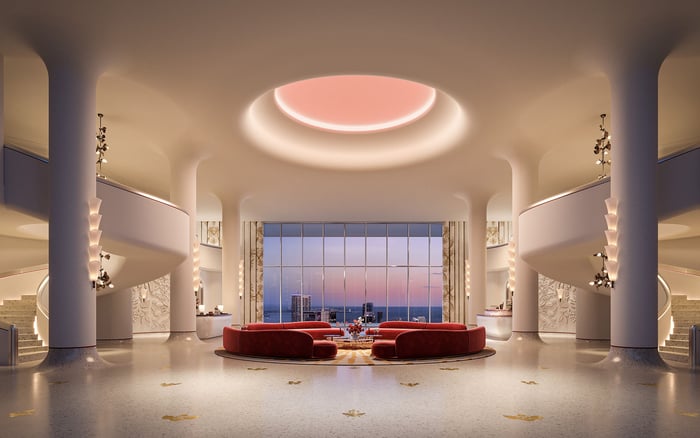
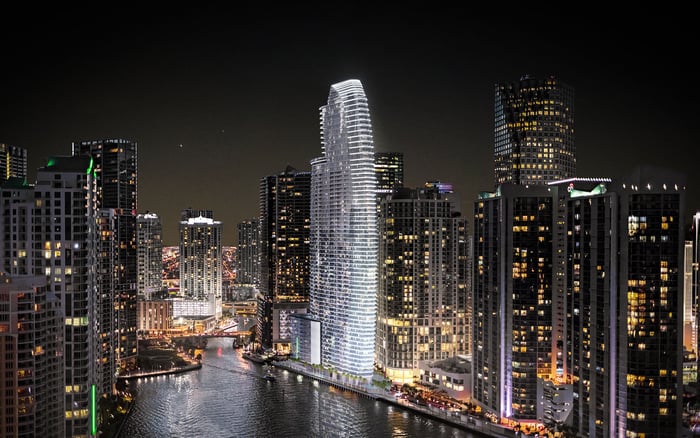
In Downtown Miami, the choice between club adjacency and true residential privacy is less about amenities and more about daily rhythm, guest flow, discretion, and how a home should perform when the city is at its most active.

In Downtown Miami, the defining luxury question is no longer whether a residence sits close to the action. It almost always does. The sharper question is whether a buyer wants that energy woven into the residential experience, or kept carefully at the edge.
Club adjacency has an immediate appeal. It places restaurants, lounges, cultural evenings, wellness programming, and social gravity within easy reach. It can make a pied-à-terre feel alive the moment an owner arrives. True residential privacy offers another form of luxury: protected thresholds, quieter routines, fewer casual encounters, and a clearer separation between the public city and the private home.
That distinction carries more weight in Downtown than it does in quieter coastal enclaves. Downtown is layered, vertical, and increasingly residential, with hospitality, offices, entertainment, dining, and waterfront life overlapping at close range. A buyer considering Aston Martin Residences Downtown Miami, Waldorf Astoria Residences Downtown Miami, or Casa Bella by B&B Italia Downtown Miami is not simply comparing buildings. They are choosing a degree of exposure to the city.
Club adjacency is often reduced to an amenity story. In practice, it is lifestyle architecture. It removes friction between residence and occasion. Dinner downstairs, a hosted drink nearby, a wellness appointment without a drive, a guest entertained without turning the private residence into the venue: these are meaningful conveniences for owners who use Downtown as a social base.
For a global buyer, that immediacy can be especially compelling. A home that feels connected on arrival makes short stays more efficient. The residence does not need weeks of planning to become useful. The neighborhood does much of the hosting.
The tradeoff is shared intensity. Even when residential areas are well separated, a building with a strong social component asks owners to accept more activity around arrival, lobby movement, elevators, valet rhythm, and guest presence. For some, that is precisely the appeal. For others, it is the first indication that the home may not be private enough.
This is why projects such as Faena Residences Miami Downtown Miami enter the conversation not only as addresses, but as signals of a buyer’s preferred relationship with culture, hospitality, and curated urban life. Club adjacency is not automatically less private. It is a different privacy model, one defined by separation, circulation, and governance.
True privacy begins before the front door. It is felt in the arrival sequence, the tone of the lobby, the discretion of staff interaction, the predictability of elevator access, and the way guests are managed. It is also felt in what does not happen: fewer non-resident encounters, less event spillover, and less ambiguity about who belongs where.
In Downtown, that protection can be more valuable precisely because the district is active. A private residence in a highly connected setting offers the best of both conditions only when the building is disciplined about transitions. The owner can step into the city quickly, then return to a setting that feels composed.
Buyers who prioritize privacy tend to ask different questions. Is there a clear residential entrance? Are amenity spaces primarily resident-focused? Is the building designed for quiet daily repetition, not just grand arrival? Can family, staff, and guests move through the property without unnecessary exposure? These details rarely appear in glossy descriptions, but they define ownership.
Privacy also has emotional value. It allows a residence to function as a refuge rather than a stage. For founders, public figures, family offices, and buyers who host selectively, that distinction can outweigh the appeal of a club-like setting.
Brickell sits close enough to Downtown that many buyers compare the two as part of the same urban decision. Yet Brickell often sharpens the question because its residential identity is tied to finance, dining, mobility, and daily convenience. The Brickell label may suggest immediacy, but the best residences still differ dramatically in how they manage public and private life.
A buyer looking at Baccarat Residences Brickell may be drawn to a refined hospitality sensibility, while another considering The Residences at 1428 Brickell may be focused on a more residential interpretation of vertical city living. The point is not that one approach is superior. It is that each answers a different version of the same question: should the building extend the owner’s social life, or protect the owner from it?
For end users, the distinction becomes clearer over time. A lively building can feel glamorous during the first season and intrusive by the fifth year if it does not match the owner’s daily rhythm. Conversely, a highly private building can feel too quiet for someone who bought Downtown to feel connected.
The most practical way to decide is to map a normal week, not an ideal weekend. Where do you take morning meetings? How often do you host? Do guests come for dinner, for a week, or only for events? Do you want to know your neighbors, or simply trust the building around you? Do you arrive alone, with family, with staff, or with security needs?
Club adjacency rewards owners who value spontaneity. It is ideal when the residence functions as a launch point, a social hub, or a hospitality extension. True privacy rewards owners who value control. It is ideal when the residence is the quietest part of a very full life.
The Downtown buyer should also consider resale psychology. Future buyers will not only evaluate finishes and views. They will interpret the building’s atmosphere. A property with a distinct club identity may appeal deeply to one segment and less to another. A property with strong residential privacy may attract buyers seeking permanence, family usability, and discretion.
Neither path is inherently safer. The safer choice is the one aligned with the most durable use case. If the home will be occupied often, privacy and routine may matter more. If the home will be used episodically, adjacency and service may carry more weight.
Downtown luxury is evolving from a checklist of amenities into a study of thresholds. The best buyers are not asking how much a building offers. They are asking what the building allows into their lives, and what it keeps out.
That is the essential shift. Club adjacency is a privilege when chosen deliberately. True residential privacy is a privilege when protected intelligently. In Downtown, where the city is never far away, the most valuable residence is the one that understands how close the owner wants to be.
Is club adjacency the same as living in a hotel-style building? Not necessarily. It usually means the residence is closely connected to social, dining, wellness, or hospitality-style spaces, but the degree of residential separation can vary.
Who is the best fit for club adjacency in Downtown Miami? It suits owners who want convenience, social access, and a residence that feels activated when they arrive.
Who should prioritize true residential privacy? Buyers who value discretion, quiet arrival, controlled guest flow, and a calm daily routine should place privacy first.
Does Downtown make privacy harder to achieve? Downtown is naturally active, so privacy depends more on building design, access control, and circulation than on location alone.
Can a residence offer both club energy and privacy? Yes, but only when public, amenity, guest, and resident pathways are carefully separated.
Is Brickell part of the same decision set? Often, yes. Brickell buyers frequently weigh the same questions of access, service, social energy, and residential calm.
Should investors prefer club adjacency? Not automatically. The stronger choice depends on the target buyer or tenant profile and how the building’s atmosphere will age.
What should families evaluate first? Families should study arrival, elevator use, guest policies, amenity tone, and whether daily routines feel protected.
Do branded residences always mean less privacy? No. Branding can support service and consistency, but privacy depends on operations and physical separation.
What is the simplest test before buying? Ask whether you want the building to expand your social life or make the city disappear when you come home.
For a confidential assessment and a building-by-building shortlist, connect with MILLION.
If branded residences are on your mind — as a home or as an allocation — we would be glad to share what we are seeing, privately.
Begin a quiet conversation