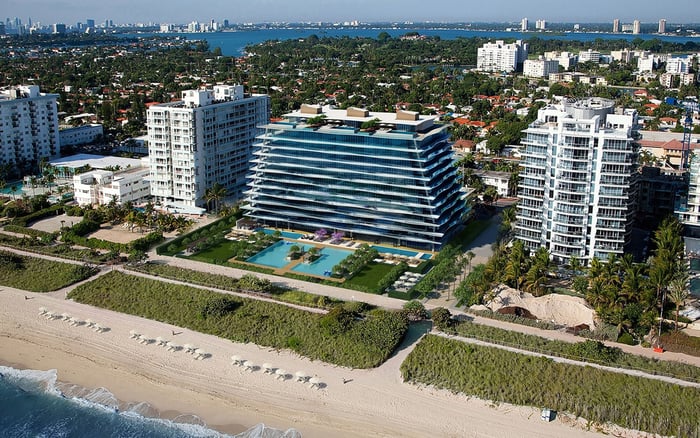
A discreet buyer’s guide to coordinating private school planning, domicile intent and residential selection when moving from Chicago to Surfside.

For a Chicago family considering Surfside, the residence is only one part of the decision. The more consequential work is alignment: where children will attend school, where daily life will be centered, and how the home supports a credible transition into South Florida.
Private-school planning and domicile planning often move on different clocks. Admissions teams may be focused on grade openings, interviews, transcripts and family fit. Legal and tax advisers may be focused on intent, documentation and behavioral consistency. The real estate search sits between the two, translating a family’s ambitions into a place that can function from the first Monday morning of the school year.
This is where Surfside becomes compelling for certain buyers. It offers a quieter coastal rhythm, proximity to neighboring luxury enclaves, and a residential scale that feels more intimate than the region’s larger urban centers. Yet that intimacy also demands precision. A beautiful home that creates a difficult school commute, or a glamorous second-home pattern that does not match domicile goals, can create friction later.
Private-school placement should be addressed before a family becomes emotionally attached to a residence. In practice, that means building the home search around school calendars, application expectations, commute tolerance and after-school logistics. The most elegant purchase is the one that makes daily life easier, not merely the one with the strongest view.
A Chicago buyer should begin by defining the school universe. That includes the child’s grade level, academic profile, extracurricular priorities, sibling considerations and the family’s preferred educational culture. Once that framework is clear, the real estate search can be mapped around practical drive times, morning traffic patterns, parking realities and the parent schedule.
This is especially important for families comparing Surfside with Bal Harbour, Bay Harbor Islands, Miami Beach and other nearby pockets. A residence such as The Delmore Surfside may appeal to a buyer seeking a refined Surfside address, while the school decision may pull the family’s daily orbit north, south or inland. The best outcome is not a compromise. It is a plan in which the home, school and family rhythm reinforce one another.
Domicile should be treated as a serious planning matter. It is not simply a preferred mailing address or a seasonal intention. Families should coordinate with their own legal and tax advisers before making decisions, especially when the move involves substantial assets, operating businesses, trusts, club memberships, philanthropic commitments or continued ties to Chicago.
The central question is whether the family’s life genuinely shifts. Advisers may consider documentation, personal records, voting habits, driver licensing, where valuables are kept, where children attend school, where physicians are used, where pets are registered and where day-to-day family decisions occur. No single element tells the full story. The pattern matters.
Private-school enrollment can be one meaningful piece of that broader pattern, particularly when children are physically attending school in South Florida and the household is organized around that schedule. But school alone is not a domicile plan. The residence, calendar, family routines and documentary record should all be coherent.
For buyers considering an oceanfront home at Ocean House Surfside, the question is not only whether the property is serene and well located. It is whether the home can become the family’s operational center, with routines and records to match.
Luxury buyers often focus on architecture, privacy, service, beach access and entertaining space. Relocating families should add another layer: administrative durability. The home should support the practical evidence of life in South Florida, from school correspondence and medical appointments to household staffing, deliveries, family vehicles and local professional relationships.
A polished residence used lightly may serve a second-home purpose beautifully. A domicile-minded residence needs to do more. It should function as the place where the family wakes up on school mornings, receives important mail, hosts tutors or coaches, stores seasonal wardrobes, keeps children’s materials and anchors ordinary life. The ordinary details are often the most persuasive.
Surfside buyers frequently appreciate discretion, and buildings such as Arte Surfside speak to that taste for privacy and design restraint. Still, the family should evaluate the property through weekday eyes. Is there enough storage for real family life? Does the elevator experience work during school rush? Is the staff model compatible with children’s routines? Can visiting grandparents, drivers, nannies or tutors be accommodated without turning every morning into choreography?
A move from Chicago to Surfside may involve more than a school transfer and a purchase contract. Families often need to consider the sequence of selling, retaining or reclassifying a prior residence; managing existing professional relationships; changing household staffing; and deciding how much of the old life remains active.
The cleanest transitions are usually choreographed before the closing. Families should decide who will manage school applications, who will coordinate documents, who will speak with advisers and how children will be introduced to the move. For students, continuity matters. For parents, consistency matters. For advisers, documentation matters.
It is also wise to avoid making the residence search too narrow too early. Surfside may be the preferred destination, yet nearby communities can offer alternatives depending on school fit and commute needs. A family drawn to the legacy atmosphere of The Surf Club Four Seasons Surfside may still compare options through the lens of morning drive time and extracurricular geography. The address should elevate the lifestyle, but it should also support the plan.
Private-school decisions can reveal how a family actually wants to live. Some buyers want a highly structured academic environment. Others prioritize arts, athletics, faith tradition, language, social continuity or proximity. The right school can shape friendships, weekend geography and parental networks as much as the right residence.
This is why private-school alignment should be discussed at the same table as domicile. If one parent expects a South Florida life while another continues to spend substantial time elsewhere, the school calendar will quickly expose the disconnect. If children remain emotionally and socially anchored in Chicago, the transition may require more time and support. If the household staff and family office continue to operate as though Chicago is the center, advisers may need to revisit the plan.
None of this diminishes the romance of the move. It makes the move stronger. A successful Surfside purchase should feel graceful because the invisible architecture has been resolved: school timing, documentation, family rhythm and the legal posture all point in the same direction.
The most sophisticated buyers do not ask only, “Which residence is best?” They ask, “Which residence makes our intended life credible?” For a family relocating from Chicago to Surfside, that question is both practical and strategic.
Start with the children’s school needs. Then build a domicile plan with qualified advisers. Then evaluate residences not only for beauty, privacy and prestige, but for how well they support ordinary daily life. Surfside can be an exceptional answer for families seeking oceanfront calm with access to the broader Miami ecosystem. It is most powerful when the purchase is part of a disciplined transition, not a decorative gesture.
Should school planning come before choosing a Surfside residence? Yes. School calendars, admissions timing and commute patterns should shape the search before a buyer commits to a specific home.
Can private-school enrollment help support domicile planning? It can be one element of a broader pattern, but it should not be treated as a standalone domicile strategy.
Do buyers need legal and tax advisers before relocating? Yes. Families with meaningful assets, business interests or continuing Chicago ties should coordinate qualified advice early.
Is Surfside better for full-time living or second-home use? It can serve either purpose, but domicile-minded buyers should select a home that genuinely supports daily family life.
What should families evaluate beyond the residence itself? Morning routines, school access, household staffing, medical relationships, records, storage and transportation all matter.
Should buyers compare Surfside with nearby enclaves? Yes. Bal Harbour, Bay Harbor Islands and Miami Beach considerations may enter the discussion depending on school and commute needs.
How early should a Chicago family begin the process? Early enough to coordinate admissions, advisory work, household logistics and a real estate search without rushing decisions.
Does keeping a Chicago home create complications? It may require careful planning. The key issue is whether the family’s actual life and records support the intended position.
What makes a residence domicile-friendly? It should function as the operational center of the household, not merely as an occasional retreat.
What is the best first step for a relocating family? Define the school strategy, then align advisers and residences around the life the family intends to live.
When you're ready to tour or underwrite the options, connect with MILLION.
If branded residences are on your mind — as a home or as an allocation — we would be glad to share what we are seeing, privately.
Begin a quiet conversation